Strategic Human Resource Management for Hospitality Teams
Published on
By Tony Newcome — Founder of AnchOps · Owner, Pizza Harbour
This article was drafted with AI assistance and reviewed by Tony Newcome, a working restaurant operator.
It's 6:40 on a Friday and the board already looks wrong. Two cooks called off, a server quit after lunch, and labor is running ahead of sales before the first dinner ticket prints. You can post a help-wanted ad tonight and still be short a grill cook at 7 pm. Counting heads won't fix a missing skill, a rota nobody trusts, or a timecard nobody can defend.
Strategic human resource management is the practice of tying those people decisions to coverage, cost, and fair treatment. The schedule, the attendance record, the labor target, and the payroll file are one operating system. Move one and the others should move with it.
Table of Contents
- What Strategic HRM Covers in Hospitality Operations
- Run one linkage test this week
- Plan Workforce Capabilities, Not Just Headcount
- Close the gap in five steps
- Keep Frontline Staff With Stable Schedules and Fair Treatment
- How poor job quality shows up on the floor
- Score Reliability Fairly Without Turning Data Into Judgment
- Separate description from prediction
- Safeguards before any assignment change
- Keep Timekeeping and Payroll Records Audit-Ready
- What the payroll administrator does each week
- Control Labor Cost Without Understaffing Service
- The in-shift loop
- Start Scheduling and Reliability This Quarter
- A four-week pilot with a date on the calendar
What Strategic HRM Covers in Hospitality Operations
A Friday dinner shift can have enough people on the rota and still lack the skills needed at the busiest stations. Strategic human resource management connects workforce planning, retention, reliability, scheduling, labor cost, and payroll so managers can see how decisions in one area affect the others.
| HR area | Business question | Metric to track | Usual owner |
|---|---|---|---|
| Workforce planning | Which skills must be on shift at peak times? | Verified skill coverage by daypart | General manager |
| Retention | Why do capable people leave within the first year? | Turnover by role and tenure | HR lead or general manager |
| Performance and reliability | Who can be counted on for each shift, and why? | On-time rate, late arrivals, no-shows, covers | Shift supervisor |
| Scheduling | Does the published rota match expected demand? | Projected vs actual labor hours | Scheduler or manager |
| Labor cost | Is labor drifting above target this week? | Labor cost percentage and overtime hours | Owner or finance lead |
| Timekeeping and payroll | Are recorded hours accurate and approved before pay runs? | Edits with reason and approver, approval lag | Payroll administrator |
These areas work as a connected operating system. A schedule change can affect coverage, labor spend, attendance, and payroll records. Treat each metric as a prompt for action, not a score in isolation: a lower labor percentage is not a win if it leaves a key station uncovered or makes schedules less fair.
A 1995 study by Mark Huselid, published in the Academy of Management Journal, found relationships between systems of high-performance work practices and employee turnover, productivity, and corporate financial performance, as reported in the Academy of Management Journal. The practical lesson is to coordinate people practices rather than optimize each one separately.
Strategic human resource management means aligning people decisions with dependable coverage, controlled labor spend, and fair treatment. A hiring push that ignores which stations need coverage, or a labor cut that creates an unreliable rota, works against those goals. The Turn On Work HR planning guide can help managers put those priorities into a written plan.
Run one linkage test this week
Choose one row and record its metric. Then check whether a change in another area affects it. For example, if on-time arrivals fall after the rota is posted, review scheduling and reliability together. Keep the metric only if it helps someone decide what to change.
Practical rule: Assign one owner to each metric and review weekly whether changes in another area affected it.
Plan Workforce Capabilities, Not Just Headcount
Most planning starts with "how many do we hire?" Service fails on a different question: which skills are missing at 7 pm. A Friday dinner may need three certified line cooks, one trained expediter, and two experienced servers. Twelve people on the clock can still leave the pass uncovered if none of them can expo.
Only 11% of organizations take a long-term workforce-planning perspective, and 23% of employees lack at least some skills their current role requires, according to the McKinsey HR Monitor. Headcount hides both facts. A fuller set of modern workforce planning strategies helps when you connect skill inventories to daily deployment, not just annual hiring targets. Pair that thinking with a practical labor planning routine so the gap shows up on the rota, not in a quarterly deck.

Close the gap in five steps
- List demand by daypart and station. Write Friday dinner as stations and hours, not as a single headcount. Lunch and late night get their own lines because the skill mix isn't the same.
- Map the skill each station needs. Grill, sauté, expo, and bar each get a short list a supervisor can observe. "Experienced" isn't a skill until you name the task.
- Verify with a sign-off, not a self-report. A trainer or lead watches the task and initials it. Someone who says they can work the pass hasn't proved it until a ticket run goes clean.
- Subtract verified skills from required skills. The remainder is the gap for that daypart. A zero on expo at 7 pm is a coverage problem even when total hours look fine.
- Close each gap on purpose. Cross-train, hire, or change the menu and the rota. Don't leave the hole and hope a call-off doesn't land there.
Cutting hours isn't automatically strategic. Under-capacity hurts reliability, the guest experience, retention, and revenue. I'd rather run one extra trained closer than save a shift and lose the second turn.
Build a one-page gap sheet this week. Columns: daypart, station, skill required, people signed off, gap, and the close (train, hire, or change the offer). Update it when someone is signed off or leaves. That's the workforce plan the Friday board can use.
Keep Frontline Staff With Stable Schedules and Fair Treatment
Pay matters, and it isn't the whole retention problem. In January 2024, the median tenure of U.S. wage and salary workers was 3.9 years, while workers in food preparation and serving-related occupations had a median tenure of just 2.0 years, the lowest among major groups in the Bureau of Labor Statistics tenure release. You feel that churn every time the schedule has to be rebuilt from scratch.
Research summarized in Cornell Hospitality Quarterly reports that multiple noneconomic dimensions of job quality are significantly associated with hospitality workers' job satisfaction, turnover intentions, or both. Schedule instability, voice, job security, and discretion sit in that set. Those aren't soft topics. They're operating conditions a manager sets.
How poor job quality shows up on the floor
A rota posted two days ahead means people can't plan a second job or childcare. A time-off request that disappears tells them the process is optional for the supervisor and mandatory for them. A swap that needs three approvals trains people to call off instead. Write the rules once, in your employee policies, and use the same path every week.
Publish with a notice period you can keep. Run one availability and time-off process, and log every denial. Allow peer-approved shift swaps so managers aren't the bottleneck on a fair trade. Give people a clear route to correct an attendance or payroll record. Open shifts go first to the most reliable employees, which rewards the people who already show up without turning the score into a secret list.
| Leading indicator | What it reveals | Response |
|---|---|---|
| Last-minute schedule changes | Unstable planning or late demand forecasts | Publish earlier and set a minimum notice period |
| Denied availability or time-off requests | Poor fit between staff preferences and the rota | Review availability weekly and log reasons for each denial |
| Peer swap activity | Staff managing their own time within agreed rules | Approve valid swaps quickly and track repeat requests |
| Repeated open-shift outreach for one role | A coverage gap in a specific role | Cross-train or recruit for that role |
| Staff who report not seeing their shifts | Communication failure | Post shifts in one shared place and confirm each employee has seen them |
Compare these signals with turnover and absence by role. A spike in last-minute changes points to unstable scheduling. Repeated outreach for one station points to a capability gap. People who never see their shifts point to communication, not headcount. Supervisors who deny time off without a logged reason are a management problem, and a wage increase won't cover it.
Stable hours and a visible correction path keep capable people longer than a hiring push that replaces them every two years.
Score Reliability Fairly Without Turning Data Into Judgment
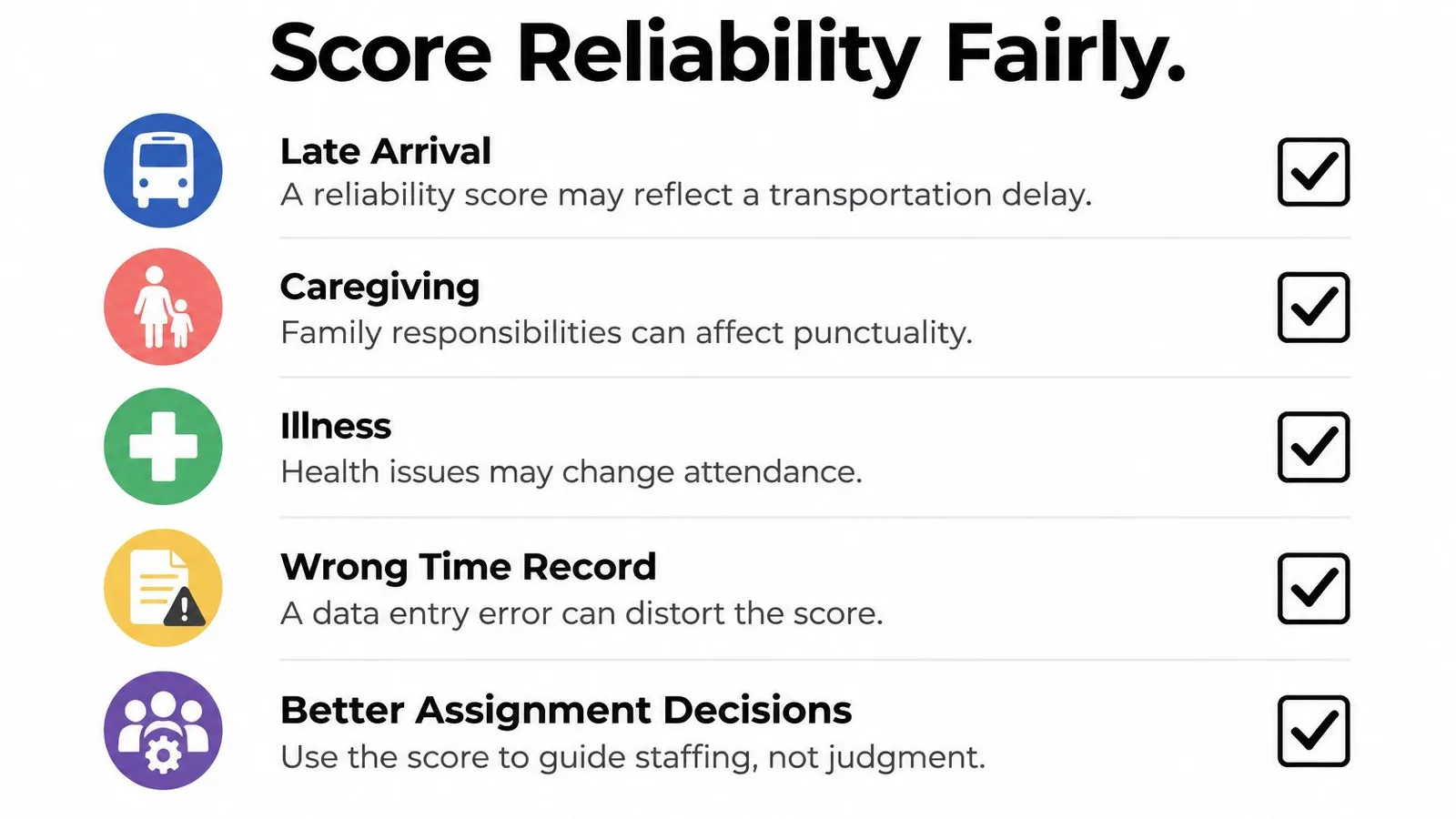
A reliability score can make the next assignment clearer. It can also punish someone for a bus that didn't come. A late arrival may be transport, caregiving, illness, or a wrong punch. If the number can't tell those apart, it isn't ready to decide who works Saturday.
Separate description from prediction
Descriptive measures state what happened: on-time rate, late arrivals, no-shows, and covers worked. Predictive scores claim to forecast who will fail next. Keep them in different columns. Use description to inform a review. Don't let a forecast become the review.
Recent scholarship on algorithmic HRM warns that software can improve consistency and still produce discriminatory outcomes or systematic disadvantages for marginalized groups, as discussed in Humanities and Social Sciences Communications. Employees are more willing to raise concerns when they see fairness and psychological safety. Transparency and an appeal path are operating practices, not a legal afterthought.
Use a rolling window, such as the last 90 days, so an old mistake fades and a recent improvement counts. New hires start with a neutral Show-Up Score, so nobody is marked unreliable before they've worked a shift. Top scorers earn Anchor status and first pick of open shifts. That's a reward for observed behavior, not a personality label.
Safeguards before any assignment change
- Explain the data. Tell people what is collected, who sees it, and what it does not include.
- Audit outcomes. Check whether late marks or lost shifts cluster by demographic group, and investigate the pattern before you defend the rule.
- Allow correction and appeal. A wrong time record gets fixed, with the reason stored.
- Name the human override. A supervisor can set aside the score when context warrants it, and must write why.
- Watch behavior, not just the average. If people stop reporting illness or transit problems because the score punishes honesty, the metric is doing harm.
A score informs the review. It doesn't replace one. Look at the shift history, the exception notes, and the person's account before you change who gets the close or the open shift. I'd rather miss one "efficient" assignment than teach the team that context doesn't count.
Keep Timekeeping and Payroll Records Audit-Ready
A timekeeping system should record the hours people worked, not reprint the plan. The U.S. Department of Labor requires employers to keep complete and accurate records of hours worked and wages paid for nonexempt employees, wherever the work is performed. Any method is acceptable, including a time clock or records the employee enters, as long as you record deviations when someone works longer or shorter than scheduled.
Retention is part of the same duty. Payroll records generally must be kept at least three years. Wage-calculation records, including time cards, wage-rate tables, schedules, and deduction records, generally must be kept at least two years.
What the payroll administrator does each week
- Require a clock-in and a clock-out. A scheduled shift isn't a timecard.
- Document every edit with the reason and the approver. Silent changes are how disputes start.
- Reconcile POS or clock data before export. For restaurants on Toast, timecard hours sync into one weekly grid where they can be batch-approved and exported to payroll. A person still confirms them.
- Keep an audit trail for every correction, including who changed what and when.
- Review exceptions: missed punches, early starts, late finishes, breaks, and overtime. Weekly batch approval saves time. It doesn't replace that review. Flag overtime in the same pass, and keep the overtime tracking rules next to the grid so a long close doesn't become a surprise on payday.
Synced hours still need a person before pay is released. If the clock and the floor disagree, the floor wins, and the edit gets a name on it.
Control Labor Cost Without Understaffing Service
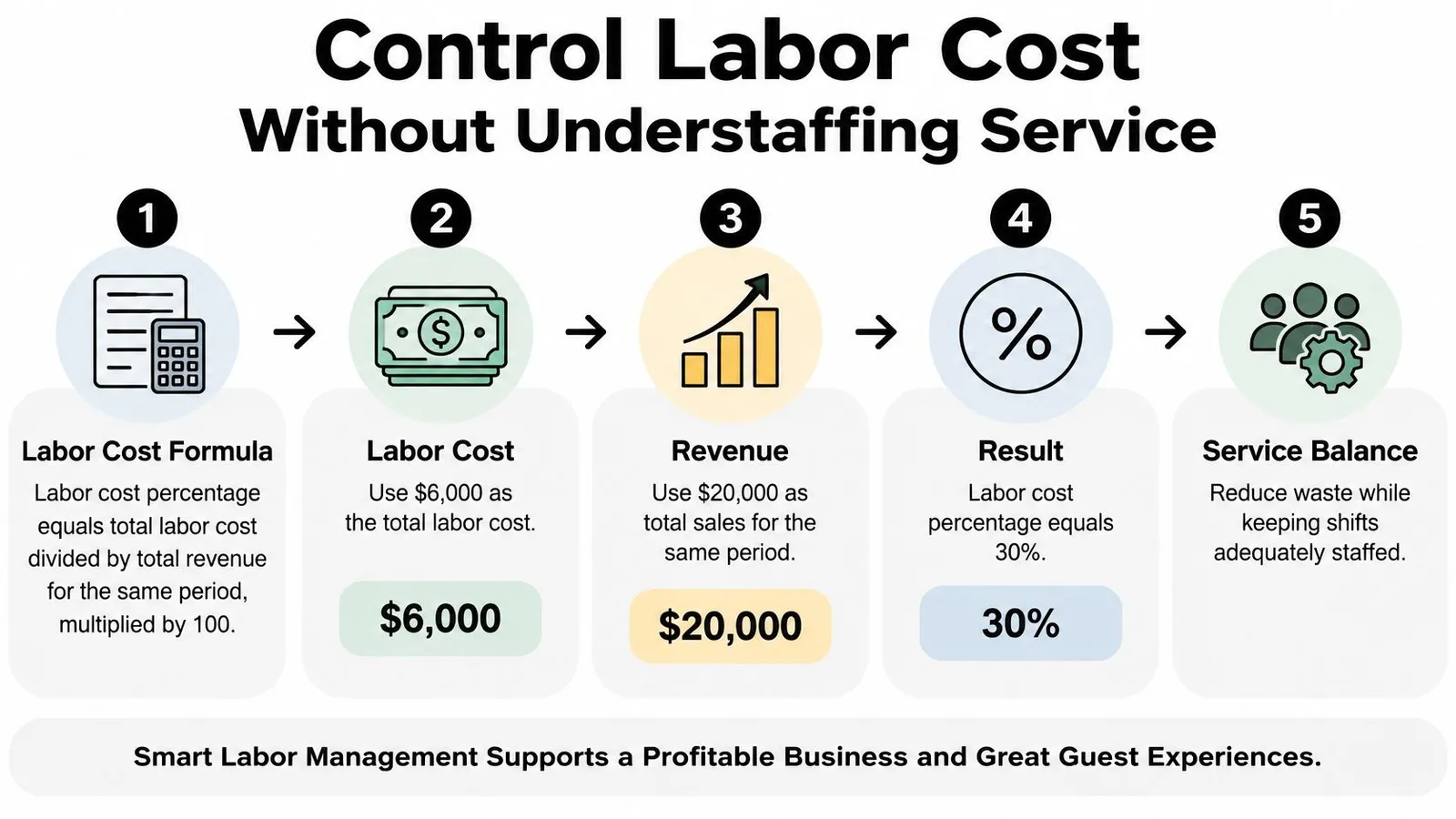
Labor cost percentage equals total labor cost divided by total revenue for the same period, multiplied by 100. Say a week runs $6,000 of labor against $20,000 of sales. That's 30%. The arithmetic is the easy part. A monthly close tells you the damage after the guests have gone.
Check it during the shift, not after the month. Bureau of Labor Statistics Job Openings and Labor Turnover data for December 2024 recorded 994,000 hires in accommodation and food services, 815,000 separations, and a 6.7% separation rate, in the JOLTS news release. A published schedule won't stay fully staffed, and labor won't stay on the original plan by itself.
The in-shift loop
- Set a labor target for each service period. Dinner has its own number. Don't hide a bad Friday inside a calm Monday.
- Compare projected hours and payroll with clocked hours while service is running. The gap you can still act on is the one you see at 7:30, not next Tuesday.
- Flag variance above a threshold you set in advance. Write it as a percent or a dollar amount, and use the same figure every week.
- Pick a corrective action that protects the guest. Move a qualified person to a busy station, pause extra call-ins, or approve overtime only when the tickets justify it.
- Document the threshold, and read wage-and-hour rules before you send anyone home or cut hours. Lawful release is not the same as a convenient one.
| Variance level | What it signals | Response |
|---|---|---|
| Within the manager-set threshold | Actual labor tracks the projection | Keep the schedule and log the period |
| Slightly over, for one service period | Early drift, often a busy spell | Pause extra call-ins and watch the next period |
| Over the threshold during the shift | Labor is running above target now | Move qualified staff to busy stations or release unneeded staff where lawful |
| Over the threshold for several weeks | A structural mismatch between schedule and demand | Rebuild the schedule template and recheck the forecast |
| Overtime without a documented need | Scheduling or approval gap | Require approval for each overtime shift |
Understaffing isn't a win just because the percentage dropped. If the pass is backing up and the closer is alone, you bought a cheaper hour and a worse service. I'd hold the extra trained person when the threshold is only slightly over and the dining room is still filling.
Start Scheduling and Reliability This Quarter
Start with the rota. A stable schedule and a fair reliability measure cut call-offs, support retention, and make the labor percentage easier to hold. Build each rota from forecast demand by daypart and station. Publish it ahead of a notice period you can meet. Offer open shifts first to the most reliable people, using the descriptive measures, not a hidden forecast of who might fail.
Before you publish, check projected labor hours against the labor target for that service. If the draft is already over, fix the template. Don't hope the mid-shift will save you.
A four-week pilot with a date on the calendar
- Record one baseline. Use projected versus actual labor hours, or the share of shifts filled on time. Write the number down before you change anything.
- Change one thing. Publish the rota earlier, or approve valid peer swaps the same day. Don't pile on a new score, a new notice rule, and a new overtime policy in the same month.
- Run it for four weeks with a named owner. That person logs the baseline metric and the leading retention signals, including last-minute changes and unanswered open shifts.
- Review against the variance levels. If labor stays inside the threshold and call-offs drop, keep the change. If people stop reporting problems or denied time-off requests pile up, the efficiency gain isn't worth the trust you spent.
Projected labor is shown before a schedule is published, and a mid-shift alert is sent when actual labor drifts over the target. On the Pro plan, a built-in time clock and payroll export sit next to that view, and every employee has a Show-Up Score built from every shift. Use those as the pilot's instruments, not as a substitute for the review.
Set the review date now, before the first week starts. Judge the result against that fixed plan. A feeling that "it seemed smoother" isn't a decision.
AnchOps helps shift-based teams draft schedules from availability and the labor budget, fill open shifts with the most reliable people first, and watch labor against target during the shift. If you want scheduling, coverage, and reliability in one place instead of a spreadsheet and a group text, visit AnchOps and see how a rota, a Show-Up Score, and payroll-ready hours fit the way your floor already runs.
Your back-of-house partner is ready
AnchOps handles scheduling, tip calculations, labor costs, and timecards — so you can focus on your restaurant, not your paperwork.