Employee Policies for Restaurants: 2026 Legal Guide
Published on
By Tony Newcome — Founder of AnchOps · Owner, Pizza Harbour
This article was drafted with AI assistance and reviewed by Tony Newcome, a working restaurant operator.
Restaurants need written employee policies in ten core areas — led by attendance and scheduling, tip pooling and payroll, and workplace safety and conduct — because clear rules stop small exceptions from becoming daily chaos. When policy lives in a binder instead of a manager's memory, breaks, swaps, overtime, and tips stop depending on whoever happens to be running the shift.
That doesn't feel like an HR problem. It feels like operations slipping.
That's why good employee policies for restaurants matter. Not because a binder looks professional, but because clear rules stop small exceptions from turning into expensive, daily chaos. In a restaurant, policy is what keeps scheduling, pay, safety, conduct, and accountability from depending on whoever happens to be managing that shift.
Table of Contents
- Why Your Restaurant Runs on Policies Not Just People
- Chaos usually starts with exceptions
- A good policy removes guesswork
- The 10 Essential Policies Your Restaurant Needs
- What belongs in every core handbook
- What strong policy language actually looks like
- Crafting Your Attendance and Scheduling Policies
- Write the rule for the moment managers actually face
- Scheduling policy should control cost, not just document it
- Nailing Your Tip Pooling and Payroll Policies
- Where pay disputes usually start
- Payroll policy is really a trust policy
- Building a Safe and Respectful Workplace Culture
- Vague health rules fail when you need them most
- Conduct policies need steps, not slogans
- Managing Legal Compliance Across Different Locations
- Build one handbook structure, not one universal rulebook
- Multi-state compliance fails at the manager level first
- How to Roll Out and Enforce Policies Effectively
- Rollout fails when managers are handed rules instead of being trained to use them
- Make the approved process faster than the workaround
Why Does Your Restaurant Run on Policies, Not Just People?
Restaurants love to say they're in the people business. That's true, but it's incomplete. A restaurant also runs on repeatable decisions. If those decisions live only in a manager's head, the business gets inconsistent fast.
You can see it in the usual friction points. One manager lets employees text shift swaps directly to each other. Another requires approval. One supervisor rounds time one way, someone else does it differently. A late arrival gets a warning on Monday and a shrug on Wednesday. Staff stop trusting the system because there is no system.
That's where written policy earns its keep. It doesn't replace judgment. It gives judgment boundaries.
Chaos usually starts with exceptions
The painful part is that most restaurant problems don't arrive as major incidents. They show up as exceptions that pile up. A missed break. An undocumented availability change. A payroll correction nobody wrote down. A “just this once” tip adjustment. By the time an owner sees the damage, the team has already learned that rules are negotiable.
Restaurants are especially vulnerable to this because turnover is so high. Industry reporting cited by Meez puts average restaurant turnover at roughly 75% to 80% annually, compared with about 47% across all U.S. industries, and notes that fast food and quick-service turnover can exceed 130% annually. The same reporting says 9 in 10 restaurants have fewer than 50 employees and 7 in 10 are single-unit operations. That's why written rules on scheduling, training, attendance, and performance aren't paperwork. They're the basic structure that keeps a small team operating consistently in a high-churn environment (restaurant turnover and small-business staffing reality).
Policies don't slow a restaurant down. Bad policies do. Clear policies let managers make fast decisions without making different decisions every shift.
A good policy removes guesswork
Strong employee policies for restaurants do three things well:
- Define the rule: Employees know what is expected before the problem happens.
- Define the process: Managers know what steps to follow when the rule is tested.
- Define the record: Someone documents what happened, who approved it, and what changed.
If a policy can't answer those three questions, it usually won't hold up during a rush, a resignation, or a payroll dispute.
The operators who run calmer restaurants usually aren't calmer by personality. They've stopped rebuilding the same answer every day.
Which 10 Policies Does Your Restaurant Need?
Most handbooks fail for one of two reasons. They're either too thin to guide real decisions, or they're so legalistic that nobody uses them on the floor. The middle ground is what works. Write policies managers can apply during service, during payroll review, and during conflict.
The easiest way to think about it is by coverage. If your handbook leaves a gap in pay, scheduling, conduct, or safety, managers will fill that gap informally. Informal systems are where inconsistency starts.
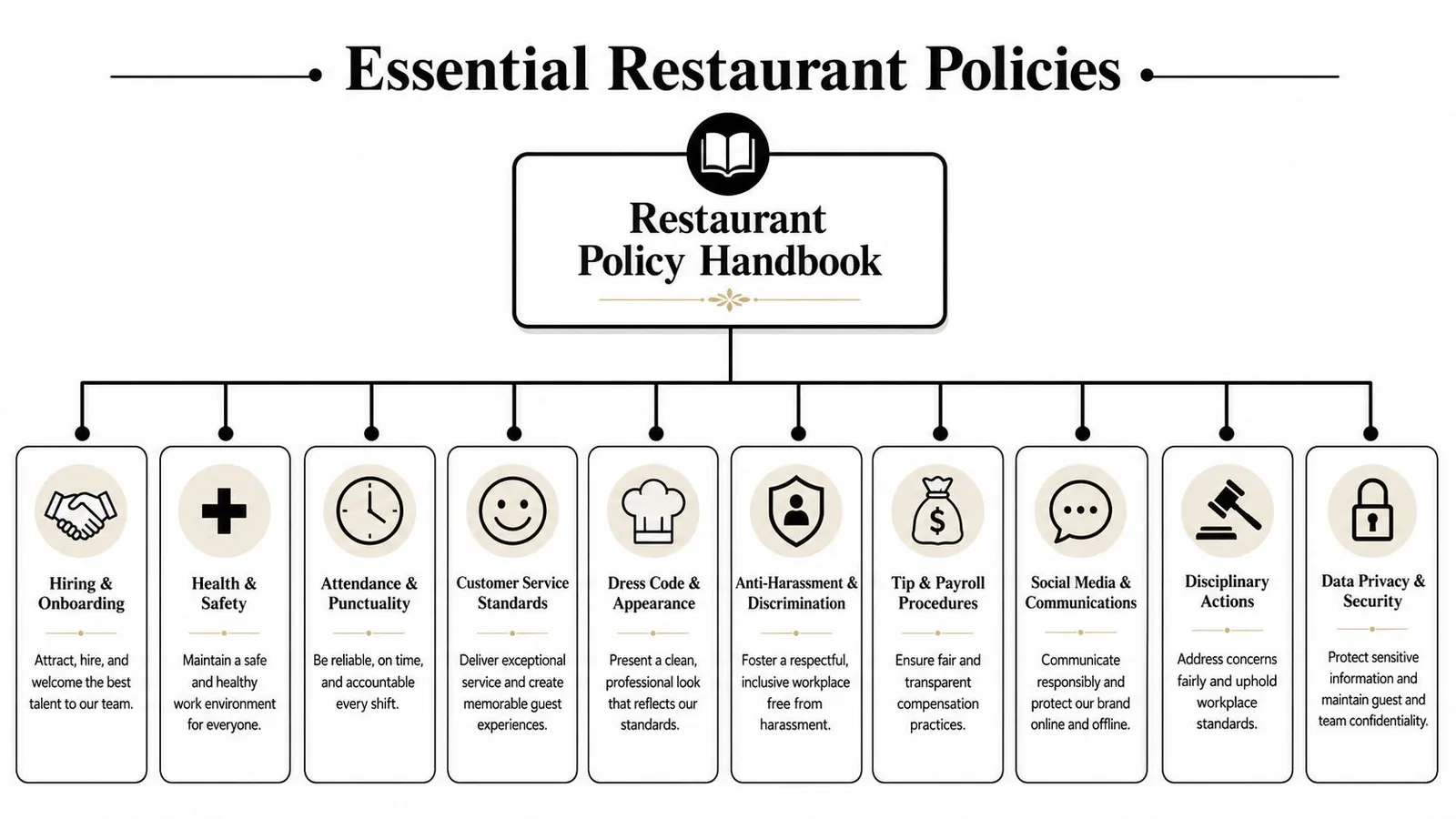
What belongs in every core handbook
These are the ten policy categories every restaurant should have in writing.
Hiring and onboarding
Spell out required documents, introductory training, acknowledgement forms, and when a new hire is cleared to work independently.Attendance and punctuality
Define tardiness, no-shows, call-out timing, who must be notified, and what happens when employees miss the process.Scheduling and availability
Clarify how availability is submitted, how far in advance schedules are posted, whether employees can cap hours, and how shift swaps are approved.Timekeeping and breaks
State where employees clock in and out, when meal or rest periods apply, how missed or interrupted breaks are handled, and who reviews edits.Compensation and payroll
Cover pay periods, overtime handling, tip procedures, paycheck corrections, deductions where lawful, and final-pay practices.Tip pooling and tip-outs
Identify eligible roles, the distribution method, timing, documentation expectations, and dispute resolution.Health and food safety
Include symptom reporting, exclusion rules, injury response, handwashing, contamination prevention, and return-to-work steps.Anti-harassment and discrimination
Explain prohibited conduct, reporting options, anti-retaliation language, investigation handling, and manager escalation duties.Code of conduct and guest service
Set rules for professionalism, substance use, phones, conflicts with guests or coworkers, and standards for representing the brand.Discipline and policy acknowledgement
Document how warnings work, when immediate action may apply, and how employees acknowledge receipt of policies.
What strong policy language actually looks like
The test is simple. If a manager asked, “What do I do right now?” could the policy answer clearly?
Weak language says, “Employees should be on time.”
Useful language says, “Employees who expect to be late must notify the manager on duty before the scheduled start time using the approved communication method.”
Weak language says, “Shift trades may be allowed.”
Useful language says, “Shift swaps require manager approval before the shift begins, and the originally scheduled employee remains responsible until approval is recorded.”
Practical rule: If your policy depends on common sense, two managers will interpret it two different ways.
A lot of operators build these documents from templates, which is fine if they edit aggressively. The problem isn't using a template. The problem is leaving in language that doesn't match how your restaurant operates. If you want a guide your team will actually use, start with plain language, operational steps, and examples your managers recognize from real shifts.
A handbook doesn't need to be elegant. It needs to survive Friday night.
Crafting Your Attendance and Scheduling Policies
Attendance and scheduling policies cause more day-to-day friction than almost anything else because they hit labor cost, guest service, and morale at the same time. When these rules are vague, managers spend half their shift negotiating exceptions.
That's why scheduling policy has to function like an operating control, not a courtesy memo. It should tell people when schedules go up, how availability changes are submitted, what counts as an approved swap, and what happens when someone tries to solve coverage through side texts instead of the official process.
Write the rule for the moment managers actually face
Most attendance policies fail because they stop at labels. They define “tardy” and “absence” but don't explain the workflow. Managers need specifics they can enforce in real time.
Your attendance policy should answer:
- How call-outs happen: Who gets notified, by what method, and by when.
- What doesn't count as notice: Posting in a group chat, telling a coworker, or leaving a message with the wrong person.
- How shift responsibility transfers: A swap is not approved just because another employee said yes.
- When documentation is required: For repeated absences, payroll corrections, or schedule disputes.
A solid scheduling rule also covers availability changes. Employees shouldn't be able to announce permanent availability changes after the schedule is built and expect immediate accommodation. That doesn't mean being rigid. It means having a submission deadline and review point so staffing plans remain workable.
Scheduling policy should control cost, not just document it
Legal risk and labor cost converge. Industry handbook guidance treats scheduling as an operational control because predictive-scheduling laws in some cities can trigger predictability pay or schedule premiums when posted shifts change without enough notice. That same guidance recommends posting schedules at least 14 days in advance where required by local law and documenting good-faith hour estimates at hire (restaurant scheduling and predictability pay guidance).
If your policy says managers can freely change posted shifts at the last minute, you may be building cost variance straight into the system.
A practical scheduling policy usually includes a table like this:
| Issue | Weak policy | Strong policy |
|---|---|---|
| Schedule posting | “Schedules will be posted weekly” | “Schedules are posted by a set deadline, and changes after posting require manager documentation” |
| Shift swaps | “Employees may trade shifts” | “Swaps require approval and recorded acceptance before the original shift starts” |
| Availability | “Tell your manager if availability changes” | “Submit availability changes by the stated deadline for future scheduling periods” |
| Call-outs | “Notify management” | “Contact the manager on duty through the approved channel before start time unless emergency conditions prevent it” |
One useful way to reduce the texting chaos is to move requests into a system that timestamps submissions and approvals. A scheduling workflow like building a staff schedule with clear approvals works better than relying on screenshots and memory. Tools like Homebase, 7shifts, and Deputy can help with communication and scheduling. AnchOps is another option for restaurants that want schedule publishing, availability checks, labor projections, and in-shift visibility tied more closely to daily labor control.
The labor budget rarely blows up because of one schedule. It blows up because no one controlled the exceptions after the schedule was posted.
If you want fewer arguments about fairness, stop leaving room for private side deals. Put the rules where everyone can see them, and enforce them the same way every time.
Nailing Your Tip Pooling and Payroll Policies
Friday night closes hard. Card tips are still settling, a server says their hours were cut short in payroll, and two cooks are asking why they are not part of the tip pool when the dining room just had its biggest sales night of the month. If your policy lives in a manager's head, that argument lands at the worst possible time.
Pay policy is an operating system. It keeps cash handling, payroll processing, and shift-level trust from turning into daily cleanup work for managers. People can work through a rough service. They stop trusting the place fast when pay feels inconsistent, delayed, or hard to explain.
Where pay disputes usually start
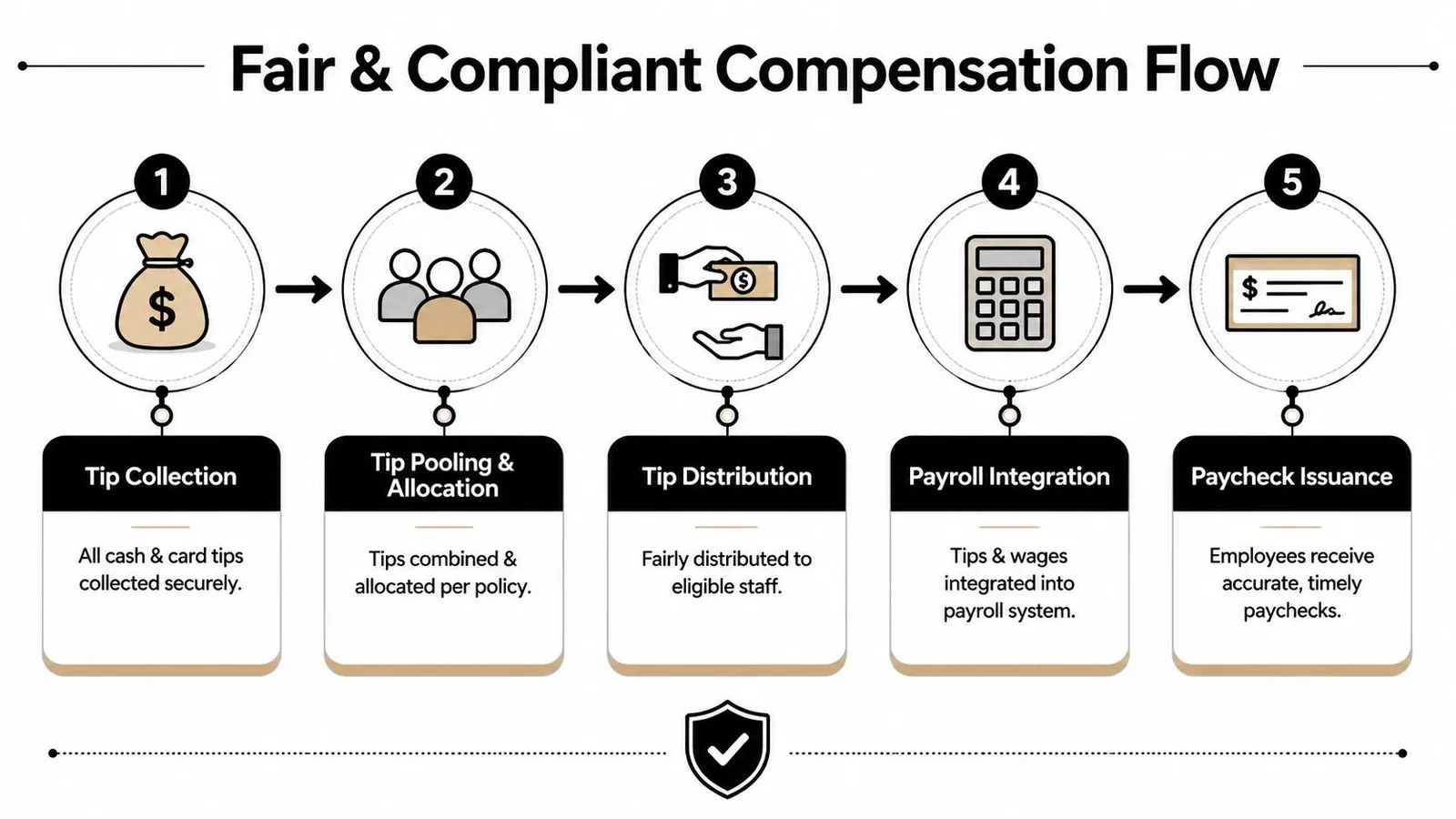
In my experience, the problem usually starts before payroll runs. It starts when nobody gave staff a clear explanation of how money moves from the guest check to the paycheck.
Your tip and payroll policy should spell out four things in plain language:
- Who is in the tip pool: List eligible roles by position title. Do not leave room for assumptions.
- How tips are handled: Explain cash tips, credit card tips, service charges, payout timing, and who records each step.
- When payroll is finalized: State the cutoff for punch reviews, declared tips, and approved corrections.
- How disputes are raised: Name the process, the deadline, and the person responsible for review.
Under the Fair Labor Standards Act, employers still have to follow federal rules on minimum wage, tip credits, and overtime, and the U.S. Department of Labor makes clear that tip arrangements have specific limits on who can share in pools and when managers and supervisors must be excluded from employee tips (U.S. Department of Labor guidance on tipped employees and tip pooling). The operational takeaway is simple. A tip pool that feels normal in one restaurant can be illegal in another setup, especially if you mix tipped and non-tipped roles or operate in states with stricter wage rules.
That is why copied policy language causes so many problems. Multi-unit operators run into this all the time. One handbook gets reused across locations, but the pay practice in the building does not match the words on the page.
A workable internal standard is even simpler than the legal language:
Every tip policy should answer four questions clearly: who is included, how the amount is calculated, when it is paid, and who reviews disputes.
If you need to document the mechanics before you finalize handbook wording, this guide on how to calculate tip pooling helps map the actual workflow.
Here's a short explainer worth sharing with managers who struggle to connect policy to payroll workflow:
Payroll policy is really a trust policy
A payroll policy works when it removes mystery. Staff should know what they are expected to check, what managers are allowed to edit, and how a mistake gets fixed without a hallway argument before lineup.
A strong payroll section usually includes:
Clock accuracy
Employees review punches and report missing or incorrect time through the approved process.Manager edits
Edits require a reason code or written note. Silent changes are one of the fastest ways to create suspicion.Error correction
The policy states who investigates pay issues, what documentation is needed, and when the correction will appear.Overtime handling
Overtime can require approval, but all hours worked still have to be recorded and paid.
There is a real trade-off here. Tight controls help prevent time theft and sloppy approvals, but too much friction slows down legitimate fixes and turns payroll day into detective work. The better approach is controlled transparency. Require documentation. Keep approvals centralized. Let employees see enough of the process that they do not have to guess whether someone changed their pay after the fact.
That is what keeps compensation policy from becoming another recurring manager problem. Clear rules reduce disputes, speed up payroll review, and protect margin at the same time.
Building a Safe and Respectful Workplace Culture
A lot of restaurant policies talk about culture in broad, polished language. That's usually where they stop being useful. Culture isn't protected by nice wording. It's protected by clear actions, fast reporting, documented follow-up, and managers who know what to do when a problem lands in front of them.
The most effective employee policies for restaurants turn safety and conduct into observable behavior. They don't rely on “use good judgment” or “report concerns if necessary.” They specify who reports what, to whom, how fast, and what happens next.
Vague health rules fail when you need them most
Health policy is the clearest example. Research cited in Food Control found that most restaurants had no employee health policy, and where a policy existed, the most common rule was telling workers to report illness symptoms. That's weaker than an exclusion-based policy that states when employees must stay home, who they notify, and when they can return (employee health policy research in restaurants).
That difference matters in real operations. “Tell us if you feel sick” leaves too much room for interpretation. “Do not report to work if you have listed symptoms. Notify the manager on duty immediately. Return only after the stated clearance condition is met” gives everyone a usable standard.
A workable health and safety policy should include:
- Illness exclusion rules: Symptoms or conditions that require staying home.
- Notification path: The exact person or role an employee must contact.
- Return-to-work criteria: The condition for returning, not just “when you feel better.”
- Incident reporting: Injuries, accidents, spills, and near-misses should be reported right away and documented.
Conduct policies need steps, not slogans
The same principle applies to anti-harassment, discrimination, and general conduct. “We don't tolerate harassment” is important, but it doesn't tell a supervisor how to respond when someone reports a problem at lineup five minutes before service.
A stronger conduct policy defines:
| Area | What to write |
|---|---|
| Reporting | More than one reporting path so employees aren't trapped reporting to the person causing the problem |
| Response | Immediate escalation expectations for managers |
| Documentation | What gets written down, where, and by whom |
| Anti-retaliation | Plain language that employees won't be punished for raising concerns in good faith |
| Training | A recurring schedule, not a one-time orientation mention |
Industry guidance tied to this area recommends quarterly food-safety refreshers and annual anti-harassment training, which is useful because it shifts policy from aspiration to auditable routine, as noted in the same research discussion above.
A respectful workplace isn't built by values on the wall. It's built when employees know the rules, trust the reporting path, and see managers apply it consistently.
The practical test is simple. If an employee gets sick, reports harassment, or witnesses unsafe behavior, can your managers act immediately without making up the procedure on the fly? If not, the policy still needs work.
Managing Legal Compliance Across Different Locations
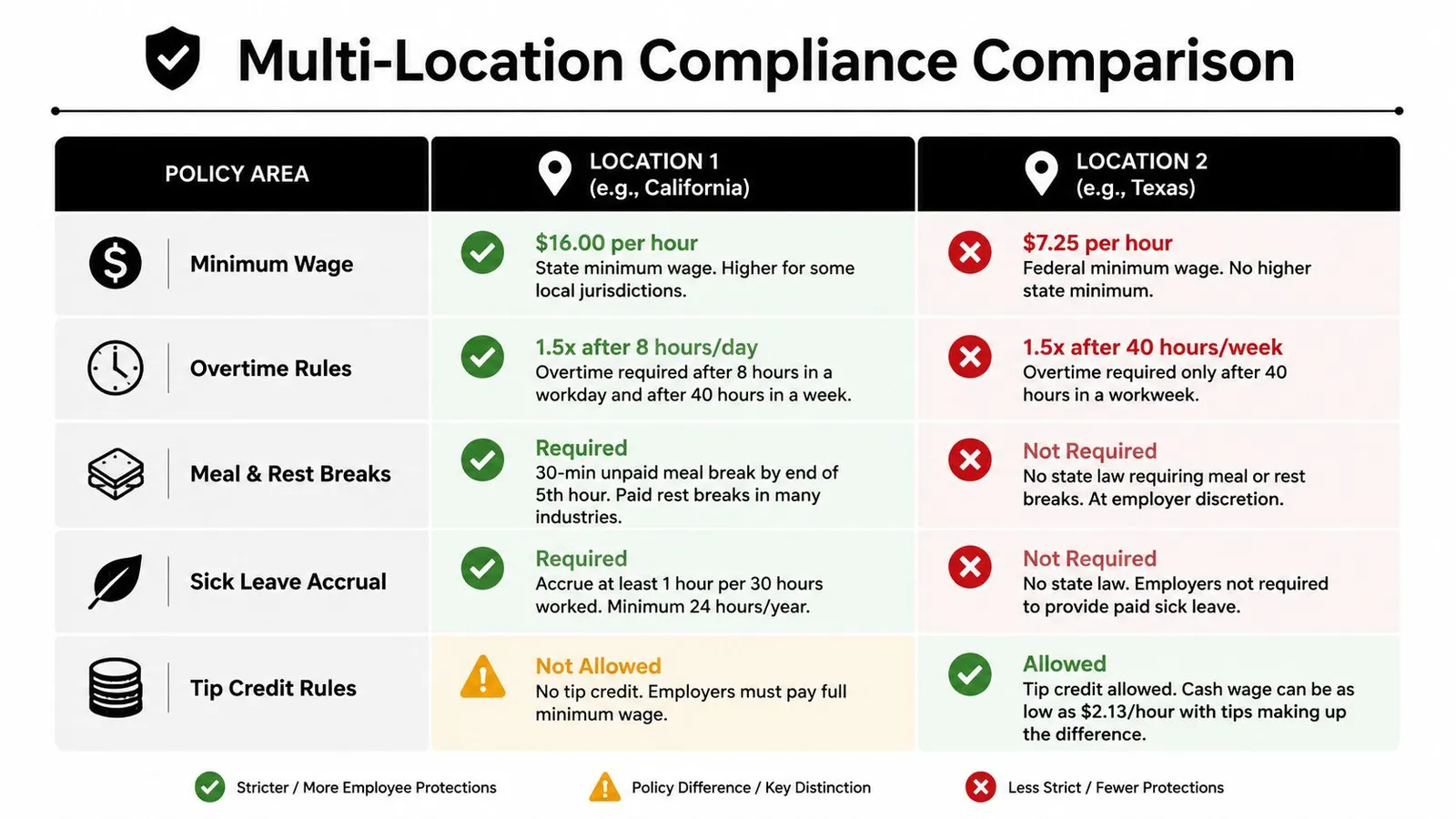
A manager copies last week's schedule from the Texas store to the California store, payroll closes, and now you have the kind of problem that eats an afternoon. The shifts looked fine on paper. The labor cost looked fine too. Then the break rules, overtime rules, or local leave rules turn that “simple” schedule into back pay, corrections, and a frustrated management team.
That is why multi-location compliance belongs in operations, not in a dusty HR folder. If your policies change by location, your scheduling, time review, and manager training have to change with them too.
Build one handbook structure, not one universal rulebook
Operators get into trouble when they treat every location like a copy of the first one. It feels efficient to hand everyone the same policy packet. It creates avoidable risk the minute one state handles overtime, breaks, tip credit, paid leave, or scheduling notices differently.
The better system is a master handbook with location-based addenda. The master document covers the standards that should not change from store to store, like conduct, reporting paths, documentation expectations, and general operating rules. The addenda handle the parts that do change, including wage rules, overtime triggers, meal and rest periods, local leave requirements, posting obligations, and any city scheduling ordinances.
That structure works because updates stay contained. If one city changes a fair workweek rule, you revise the city addendum instead of rewriting the entire handbook and hoping every manager notices the difference.
A practical setup usually includes:
Master section
Company standards, attendance expectations, conduct rules, complaint reporting, investigation steps, and basic documentation procedures.State addendum
Pay practices, overtime rules, break requirements, leave laws, final pay timing, and required notices.City or county addendum where needed
Predictive scheduling, local sick leave rules, premium pay requirements, and local posting obligations.Manager appendix
Approval workflows, who reviews timecards, who handles pay questions, where notices are posted, and when issues go to HR, payroll, or counsel.
Good operators also review the handbook the same way they review recipes or prep pars. On a set schedule. The point is preventing employment law problems, but the day-to-day payoff is simpler than that. Managers stop guessing.
Multi-state compliance fails at the manager level first
The document matters. Manager behavior matters more.
If a location leader does not know the local rule, the handbook will not save the shift. The common failure is not missing policy language. It is a supervisor approving time edits, skipping required premiums, or handling a break issue the way they did at their last store.
The fix is operational. Train managers on the rules that affect decisions they make during the week, not just what legal language appears in the handbook. The U.S. Department of Labor's guidance on the Fair Labor Standards Act is useful for setting the federal baseline on pay, hours worked, and overtime, especially for teams running stores in multiple states (FLSA compliance guidance for pay and hours). Then layer local rules on top in manager training, checklists, and approval steps.
For practical enforcement, keep a current record of four things:
- Where each location operates
- Which pay, break, leave, and scheduling rules apply there
- Which version of the addendum is active at that location
- Which managers have been trained on that version
That last point gets missed all the time. A policy update is not implemented because the PDF changed. It is implemented when the people approving schedules, edits, breaks, and payroll understand what changed and what to do about it.
A separate operating tool also helps managers catch issues before payroll closes. A process for tracking overtime across restaurant teams gives supervisors a way to see whether policy is showing up in schedules, punches, approvals, and labor decisions.
Growth exposes weak policy systems fast. One store can survive on memory and manager instinct for a while. Five stores in different jurisdictions cannot. The restaurant groups that stay out of trouble usually do one thing well. They treat compliance as part of daily operations, with clear ownership, local rules built into the workflow, and managers trained to apply them the same way every time.
How Do You Roll Out and Enforce Policies Effectively?
It is 4:45 on a Friday. A line cook texts that he is sick, a server wants to swap a closing shift, and an assistant manager approves both without checking the policy because service is about to start. By Monday, one employee says the call-out rule was enforced unfairly, payroll is missing notes on the shift change, and the GM is stuck sorting out a problem that started as a rushed decision.
That is how policy failures usually show up in restaurants. Not in the handbook. In the middle of service, when a manager has 30 seconds to decide what happens next.
A policy only works if the floor managers can apply it under pressure. If they have to hunt through a PDF, ask three people what the rule means, or choose between speed and compliance, they will improvise. Improvisation is expensive. It leads to uneven discipline, payroll corrections, and the kind of resentment that spreads fast through a team.
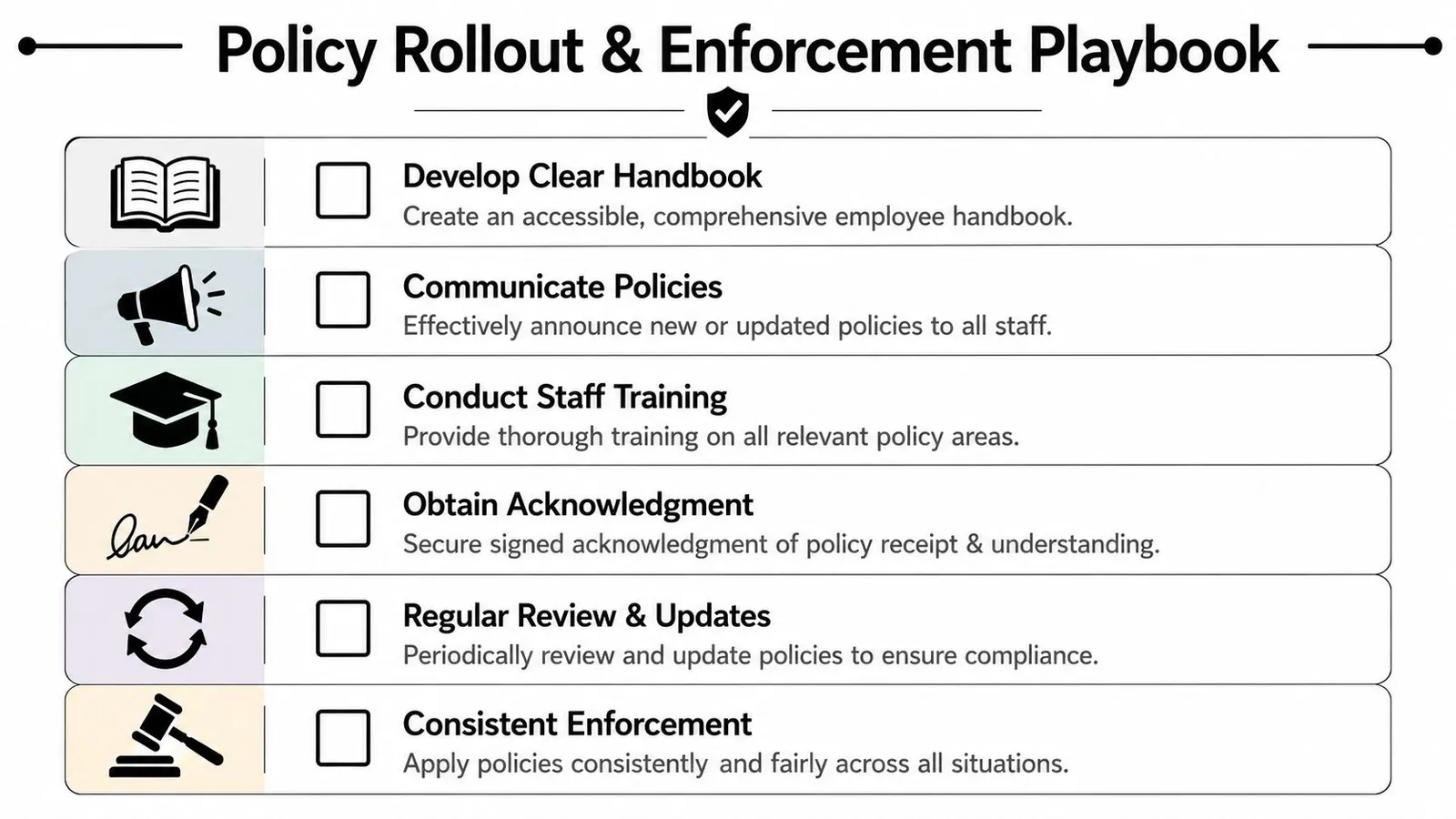
Rollout fails when managers are handed rules instead of being trained to use them
Hourly staff need the policy. Managers need the playbook.
The weak spot in most rollouts is not distribution. It is application. Owners send the handbook, collect signatures, and assume the system is live. Then one manager allows texted shift swaps, another demands formal approval, and a third ignores the rule for strong performers. Now the policy exists on paper, but operations are running on personal judgment.
A rollout that holds up in real life usually follows this order:
Finalize the written policy
Write the rule around actual restaurant decisions, not abstract language. If managers cannot tell when to approve, deny, document, or escalate, the wording is not ready.Train managers first
Use real scenarios from your stores. Late call-outs, missed breaks, cash shortages, harassment complaints, tip disputes, timecard edits. Managers remember examples they have lived through.Give employees a usable copy
Staff should be able to read it easily and access it without asking a manager to dig up a binder.Collect acknowledgements
Signed or electronic acknowledgements create a clean starting point. They do not solve enforcement, but they remove the excuse that nobody received the policy.Review the first few weeks closely
Check actual incidents, not just whether forms were signed. Look at call-outs, schedule changes, punch edits, and write-ups. You are checking for consistency, not just completion.
Strong enforcement should feel routine. The team should already know who approves what, what gets documented, and what happens when someone breaks the rule.
If you want the legal side of why handbook language matters, this piece on preventing employment law problems is a useful companion to the operational side.
Make the approved process faster than the workaround
Managers break policy for a simple reason. The shortcut saves time.
If requesting a shift swap takes six steps, it will happen by text. If documenting a time edit is clunky, someone will fix the punch and move on. If nobody can find the attendance rule during pre-shift, the loudest interpretation wins.
Good enforcement systems remove that temptation. They make the correct path the easiest path.
Use a few practical controls:
- Keep policies where managers already work: Phone access beats an office binder every time.
- Train with decisions, not lectures: Ask what they would do, what they would document, and when they would escalate.
- Require a record for exceptions: Shift changes, punch edits, schedule deviations, and policy exceptions should leave a trail.
- Spot-check manager behavior: Review who is applying rules unevenly, approving off-policy exceptions, or skipping documentation.
- Refresh training after the first miss: One messy incident usually exposes exactly where the rule or training is weak.
The restaurants that enforce policies well do not treat them as HR paperwork. They treat them as operating systems. Clear rules reduce arguments, speed up decisions, protect payroll, and keep managers from reinventing the same answer every night.
If you want to tighten scheduling, overtime control, tip calculations, and timecard review in one place, AnchOps is built for restaurant operations. It helps teams publish schedules with clearer labor visibility, manage shift changes in-app, review timecards in a weekly grid, and handle tip pools without nightly spreadsheet work.
Your back-of-house partner is ready
AnchOps handles scheduling, tip calculations, labor costs, and timecards — so you can focus on your restaurant, not your paperwork.