How to Sell a Restaurant: Valuation to Closing Playbook
Published on
By Tony Newcome — Founder of AnchOps · Owner, Pizza Harbour
This article was drafted with AI assistance and reviewed by Tony Newcome, a working restaurant operator.
189 days was the median time on the market for U.S. restaurant businesses sold in full-year 2025, according to BizBuySell transaction data compiled by Forefront Business Advisors. If you want to sell a restaurant, that's a useful reality check: finding a buyer is only part of the job. Protecting your price means proving that the earnings are real, the operation can run without you, and the buyer can take over without inheriting surprises.
The strongest sale package isn't a glossy description of your concept. It's a defensible earnings calculation, an organized diligence file, and operating records that answer a buyer's difficult questions before those questions become demands for a discount.
Table of Contents
- The Six-Month Roadmap From Prep to Closing
- Build the sale calendar backward
- What Your Restaurant Is Worth and How Buyers Price It
- Build earnings the buyer can defend
- Separate valuation from wishful thinking
- Decide Whether to List Now or Stabilize First
- Compare the cost of waiting with the likely benefit
- Financial Cleanup and the Due Diligence File
- Reconcile before you organize
- Build a controlled data room
- Operating Proof Buyers Check Before They Pay
- Turn manager knowledge into checkable records
- Choosing a Broker or Going It Alone
- Match the route to the transaction
- Read the engagement before signing
- Deal Structure, Tax and Transition Terms
- Define the assets and retained obligations
- Compare the money you keep and the money you might not collect
- Make the handover finite
- Negotiate the Letter of Intent and Close the Sale
- Put dates and evidence behind the offer
The Six-Month Roadmap From Prep to Closing
Plan for roughly six months from listing to closing, with preparation before that and room for landlord or licensing delays. Don't treat the listing date as the starting line for cleaning up the business. By then, you should know what you're selling, what it earns, and which approvals could stop the transaction.
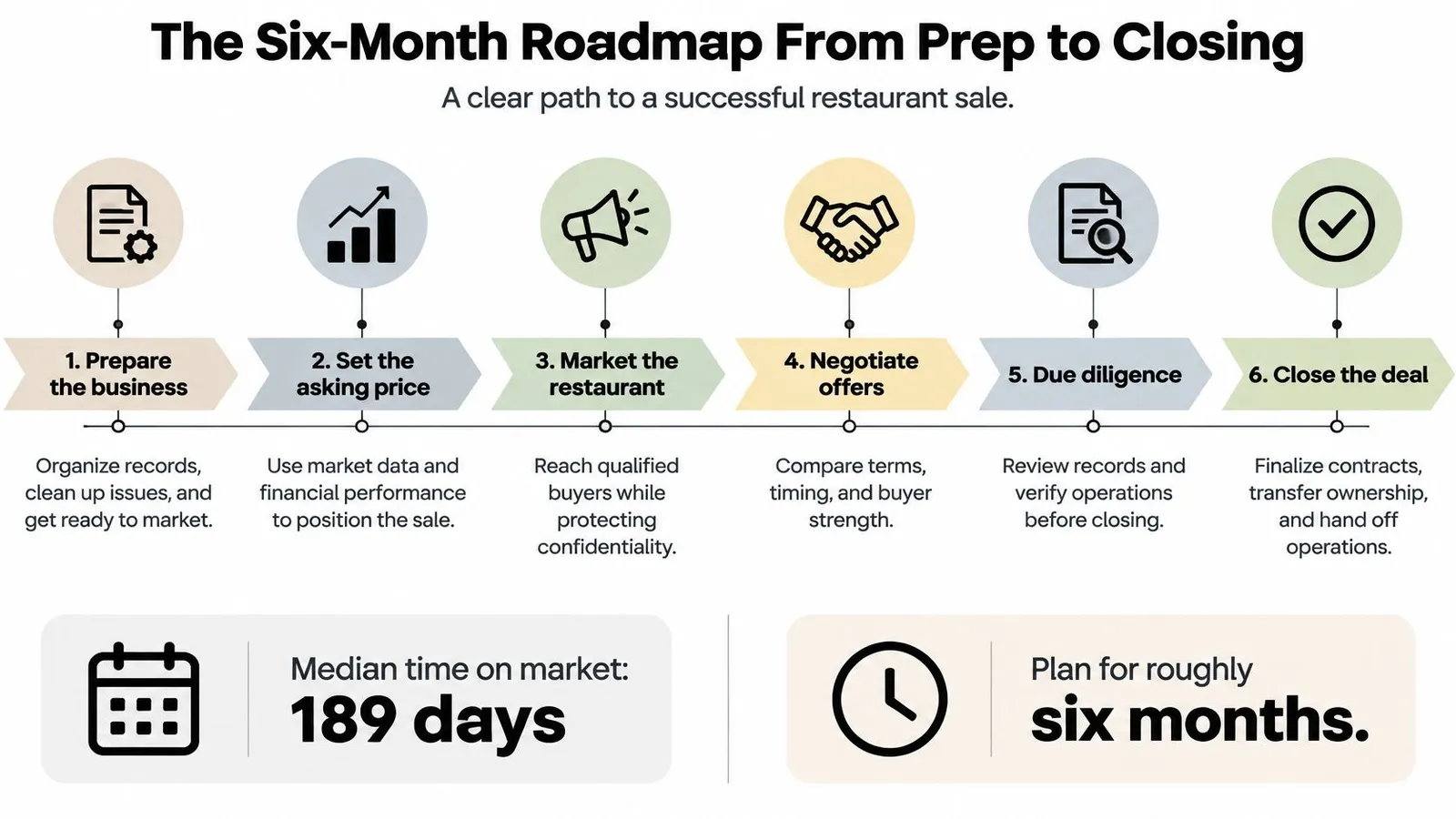
Build the sale calendar backward
Use this illustrative preparation calendar, then adjust it around your lease, records, and adviser availability.
- Weeks 1–3, establish a valuation range. Calculate normalized owner earnings and identify relevant comparable sales. Set a defensible range before choosing an asking price.
- Weeks 3–10, reconcile the financial history. Bring three years of tax returns, bank deposits, POS reports, and payroll into agreement. Explain differences rather than hiding them in a spreadsheet.
- Weeks 4–6, check transfer permissions. Have counsel review lease assignment, landlord consent, and liquor-license transferability before marketing.
- Throughout preparation, repair operating gaps. Resolve open shifts, overdue timecards, vendor arrears, and recurring manager bottlenecks. Keep evidence of the fixes.
- Around week 8, select your selling route. Choose a broker or owner-led process and prepare a confidential buyer summary. Keep exact sales out of public advertising.
- Once marketing begins, qualify interest. Check financing capacity and operating experience, require a nondisclosure agreement, and request written indications of interest.
- After selecting a buyer, negotiate the documents. Move from a letter of intent to a purchase agreement with financial, lease, license, tax, equipment, and employment contingencies.
- Before funds change hands, complete the closing checklist. Settle inventory-count procedures, gift-card treatment, equipment payoffs, permits, and handover responsibilities.
For the broader owner decision, Dealmaker Wealth Society's resource on planning a successful business exit provides useful context alongside restaurant-specific preparation.
Practical rule: An offer without proof of funds isn't a reason to open your records. It's a reason to qualify the buyer.
Keep running the restaurant while you sell it. A missed payroll reconciliation or deteriorating service during negotiations gives the buyer a fresh problem to price.
What Your Restaurant Is Worth and How Buyers Price It
Restaurant sale benchmarks from recent transaction data
| Benchmark | Value | How to use it |
|---|---|---|
| Median sale price, full-year 2025 | $225,000 | Typical deal size across 1,774 transactions |
| Median reported cash flow, full-year 2025 | $126,500 | Earnings base buyers compare against price |
| Average sale multiple of cash flow | 2.26x | Market-level reference point, not a fixed rule |
| Average earnings multiple of SDE, sales 2021–2025 | 2.15x | Average reference for normalized owner earnings, not a statistical midpoint |
| Middle half of sold restaurants, SDE multiple | 1.34x–2.53x | The central half of reported transactions, not a guaranteed range |
| Independent restaurant guidance, SDE multiple | 1.5x–3.0x | Reduce toward the low end for weak records or owner dependence |
| Average revenue multiple | 0.39x | A cross-check, not a substitute for earnings analysis |
| Median time on the market | 189 days | Plan cash runway and owner patience for about six months |
The full-year figures are the BizBuySell benchmarks identified above; Iconic's restaurant valuation analysis reports the 2021–2025 average of 2.15x SDE, the middle-half range of 1.34x–2.53x, and the 0.39x average revenue multiple. Ad Astra Equity's restaurant valuation guidance places independent restaurants around 1.5x–3.0x SDE and recommends building the calculation from at least three years of financial records.
Build earnings the buyer can defend
For an owner-operated restaurant, seller's discretionary earnings, or SDE, measures the financial benefit available to an owner-operator. Start with reported profit, then add back supportable owner compensation, personal expenses, depreciation, interest, and nonrecurring costs.
Don't confuse discretionary with avoidable. If a family member manages the dining room, their work still needs doing after the sale. Likewise, a repair isn't nonrecurring merely because you'd prefer not to pay it again.
Say your restaurant has $150,000 in supportable SDE, and comparable transactions support an illustrative 2.0x multiple. That produces an operating-business indication of $300,000. It's an example, not a market promise, and the final price still depends on what assets the comparable deals included.
Separate valuation from wishful thinking
Cross-check transactions by concept, location, earnings quality, lease economics, and owner involvement. The broader pricing advice from The Owner's Shortlist can help frame the asking-price decision, but restaurant-specific comparables should support your final number.
Buyers have concrete reasons to reduce a multiple:
- Declining performance: Recent deterioration makes historical earnings harder to rely on.
- Owner dependence: The buyer must replace your labor, relationships, or judgment.
- Transfer risk: An unfavorable lease or uncertain license can weaken the operating proposition.
- Unsupported adjustments: Buyers and lenders can remove owner benefits that lack documentation.
A well-designed bar drinks menu may support the beverage operation, but buyers will still want the resulting margins, not just the menu.
Create separate schedules for equipment, inventory, the liquor license, and real estate. Separately value them, but don't automatically add them twice if the operating-business comparison already includes required equipment. Finish with an add-back schedule that identifies the amount, rationale, and source document for every adjustment.
Decide Whether to List Now or Stabilize First
Should you enter a selective market now, or fund a turnaround before selling? Waiting only makes sense when you can name the problem, afford the remedy, and demonstrate improvement before your cash or lease runway becomes tight.
In a hospitality industry survey discussed in Seale & Associates' restaurant report, 43% of respondents identified rising costs as their top challenge in 2025. You can't control acquisition-market conditions, but you can decide whether waiting will leave a buyer with a stronger or weaker restaurant.
Compare the cost of waiting with the likely benefit
Put the decision on a single worksheet:
- Normalized cash flow: Is the underlying trend improving, flat, or deteriorating?
- Lease runway: Is there enough remaining term and renewal certainty to support a takeover?
- Owner dependence: Can a manager handle staffing, purchasing, and service decisions?
- Staffing reliability: Are key roles stable, or are departures creating coverage problems?
- Labor variance: Can you explain the difference between scheduled and actual labor?
- Turnaround funding: What cash must you commit before the improvement becomes credible?
Survival gives context, not a valuation formula. BLS accommodation and food-services establishment data summarized by SMBS show 85.3% first-year survival for establishments born in the year ending March 2024, 59.3% five-year survival for the 2020 cohort, and 41.6% ten-year survival for the 2015 cohort. Those figures cover a broader sector than restaurants alone, but they reinforce the importance of demonstrating durable operations rather than selling a launch story.
Stabilize first when you have a specific, affordable operating fix. Don't wait merely because you dislike today's valuation.
For example, a six-month stabilization effort may be sensible if sales are soft, records are clean, employees are staying, and the lease has room. If margins are falling, managers are leaving, and nobody can explain labor overruns, consider listing sooner while you can still demonstrate control.
Don't price from emotion, assume the lease transfers automatically, or keep critical procedures in your head. If continued operation requires cash you can't responsibly commit, compare an operating-business sale with an orderly asset sale or closure.
This week, pull three years of records, calculate normalized SDE, and read the lease-assignment clause. That work will tell you more than another month of watching listings.
Financial Cleanup and the Due Diligence File
Buyers ask for extensive documentation because they're checking three things: whether reported sales are real, whether earnings are repeatable, and whether unpaid obligations sit behind the business. A tidy profit-and-loss statement doesn't answer all three.
UpMenu's restaurant acquisition checklist identifies three years of filed tax returns, twelve months of bank statements, and 24 months of health-inspection reports, alongside the lease, lien search, and vendor and equipment contracts. Assemble the package before public marketing, not after a buyer starts a deadline.
Due diligence documents and the gaps that slow deals
| Document | What It Proves | Gap That Slows or Kills a Deal |
|---|---|---|
| Three years of filed tax returns | Reported income matches what you declared | Unexplained differences from POS or bank totals |
| Year-to-date and monthly P&L statements | Current trend, not just last year | Unexplained spikes or missing months |
| Twelve months of bank statements | Sales reconcile to deposits | Deposits that cannot be traced to POS reports |
| POS sales and payroll reports | Labor and sales figures agree | Tip or payroll discrepancies |
| Complete lease and all amendments | Remaining term, renewal options and consent rules | Missing amendments or unclear assignment conditions |
| UCC lien search | Whether assets are subject to recorded security claims | Unpaid equipment loans with no payoff letter |
| 24 months of health-inspection reports | Compliance history | Open violations or repeat citations |
| Vendor and equipment contracts | Who owns what, and what is owed | Leased or financed equipment not disclosed |
| Gift card and chargeback records | Liabilities requiring contractual treatment | Unrecorded gift card balances |
| SDE add-back schedule with source documents | Each owner benefit is supportable | Add-backs with no receipts or statements |
Reconcile before you organize
Begin with tax returns, financial statements, POS totals, bank deposits, and payroll. Build a reconciliation that explains timing differences, merchant processing deductions, refunds, cash deposits, and other legitimate adjustments. The objective isn't identical totals on every document; it's a traceable explanation of why the totals differ.
Don't label an unexplained deposit as revenue just to make the worksheet balance. Identify capital contributions, transfers, and loan proceeds separately. If your current process relies on a basic cash log, this explanation of single-entry bookkeeping helps clarify its limits before your accountant builds a transaction-ready reconciliation.
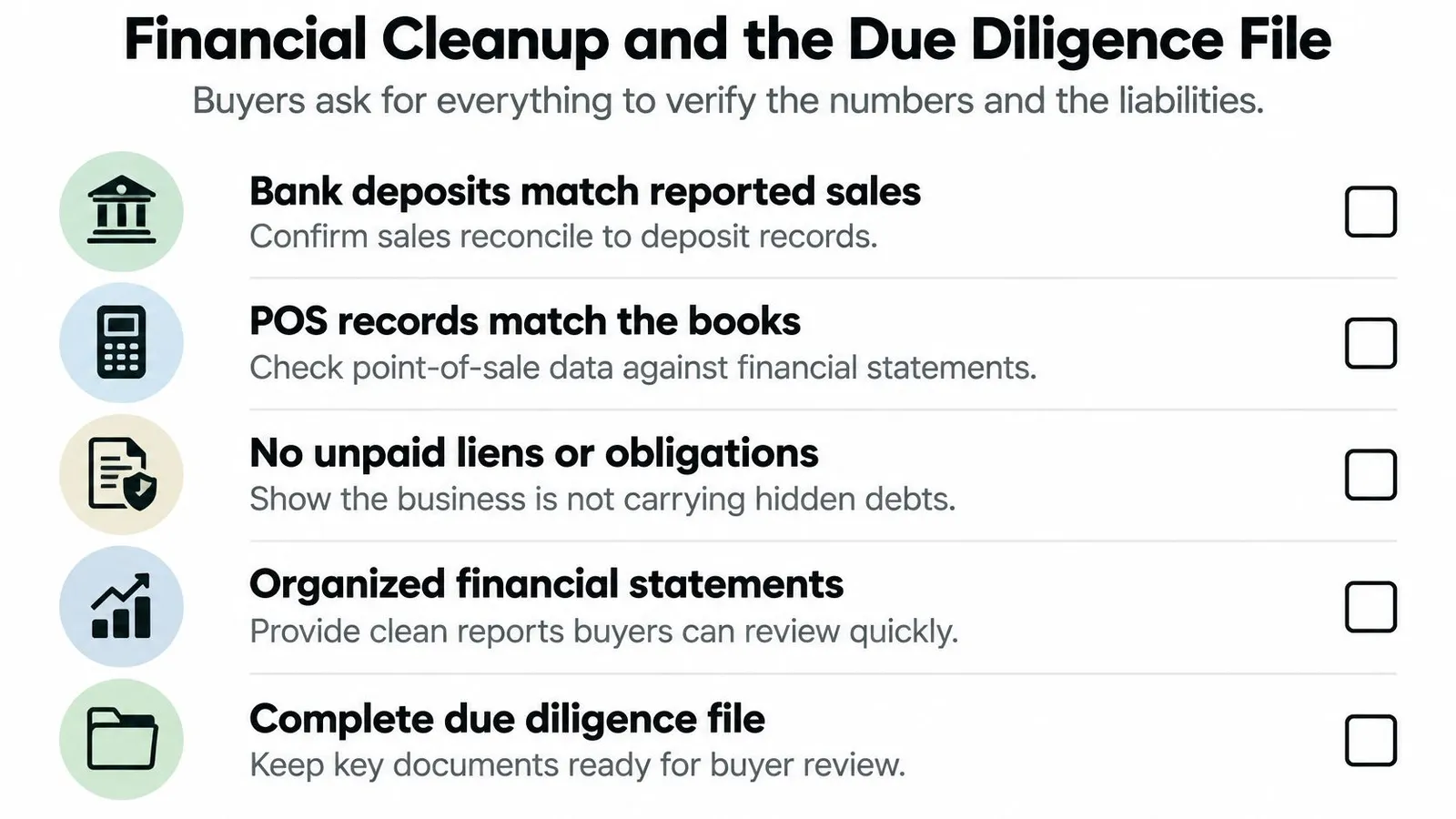
Build a controlled data room
Use a permission-controlled document platform with folders for financials, lease, licenses, equipment, employment, vendors, and liabilities. Maintain a request log showing the document owner, upload date, and unresolved question. Restrict employee personal information and customer data rather than uploading everything indiscriminately.
Complete these cleanup tasks before inviting detailed review:
- Equipment financing: Obtain payoff letters and identify the process for lien releases.
- Employee obligations: Document accrued amounts, payroll issues, and unresolved claims for counsel.
- Customer balances: Reconcile gift cards, deposits, refunds, and chargeback exposure.
- Unusual expenses: Explain a major repair or rent catch-up in writing, with the invoice and payment evidence.
- Lease documentation: Include amendments, renewal notices, rent changes, permitted use, and consent procedures.
Missing records create room for a buyer to seek a lower offer, escrow, extra indemnities, or financing changes. An organized file won't make a weak business strong, but it prevents avoidable uncertainty from making a sound business look unreliable.
Keep exact sales out of public listings. And don't let anyone build an offer around add-backs that neither you nor your accountant can substantiate.
Operating Proof Buyers Check Before They Pay
Who builds the weekly schedule when you're away? If the honest answer is that nobody else knows how, the buyer must account for losing your knowledge along with your labor.
That's why operational transferability belongs in the sale file. Capstone Partners' restaurant M&A report reported a 28.9% year-over-year decline in restaurant M&A activity in 2025; the accompanying market context includes Kroll's count of 50 food-and-beverage transactions in Q1 2025. These are broader deal-market indicators, not a forecast for your listing, but they support preparing for selective buyers.
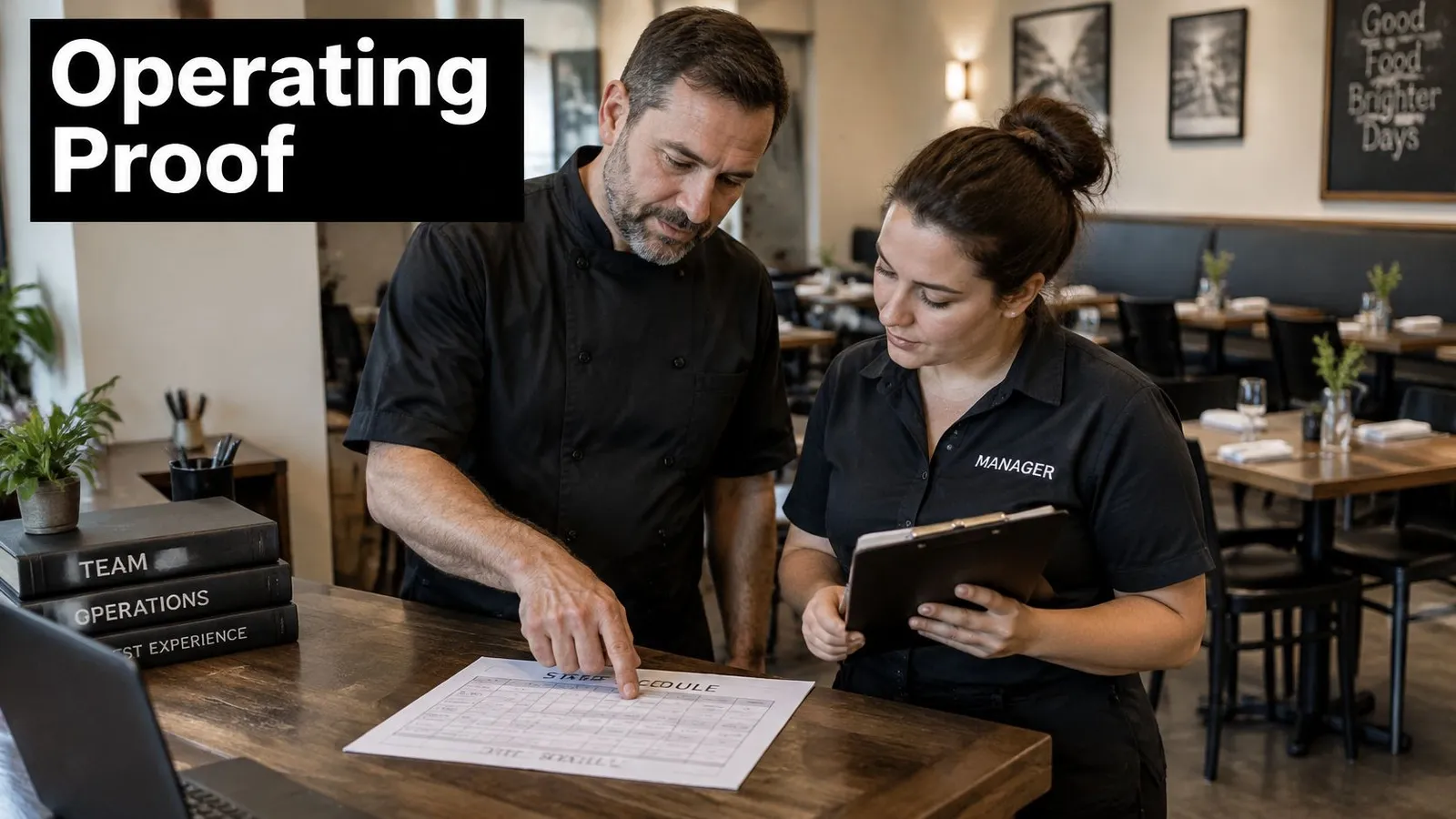
Turn manager knowledge into checkable records
As a practical preparation target, retain at least the last 90 days of schedules and let a manager run a full scheduling week without your intervention. That's a readiness test, not an industry requirement.
Give the manager a schedule template, availability rules, approval authority, coverage procedure, and escalation contacts. Then keep the resulting evidence:
- Staff continuity: Key-role departures, replacement plans, and cross-training records.
- Attendance history: Late arrivals, no-shows, shift coverage, and approved changes.
- Approved timecards: Hours reconciled with payroll and reviewed alongside POS sales.
- Daily labor control: Labor-to-sales reports with explanations for material exceptions.
Use labor planning to distinguish a planned staffing decision from an unexplained overrun. The Allied Tax Advisors restaurant bookkeeping guide is also a useful companion when connecting operating activity to the financial records a buyer reviews.
Transferability test: Can another competent manager reproduce the result using your records, rather than calling you?
Export schedule history, approved timecards, and daily labor-to-sales reports from the systems you use. Together with financial reconciliations, they form a transferability file demonstrating that performance doesn't depend on you, a key employee, or undocumented labor practices.
Choosing a Broker or Going It Alone
Broker-led sale compared with a do-it-yourself sale
| Factor | Broker-led sale | Do it yourself |
|---|---|---|
| Upfront cost | Usually none under a success-fee arrangement; confirm retainers and marketing charges | Budget for listing, legal and accounting fees, including upfront charges |
| Fee structure | Commission or success fee, set in writing | No broker commission; professional-adviser and listing costs remain |
| Buyer access | Established buyer lists and pre-qualification | Your own network and listing sites |
| Confidentiality | Broker controls who sees details | You screen every buyer yourself |
| Valuation support | Comparable sales and pricing advice | You build the valuation with an accountant |
| Negotiation | Experience with LOI and price terms | You negotiate alone or with an attorney |
| Time commitment | Lower day-to-day selling workload | Higher, while you still run service |
| Best fit | Multi-location groups or complex leases | Simple concept, clean records and a known buyer |
A broker is useful when they do work you can't perform well while operating the restaurant. That includes screening inquiries, controlling disclosures, explaining comparable sales, and keeping negotiations moving. A listing posted on your behalf isn't enough.
Match the route to the transaction
An owner-led sale can work for a single-unit restaurant with clean books, a known local buyer, and straightforward lease permissions. You'll still need an attorney for the purchase agreement and a CPA for the financial and tax implications. DIY should mean managing the process yourself, not dispensing with professional review.
A multi-location group, complicated lease, or owner with no capacity for buyer calls has a stronger reason to hire a broker. Ask who will handle your account and how they distinguish a financially qualified buyer from someone who likes the concept.
Read the engagement before signing
Don't assume the broker's fee is payable only when money reaches your account. Have your attorney review the payment trigger and what happens if the buyer defaults or the transaction falls apart.
Check these terms explicitly:
- Fee basis: What price components attract commission, including inventory, assumed debt, or seller financing?
- Upfront charges: Are valuation, advertising, or retainers charged separately?
- Exclusivity: Can you sell to an existing contact without triggering the full fee?
- Post-termination rights: Which introduced buyers remain covered after the engagement ends?
- Confidentiality: Who approves advertising and authorizes release of financials?
- Process ownership: Who tracks buyer funding, diligence requests, and deadlines?
Retain your own attorney and CPA even when the broker recommends advisers. Their responsibility is different from the broker's responsibility to market and negotiate the transaction.
I'd interview at least two brokers and ask each to defend their comparable-sales selection against your normalized SDE. Choose the adviser who explains adjustments and risks clearly, not the one who promises the highest asking price.
Deal Structure, Tax and Transition Terms
Your first structural decision is whether to sell specified assets or the legal entity. In an asset sale, the buyer purchases agreed items while you retain the corporation or LLC; in an entity sale, the buyer acquires the company itself, as Fourscore Business Law explains in its restaurant-sale guidance.
Neither label substitutes for careful liability drafting. The agreement must identify what transfers, what stays behind, and which approvals remain outstanding. Treat landlord consent and licensing approvals as closing conditions rather than assumptions.
Define the assets and retained obligations
Build an asset schedule detailed enough that nobody has to infer what was included. Cover equipment, leasehold improvements, goodwill, recipes, the trade name, inventory, deposits, customer data, intellectual property, phone numbers, websites, social accounts, and employee records. State how gift cards and permits will be handled rather than treating them as ordinary equipment.
Identify excluded assets with equal care. Your personal laptop, an unrelated catering brand, or cash in the operating account shouldn't become an argument after signing.
Address liabilities expressly:
- Taxes and employment: Allocate responsibility for tax balances, wage claims, accrued obligations, and required filings.
- Vendors and disputes: Identify unpaid invoices, litigation, and contested charges.
- Customer obligations: Specify responsibility for gift cards, event deposits, refunds, and adjustments.
- Historical exposure: Have counsel negotiate representations, indemnities, claim procedures, and escrow protections.
An allocation between buyer and seller doesn't necessarily prevent a regulator or third party from asserting a claim. Your advisers should assess that exposure before you accept the structure.
Compare the money you keep and the money you might not collect
Price allocation affects after-tax proceeds. RBT CPAs' restaurant-sale tax guidance explains that equipment can produce ordinary income or depreciation recapture, while goodwill receives different treatment; qualifying installment gain may be recognized over time.
Buyers often prefer more allocation to depreciable tangible assets, while sellers commonly prefer more goodwill. Agree on defensible values with your CPA instead of leaving allocation until the final paperwork.
A lump-sum payment gives immediate liquidity but can concentrate taxable gain in the closing year. Installments spread collections and may spread qualifying gain, but you become exposed to the buyer's ability to operate and pay. Don't confuse deferred payment with guaranteed payment.
For seller financing, document the interest rate, amortization, payment dates, guarantees, security interests, default remedies, and insurance covenants. Have counsel assess collateral and enforcement rights before you decide the note is equivalent to cash.
Make the handover finite
Define the training period, expected hours, scope, and any compensation for extra help. Include vendor introductions, recipe and purchasing files, staff-retention responsibilities, account permissions, and the point at which the buyer makes operating decisions.
A noncompete needs a stated scope and duration, with enforceability reviewed by counsel. Avoid an open-ended promise to remain available whenever the buyer needs assistance.
A lower price with clear obligations and collectible proceeds can be better than a higher headline price that leaves you exposed.
Negotiate the Letter of Intent and Close the Sale
Qualify the buyer before releasing detailed numbers. Confirm available cash, financing status, and experience with a comparable operation, then obtain a nondisclosure agreement and release the summary and data room in stages.
Acquisition Stars' restaurant transaction guide recommends a controlled process from valuation and buyer qualification through the letter of intent, purchase agreement, and closing checks. Ask interested buyers for a written indication covering price, structure, deposit, funding, and timing.
Put dates and evidence behind the offer
Select the strongest executable proposal, not automatically the highest number. Negotiate a letter of intent covering price, asset or entity structure, deposit, exclusivity, lease consent, and the diligence window. Have counsel identify which provisions are binding.
Before exclusivity begins, request the buyer's financing commitment or clear evidence of cash. If the lender can't issue a final commitment yet, understand the remaining conditions before taking the restaurant off the market.
The purchase agreement should give financial, legal, lease, liquor-license, tax, equipment, and employee diligence their own deadlines. Name the person responsible for each approval.
Closing checklist by deadline
| Item | Timing | Why It Matters |
|---|---|---|
| Landlord consent and lease assignment signed | Before closing | Buyer can operate at the site |
| Health and liquor permits transferred or reissued | Before closing | Lawful operation at handover |
| Sales-tax and payroll tax filings confirmed | Before closing | Verifies compliance and identifies remaining exposure |
| Equipment payoff letters and lien releases | Before funds release | Clean title to equipment |
| Final inventory count signed by both parties | Closing day | Accurate price adjustment |
| Gift-card and deposit balances reconciled | Closing day | Liabilities transfer correctly |
| Vendor balances and payroll brought current | Closing day | No undisclosed arrears |
| Phone, website, social and payment accounts handed over | Closing day | Continuity of sales channels |
Have counsel confirm required tax notices and any escrow or holdback release conditions. Count inventory jointly, value perishables conservatively, and arrange replacement payment-processing accounts where existing accounts can't transfer.
Walk away from a buyer who won't substantiate funding. A signed offer isn't a completed exit.
AnchOps helps restaurant teams automate scheduling and shift coverage, track reliability, manage timecards and labor costs, and calculate Toast-linked tip pools. Visit AnchOps to put those operating workflows into practice and build the checkable history a buyer needs before taking over your restaurant.
Your back-of-house partner is ready
AnchOps handles scheduling, tip calculations, labor costs, and timecards — so you can focus on your restaurant, not your paperwork.