Discipline for Employees: A Practical Guide for Restaurants
Published on
Friday dinner is already in the weeds when your line cook arrives twenty minutes late, again. The host is covering the entrance, another cook is juggling prep and tickets, and you pull the late employee aside for a quick word before service gets worse. He apologizes, nods, and gets to work. Two weeks later, the same gap opens on the schedule.
That cycle is familiar in restaurants because informal warnings feel efficient during a rush. They also create weak records, inconsistent treatment, and delayed decisions. Effective discipline for employees should correct behavior without humiliating people, protect the staff who reliably show up, and give managers evidence strong enough to support each step.
Table of Contents
- Why Informal Warnings Usually Fail in Restaurants
- The three breakdowns behind the quick word
- The Progressive Discipline Ladder Step by Step
- Stage one is counseling with a record
- Stage two is a written warning
- Stage three is the final opportunity
- Stage four is suspension or termination
- Writing a Policy That Actually Holds Up
- Sample policy language
- Running the Corrective Conversation Without Drama
- Use different language for different steps
- Write the recap before the day ends
- Legal and Documentation Pitfalls to Avoid
- Using Reliability Data and AnchOps as Evidence
- Build the record from operating evidence
- Review a rolling snapshot before meeting
- Your First-Week Discipline Checklist
- Day one, establish the facts
- Day two, make the rules usable
- Day three, train the people who enforce it
- Days four and five, close the loop
Why Informal Warnings Usually Fail in Restaurants
On a Tuesday night, a server clocks in after the dinner section has opened. The shift lead says, “You need to be here on time,” and the server says traffic was bad. The floor keeps moving, so nobody records the conversation, confirms the next expectation, or checks whether the same issue happened during the previous week.
The manager remembers the incident as a general frustration, not as a dated attendance event. A different lead handles the next late arrival and gives a different response. One employee gets a warning, another gets sympathy, and neither understands where the actual line sits.
The three breakdowns behind the quick word
Memory-based discipline is the first problem. Without a written summary, the manager has no dependable record of what happened, what explanation the employee gave, or what improvement was requested. That weakens the next conversation and makes it difficult to distinguish a single mistake from a recurring pattern.
Inconsistent application is the second. Shift leads often make reasonable decisions in the moment, but “reasonable” can vary by personality, tenure, or personal relationship. A favorite employee may get several private reminders while a newer hire receives a formal write-up for similar conduct. That inconsistency damages trust faster than a clear policy does.
The third problem is delay. Owners often tolerate tardiness, missed call-ins, or refusal to help with coverage until the behavior becomes so disruptive that termination feels like the only option. By then, the employee may believe earlier conversations were casual coaching, not warnings.
Practical rule: If a conversation changes what the employee is expected to do next, write a short record of it that day.
A structured process isn't bureaucracy for its own sake. It protects the people who arrive ready for work, helps leads respond consistently, and gives an owner a fair way to correct problems before they become dismissal decisions. Operators building a broader people-management system can also use this hospitality HR leaders guide to connect hiring, staffing, and employee experience rather than treating discipline as an isolated task.
The Progressive Discipline Ladder Step by Step
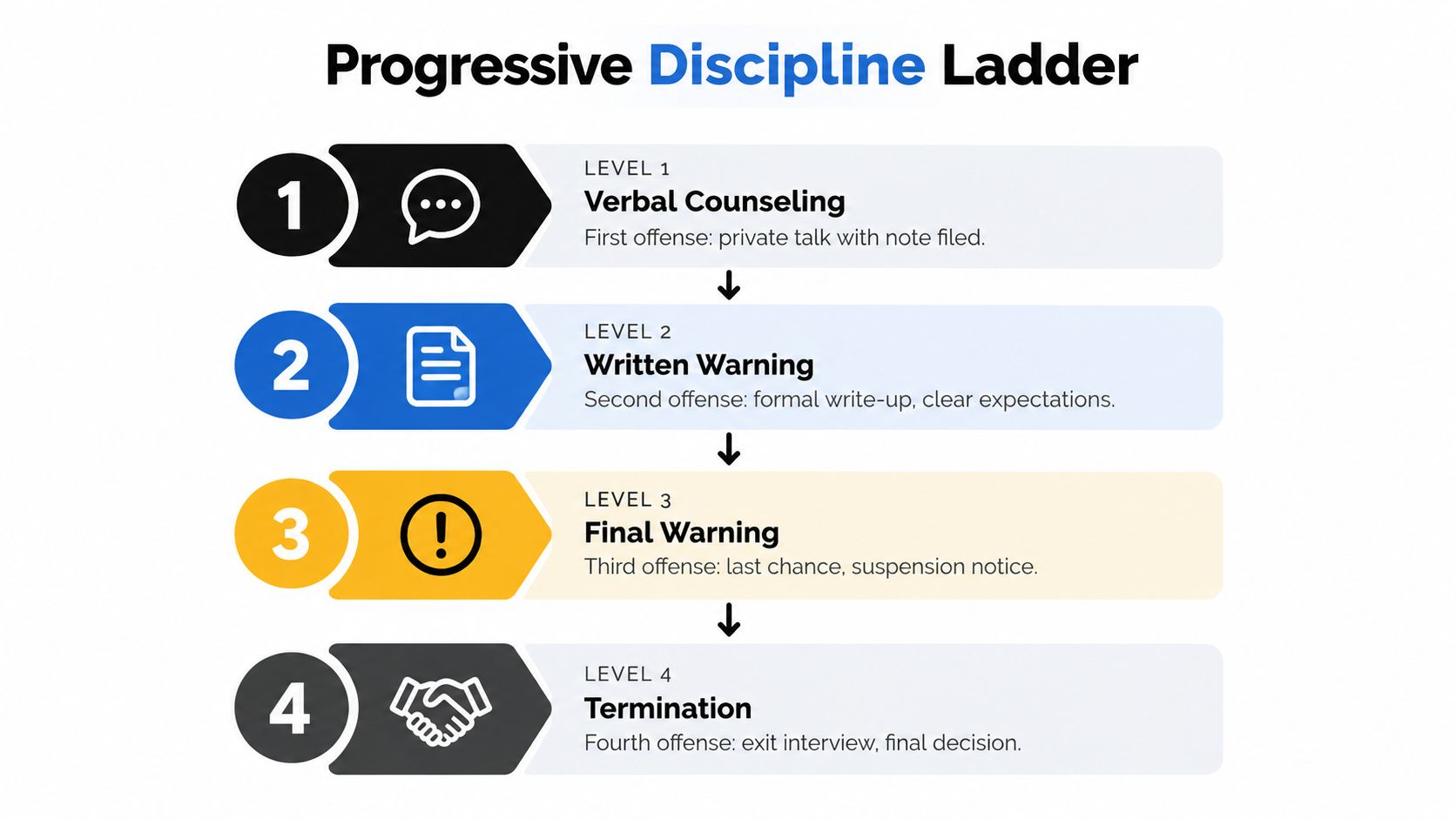
Progressive discipline works when every step answers four questions: What happened? Which rule applies? What must change? What happens if it doesn't? The sequence gives the employee a fair chance to correct the problem while giving the restaurant a consistent record.
Stage one is counseling with a record
Start with a private verbal counseling meeting for a first documented concern. State the incident, cite the expectation, ask for context, and explain the required change. Then place a short summary in the employee file.
This isn't a slap on the back. It's a logged conversation that says, “We discussed this, you understand the expectation, and we're watching for improvement.” The evidence-based progressive-discipline model similarly begins with documenting the issue, meeting the employee about the specific gap, setting a measurable timeline and support, and explaining possible consequences. This overview of progressive discipline describes the common sequence as verbal warning, written warning, final warning or suspension, and termination.
Stage two is a written warning
Use a written warning when the same behavior repeats or the first incident warrants a formal record. Tie it to a specific date, shift, timecard entry, or conduct event. Include the policy language, the correction required, and an improvement window of 30 to 60 days.
Have the manager sign it and ask the employee to acknowledge receipt. A signature confirms delivery, not necessarily agreement. If the employee refuses to sign, note the refusal and have a witness confirm that the document was presented.
Stage three is the final opportunity
A final written warning or performance improvement plan should list the exact behaviors that must change. For attendance, that might mean following the call-in process, arriving ready to clock in at the scheduled time, and responding to assigned-shift communications.
Write the consequence plainly. “Further violations may result in suspension or termination” is more useful than “improve your attitude.” The employee should leave knowing what success looks like and when the manager will review progress.
Stage four is suspension or termination
Reserve suspension or termination for serious offenses or repeated failure after the earlier steps. Skipping directly to the final step because the owner is angry is one of the most common mistakes in restaurant management. You can move faster for serious misconduct, but the reason for doing so should be documented and applied consistently.
Writing a Policy That Actually Holds Up
A policy fails when employees have to guess what words such as “late,” “excessive,” or “unreliable” mean. Restaurant attendance rules need observable definitions that a shift lead can apply while reviewing a schedule and timecard.
Define tardy as more than 5 minutes past the scheduled clock-in time. Define a no-show as failing to appear within 30 minutes of shift start without contacting the restaurant. Define a no-call no-show as zero communication for a full shift. Then state the call-out channel and notification window, including who must receive the message when a manager isn't available.
The policy should also separate an unexcused absence from a protected leave situation. FMLA, disability-related accommodation duties, and similar state protections can affect how an attendance event is handled, so managers shouldn't label an absence unexcused before checking the circumstances and obtaining appropriate legal guidance.
Sample policy language
Attendance and communication: Employees must arrive ready to work by their scheduled start time. A tardy occurs when an employee clocks in more than 5 minutes after the scheduled start. A no-show occurs when an employee hasn't appeared within 30 minutes of shift start and hasn't contacted the restaurant. A no-call no-show occurs when an employee provides no communication for the full scheduled shift. Employees must use the designated call-out channel within the stated notification window. Attendance events will be reviewed under the progressive discipline process, subject to applicable protected-leave and accommodation requirements.
Swap refusal deserves its own rule. Decide how employees should respond to swap requests, what constitutes a reasonable refusal, and when repeated refusal becomes a documented reliability concern. Don't punish someone merely for declining a swap unless the handbook clearly defines the obligation and the rule is applied consistently.
A useful companion resource is employee policies for restaurants, particularly when converting informal expectations into handbook language. The policy should identify the event, the evidence used, the review period, and the escalation trigger. Vague wording creates arguments; precise wording creates a process.
Running the Corrective Conversation Without Drama
The best corrective meetings feel controlled, not theatrical. Hold the conversation privately, remove the audience, and bring the actual timecard or schedule record. Don't begin with “You always do this.” Begin with one verifiable event.
A practical opening sounds like this:
“I want to discuss your attendance on Monday. The schedule shows a 9:30 AM start, and the timecard shows you clocked in at 9:47 AM. Our attendance policy treats more than 5 minutes after the scheduled start as tardy. Tell me what happened.”
Then listen. Traffic, childcare problems, confusion about the schedule, and a faulty clock may not erase the event, but they can affect the response. Ask whether the employee understood the schedule and call-in procedure. Keep your tone flat and curious. Anger makes people defend themselves; clarity makes the expectation easier to remember.
Use different language for different steps
For verbal counseling, say:
“This is a verbal counseling discussion, and I'm documenting it. Starting with your next shift, you need to arrive ready to work by the scheduled start time and follow the call-in procedure if an emergency prevents that.”
For a written warning, say:
“This written warning records the repeated attendance issue. The expectation is immediate improvement during the review period. Further violations may move the matter to the next discipline step.”
Don't argue about whether the employee is a good person. Keep returning to two questions: What happened? What will be different on the next shift? Excuses, deflection, and tears may be genuine reactions, but they shouldn't pull the meeting away from the event and the required correction.
Write the recap before the day ends
A same-day note should identify the employee, meeting date, incident date, behavior, policy section, explanation, expectation, review period, and consequence. Give the employee an opportunity to read it and sign acknowledgment.
Example:
“Attendance, Monday. Scheduled start 9:30 AM, clock-in 9:47 AM. Employee explained that transportation was delayed. Policy section 3 requires arrival by scheduled start and communication under the call-out procedure. Employee must arrive ready to work at scheduled start for the next 30 days and contact the manager through the designated channel if delayed. Repeated violations may result in the next discipline step.”
File the note where the manager and authorized HR personnel can retrieve it. A warning that lives only in the owner's memory isn't a management system.
Legal and Documentation Pitfalls to Avoid
Restaurant discipline becomes risky when managers treat fairness as a feeling instead of a repeatable process. The same attendance event should produce the same starting response regardless of whether the employee is a favorite, a long-term hire, or someone still learning the operation.
No-call no-show decisions also raise wage and hour questions. Don't assume you can withhold earned pay, deduct training time, or classify an absence as job abandonment without checking applicable law and policy. One public-sector policy defines a no-call/no-show through specific timing and communication conditions and connects unauthorized absence or tardiness with no pay for time not worked, but that policy isn't a universal rule for private restaurants. Its attendance policy illustrates why operators must verify the governing rules before copying a consequence.
Protected leave and accommodation issues require special care. An attendance event may connect to FMLA, disability, pregnancy, or another protected circumstance. Retaliation concerns can also arise if discipline escalates soon after an employee raises a complaint or uses protected time. Pause, preserve the records, and get qualified employment-law advice before taking irreversible action.
| Pitfall | Defensible Practice |
|---|---|
| “Attitude problem” with no examples | Describe the words, conduct, date, witnesses, and operational effect |
| Verbal warning with no record | Write a same-day summary and store it in the employee file |
| Different responses from different leads | Train leads on the same policy and review exceptions |
| Missing signatures or unexplained refusal | Record that the document was presented and note any refusal |
| Termination after one frustrating shift | Check prior steps, policy language, evidence, and protected-status concerns |
| Payroll action based on an assumption | Confirm wage rules and distinguish unpaid time from earned wages |
Review attendance records at least quarterly, identify employees below the stated standard, and use counseling to establish an improvement plan before formal discipline where appropriate. The supervisor guide to corrective discipline also supports keeping an attendance record and discussing absences or tardiness with the employee.
For operators organizing records, tools that streamline HR workflows can reduce missing forms and scattered files. New York operators should also review the specific risks discussed in New York wrongful termination guidance, while remembering that state rules differ.
Using Reliability Data and AnchOps as Evidence
A late clock-in is a policy event. Repeated late clock-ins, unanswered swap requests, early departures, and no-shows are also scheduling signals. They tell you whether a person can reliably cover the shifts assigned to them, which matters before you publish the next schedule.
The distinction changes the manager's question. Instead of asking only, “Should I write this person up?” ask, “What does the evidence show about the pattern, and what staffing decision should follow?” A single emergency may call for coaching. A repeated pattern that creates uncovered stations may require progressive discipline and a change in future assignment decisions.
Build the record from operating evidence
Use the published schedule, clock-in and clock-out records, approved swaps, call-out messages, and manager notes. A timecard shows when someone clocked in. The communication record can show whether the employee acknowledged the shift, requested a change, received a denial, or notified the restaurant through the required channel.
AnchOps can compile timecard exceptions, shift-swap activity, and call-out patterns into an employee reliability view. Its reliability scoring considers whether a shift was on time, late, covered, or a no-show, and the employee can see the personal reliability score in the mobile app. That visibility gives managers a practical starting point, but the score shouldn't replace the underlying records or the employee's explanation.
![Screenshot from https://app.anchops.com/reliability/[employee-id]](https://cdnimg.co/292146e2-2dcb-4c79-84bc-917776242438/dc3f7bb9-c5eb-4f40-a9f6-fd565ca8628f/discipline-for-employees-attendance-dashboard.jpg)
Review a rolling snapshot before meeting
Pull a 90-day reliability snapshot before a corrective conversation. Layer late clock-ins, no-shows, early clock-outs, coverage activity, and swap responses against the written policy thresholds. Check that each event is real, that duplicate records aren't counted twice, and that protected circumstances are separated from ordinary attendance events.
The manager can then export the relevant evidence into a warning or termination memo. Keep the memo factual: dates, scheduled times, actual times, communication, policy, prior counseling, employee response, and next expectation. Don't turn a score into a character judgment.
Reliability data should support a fair conversation, not decide the employee's fate without one.
This approach also improves scheduling. If a person repeatedly misses opening shifts but reliably works later shifts, the evidence may support a coaching plan and a schedule adjustment. If the same person continues to accept shifts and fail to appear, the pattern supports a stronger reliability discussion. Discipline and staffing decisions become connected, but they remain separate decisions that require clear policy and consistent review.
Your First-Week Discipline Checklist
A discipline system becomes real when managers put it on the calendar. Use the first week to create the records, policy, training, and follow-up rhythm that informal warnings usually lack.
Day one, establish the facts
- Pull attendance reports: Review current schedules, timecards, call-outs, swaps, and no-shows.
- Flag the worst patterns: Identify the employees whose records require a closer policy review, not an automatic penalty.
- Review reliability data: Compare each pattern with the published attendance and communication standards.
Day two, make the rules usable
- Rewrite the attendance policy: Define tardiness, no-show, no-call no-show, call-out communication, swaps, and protected-leave review.
- Add it to the handbook: Make sure employees can access the current version and acknowledge receipt.
- Prepare private meetings: Queue conversations by urgency and collect the specific timecard evidence for each one.
Day three, train the people who enforce it
- Train shift leads: Show them how to record incidents in AnchOps timecards and communication threads.
- Run the first counseling: Use the fact, policy, explanation, expectation structure.
- File summaries: Complete the written recap the same day and record acknowledgment or refusal.
Days four and five, close the loop
- Hold the remaining meetings: Keep each conversation private, brief, and tied to a documented event.
- Audit consistency: Compare similar incidents across employees and ask why any response differs.
- Schedule follow-up: Put the review date on the manager calendar so the file doesn't disappear after the meeting.
Use reporting an absence as a practical reference when tightening communication expectations and attendance records. The system will fail if you skip the policy rewrite because “we already have something,” apply steps differently to favorites and newer hires, never return to the file after the conversation, or refuse to escalate when step-three behavior continues.
Discipline works when it runs on a schedule, not when emotions run hot. Set the review dates, preserve the evidence, and give reliable employees the consistency they deserve.
AnchOps brings scheduling, timecards, shift coverage, employee communication, and reliability tracking into one operating workflow for shift-based teams. Visit AnchOps to see how you can turn attendance patterns into documented, defensible management decisions.
Your back-of-house partner is ready
AnchOps handles scheduling, tip calculations, labor costs, and timecards — so you can focus on your restaurant, not your paperwork.