NY Wrongful Termination: A Practical Guide for Employees
Published on
By Tony Newcome — Founder of AnchOps · Owner, Pizza Harbour
This article was drafted with AI assistance and reviewed by Tony Newcome, a working restaurant operator.
In New York, wrongful termination means being fired for an illegal reason — discrimination against a protected class, retaliation for exercising a legal right, or breach of contract — not merely an unfair one; at-will employees can otherwise be dismissed without cause. Winning a claim comes down to connecting the firing to a protected status, preserving evidence, and meeting strict filing deadlines.
That distinction matters for cooks, servers, managers, office employees, healthcare workers, executives, and nearly everyone else working in New York. The practical task is to identify what happened before the termination, connect it to a protected legal right or status, and preserve evidence before deadlines or records become harder to manage.
Table of Contents
- What Is NY Wrongful Termination?
- The legal question behind the firing
- Protected Classes and Statutory Rights
- Discrimination claims focus on protected characteristics
- Retaliation protects the exercise of rights
- Real-World Scenarios in the Workplace
- Deadlines and Filing Procedures
- A practical filing sequence
- Potential Remedies and Damages
- The loss isn't always shown on a pay stub
- Steps to Take After Termination
What Is NY Wrongful Termination?
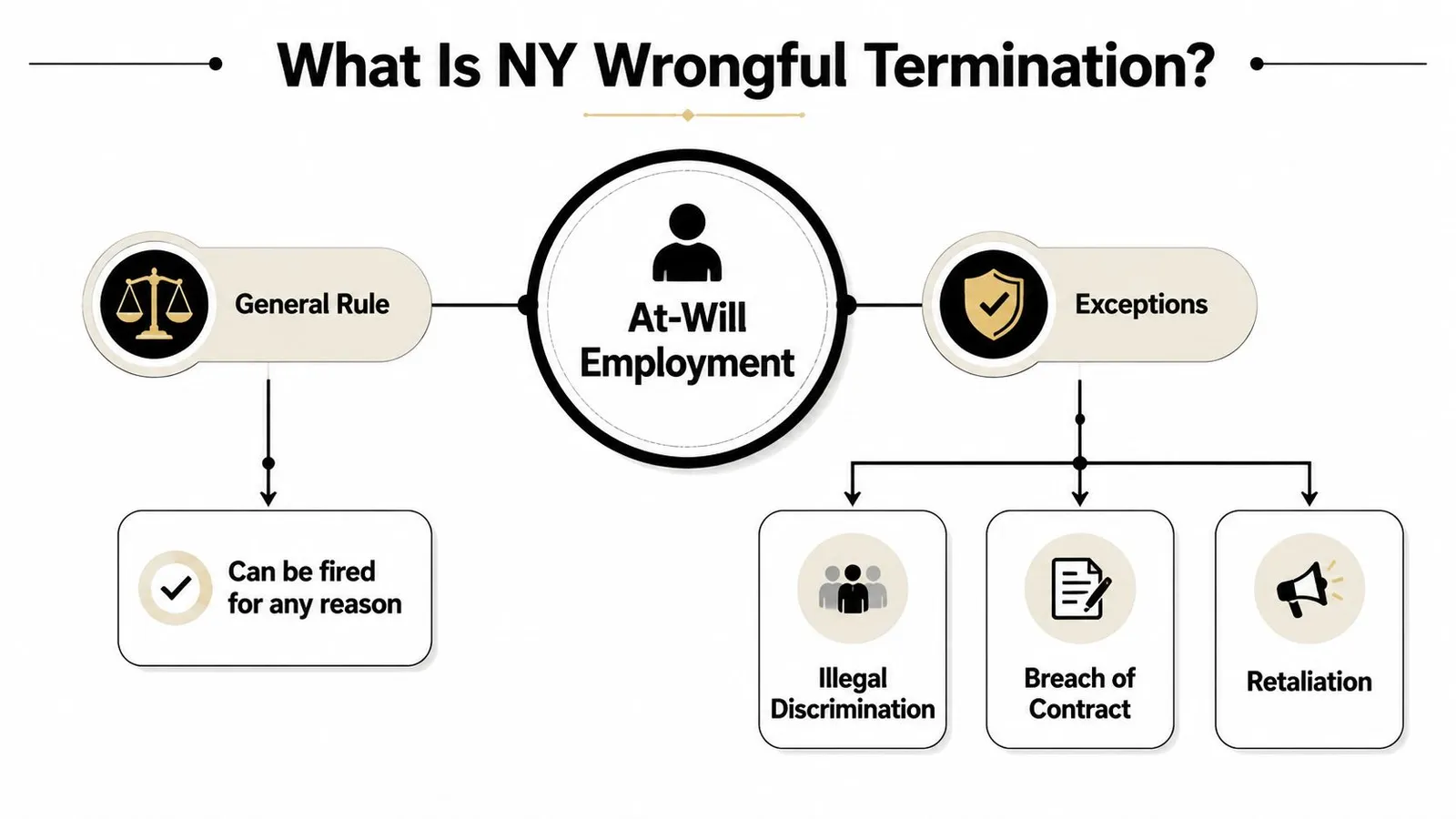
New York has long followed the at-will employment rule. An employer can generally end employment at any time, for any reason, or for no reason at all, provided the reason isn't illegal. The state's highest court reinforced this legal baseline in Murphy v. American Home Products in 1983, and later explanations of New York law continue to recognize that a typical at-will employee doesn't have a free-standing common-law claim just because a firing was unfair. See this overview of wrongful termination and for-cause termination in New York.
A restaurant owner may legally fire a server because the owner dislikes the server's attitude, misjudges a staffing decision, or changes the menu and eliminates a position. Those decisions may be harsh, careless, or economically foolish. They generally aren't wrongful termination unless the actual reason violates a statute, an enforceable contract, or another specific legal protection.
The legal question behind the firing
Ask two questions in order:
- What reason did the employer give?
- What protected activity, protected status, contract term, or statutory right may explain the decision?
The employer doesn't need a good reason under the default at-will rule. But it can't use discrimination or retaliation as the reason while hiding behind labels such as “restructuring,” “attendance,” or “performance.” A termination becomes legally actionable when the decision maps to a specific protection, not merely when the manager handled the situation badly.
That's why an employee who is fired after complaining about unpaid wages may have a stronger issue than an employee who is fired after a manager makes an arbitrary scheduling decision. The first situation may involve protected labor activity. The second may be unfair but lawful.
Practical rule: Build the claim around the legal protection that was violated, not around the employer's general unfairness.
An enforceable employment contract can change the analysis. A contract, union agreement, or other binding arrangement may limit termination to specified grounds. If you're trying to decide whether pursuing a case makes sense, a careful review of evaluating your settlement prospects can help frame the practical questions, but it can't replace advice based on your documents and timeline.
Protected Classes and Statutory Rights
The exceptions to at-will employment generally fall into two broad groups. The first concerns who you are, such as race, sex, age, disability, or religion. The second concerns what you did, such as reporting misconduct, requesting protected leave, or exercising rights under New York's Labor Law.
Discrimination claims focus on protected characteristics
An employer can make a legitimate staffing decision, but it can't fire someone because of a protected characteristic. Depending on the law that applies, relevant characteristics can include race, color, national origin, sex, gender identity, sexual orientation, religion, disability, pregnancy-related conditions, age, marital or family status, and military status. New York City workers may also have protections under the city's broader human rights framework.
Consider a restaurant that removes an older manager during a supposed “reorganization,” then assigns the same responsibilities to a younger employee. The label alone doesn't resolve the issue. The important evidence may include who was retained, how the manager was treated before the decision, what comments supervisors made, and whether the employer's explanation changed.
A disability-related termination can raise similar questions. If a worker requests a reasonable accommodation and is then dismissed instead of being engaged in a genuine workplace discussion, the timing and communications may matter. Pregnancy, childbirth, and related medical conditions can also be relevant when the termination follows an announcement, leave request, or accommodation request.
Retaliation protects the exercise of rights
Retaliation is different from discrimination. The employer may not be reacting to your identity. It may be reacting to a complaint or legally protected request.
Examples can include:
- Wage complaints: A cook reports that the restaurant is violating wage or overtime rules.
- Whistleblowing: A worker reports illegal activity or conduct presenting a substantial and specific danger to public health or safety.
- Labor Law rights: An employee exercises rights protected by New York's Labor Law.
- Leave or accommodation requests: A worker requests family or medical leave, or asks for an accommodation.
- Workers' compensation activity: An employee files or pursues a workers' compensation claim.
- Discrimination complaints: An employee reports harassment or discriminatory treatment to a supervisor, HR, or an agency.
New York Labor Law protections prohibit adverse action when employees exercise covered rights, and Labor Law §740 authorizes a civil action for retaliatory conduct. The New York Department of Labor explains the retaliation framework in its guidance on retaliation protections. Whistleblower coverage is fact-sensitive, especially where the report involves illegal activity or a substantial and specific danger to public health or safety, as described in this overview of New York whistleblower retaliation claims.
For operators and managers, documentation matters because a lawful performance decision can look retaliatory when the record begins only after a complaint. Businesses reviewing employment law essentials for businesses should pay particular attention to consistent policies, complaint handling, and contemporaneous reasons for discipline.
Real-World Scenarios in the Workplace
A cook at a busy restaurant notices that time records don't match the hours employees work. After asking a supervisor about possible minimum wage or overtime violations, the cook is removed from the schedule and then fired. The termination might still have a legitimate explanation, but the timeline creates a question: was the stated reason genuine, or was the employer punishing the complaint?

The cook should preserve schedules, messages, time records, payroll information, and any written complaint. A personal timeline can also help. Record when the concern was raised, who received it, what changed afterward, and what reason the restaurant gave for ending employment. Employees who want to understand the payroll context may also find this guide to overtime tracking useful while organizing records.
A manager takes parental leave and returns to find that key responsibilities have been reassigned. Soon afterward, the employer demotes the manager and says the role has changed. That sequence doesn't automatically establish unlawful retaliation, but it raises practical questions about the leave request, the employer's prior treatment, and whether comparable managers were handled differently.
A server in their later career applies for a promotion and is passed over for a younger colleague with less experience. If the employer then terminates the server while describing the decision as a “fresh start,” the relevant issue is whether age influenced the choice. The server should compare qualifications, comments, promotion records, schedules, and the treatment of other employees.
A close sequence between protected activity and termination can support an inference of retaliation, but timing alone isn't the entire case. The employee still needs a protected activity, an adverse action, and evidence connecting the two.
Use the following video as a general visual introduction to the workplace issues that can arise around termination and employee rights:
What Are the Deadlines and Filing Procedures?
A strong claim can fail if the employee files in the wrong place or waits past the applicable deadline. New York wrongful termination cases don't have one universal filing period because the deadline depends on the legal theory and the forum.
For many federal discrimination or retaliation claims, the employee typically must file an administrative charge with the Equal Employment Opportunity Commission within 300 days of the last discriminatory or retaliatory act. The filing is important because federal claims generally require administrative exhaustion before a federal lawsuit can proceed.
New York state deadlines can be different. For incidents occurring on or after February 15, 2024, a complaint filed with the New York State Division of Human Rights can generally be brought within three years, following the state's 2024 change from the prior one-year period for most claims. Some city-level claims can also involve a three-year civil filing period. The New York State Division of Human Rights announced the change in its notice about the new statute of limitations for unlawful discrimination.
| Jurisdiction | Filing Agency | Deadline for Claim |
|---|---|---|
| Federal discrimination or retaliation claim | Equal Employment Opportunity Commission | Typically 300 days from the last discriminatory or retaliatory act |
| New York State discrimination claim for incidents on or after February 15, 2024 | New York State Division of Human Rights | Generally three years |
| Certain New York City claims | Applicable city process or civil court | Some claims can involve a three-year civil filing period |
A practical filing sequence
First, identify the legal theory. Was the termination tied to discrimination, retaliation, whistleblowing, a wage complaint, leave, a contract, or another statutory right? The answer determines which filing path deserves attention.
Next, calculate from the relevant event. For federal discrimination and retaliation claims, count from the last discriminatory or retaliatory act, not just from the date you began feeling uncomfortable. Preserve the termination letter, messages, complaint records, and calendar entries that establish the timeline.
Then, choose the forum carefully. Some claims require an agency charge before litigation. Others may proceed under state or city law through a different route. Filing one complaint doesn't automatically preserve every separate claim, so a lawyer should review overlapping federal, state, and city theories before you commit to a path.
Payroll records can also reveal issues that overlap with the termination dispute. Keep pay statements and understand the terminology used in records, including the meaning of a pay period, but don't assume a payroll issue alone proves wrongful termination.
New York enforcement activity shows why retaliation deserves prompt attention. EEOC data cited for New York recorded 3,690 charges in 2017, which represented 4.40% of all U.S. charges. Retaliation accounted for 1,711 of those charges, including 1,492 Title VII retaliation charges. Those figures are reported in this discussion of retaliation after an EEOC complaint in New York.
What Remedies and Damages Can You Recover?
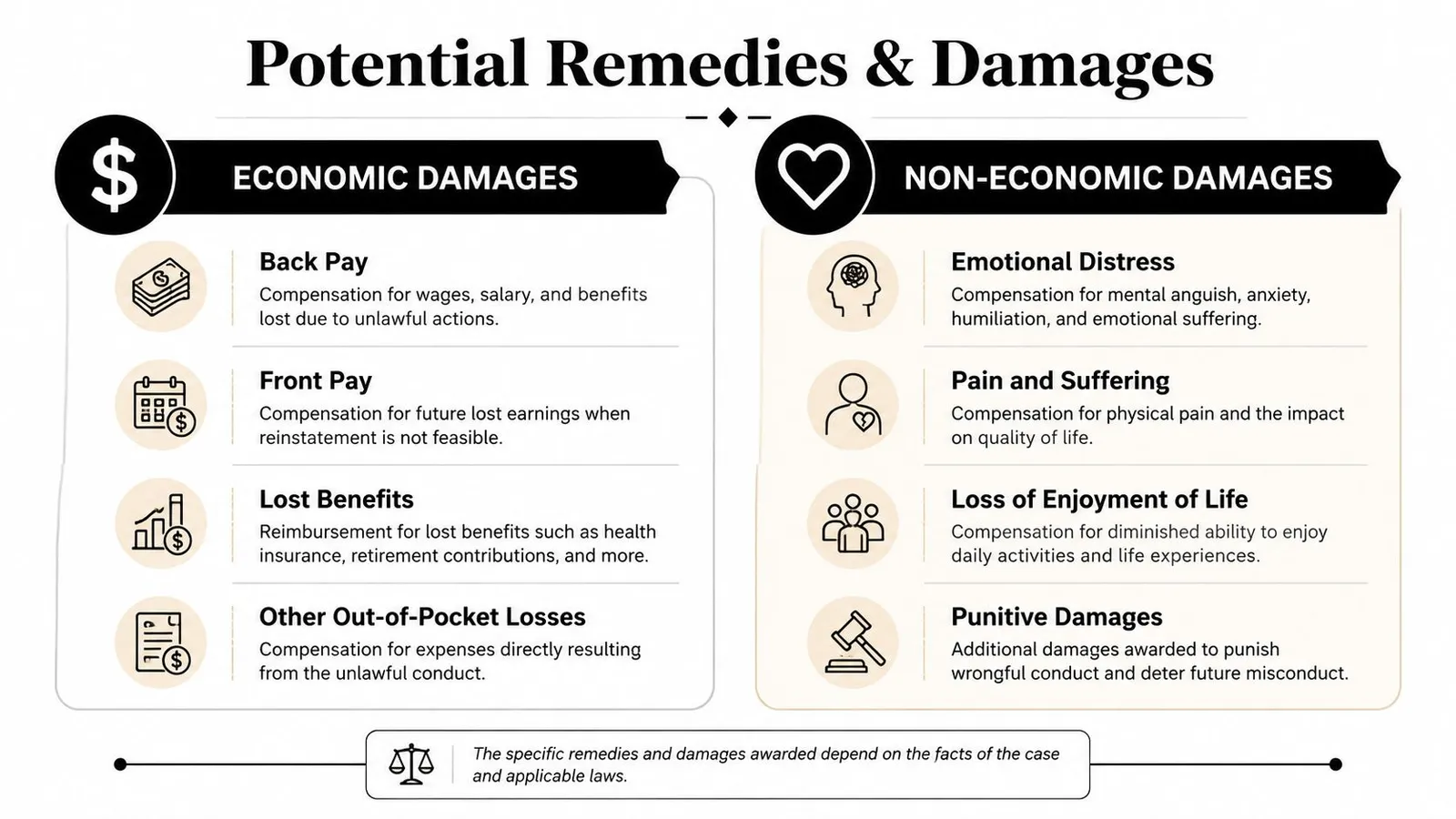
A successful claim can produce different forms of relief, and the remedy should match the harm. The most straightforward category is economic loss. Back pay may address wages and benefits lost after the termination. Front pay may address future earnings when returning to the former job isn't practical.
Reinstatement is another possible remedy. It restores the employee to the former position, although workplace relationships and trust may make that solution difficult in some cases. A settlement may instead focus on compensation and agreed employment terms.
The loss isn't always shown on a pay stub
A termination can also cause emotional harm, reputational stress, and disruption that aren't captured by a wage calculation. Depending on the applicable law and the evidence, emotional distress damages may be available.
Punitive damages are different. They aren't designed to replace lost wages. They may be considered where the employer's conduct was especially egregious and the governing law permits that form of relief. The employee's evidence, the employer's conduct, and the specific statute all influence the analysis.
Potential remedies can include:
- Back pay: Lost wages and benefits tied to the termination.
- Front pay: Future earnings when reinstatement isn't workable.
- Reinstatement: Return to the former position in an appropriate case.
- Emotional distress damages: Compensation for documented non-economic harm where available.
- Punitive damages: A possible additional remedy for particularly serious misconduct under an applicable law.
A lawyer evaluating damages will usually examine earnings history, benefits, job-search efforts, mitigation issues, medical or counseling records where relevant, and the strength of the legal theory. A case with a clear violation and strong documents may justify serious settlement discussions, while an unfair but lawful firing generally doesn't create a damages claim.
What Should You Do After a Termination?
The first response should be organized, not impulsive. Write down what happened while the conversation is fresh, including who attended, the words used, the stated reason, and what documents you received.
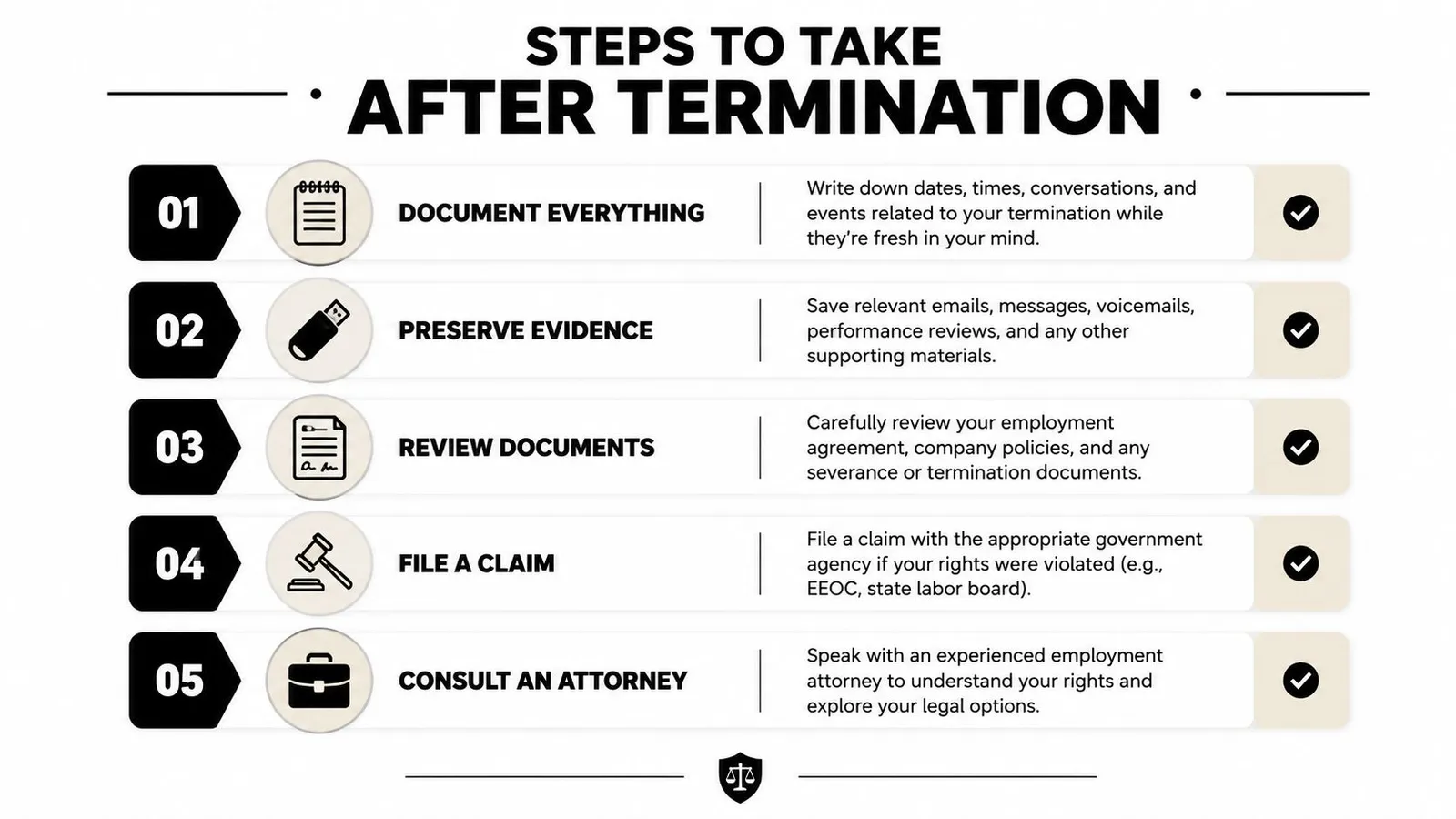
Use this short checklist:
- Document the timeline. Note complaints, leave requests, accommodation requests, discipline, schedule changes, and the termination.
- Preserve evidence lawfully. Keep emails, text messages, performance reviews, schedules, pay records, policies, and termination documents that you're entitled to retain. Don't access company systems after termination or take confidential information you're not allowed to possess.
- Review what you're asked to sign. Severance agreements and releases can affect your options. Don't sign under pressure before understanding the terms.
- Check final pay information. Review wages owed and benefit information, and keep the related records.
- Get advice promptly. A New York employment attorney can help identify the legal theory, filing forum, evidence gaps, and deadlines.
Restaurant employees and operators should also keep clear policies for scheduling, leave, discipline, complaints, and payroll. A practical review of employee policies for restaurants can help identify where inconsistent practices create confusion.
If you're unsure whether the firing was merely unfair or legally actionable, you don't need to solve that question alone. Bring your timeline and documents to a qualified employment attorney before filing, signing a release, or allowing a deadline to pass.
AnchOps helps restaurant operators organize schedules, time entries, labor policies, payroll-ready records, and employee communication in one practical system. Visit AnchOps to see how clearer labor operations can help managers document decisions consistently and run more predictable shifts.
Your back-of-house partner is ready
AnchOps handles scheduling, tip calculations, labor costs, and timecards — so you can focus on your restaurant, not your paperwork.