How to Build a Profitable Bar Drinks Menu Step by Step
Published on
By Tony Newcome — Founder of AnchOps · Owner, Pizza Harbour
This article was drafted with AI assistance and reviewed by Tony Newcome, a working restaurant operator.
To build a profitable bar drinks menu, define your bar concept and target guest, calculate the true pour cost of every drink, set pour-cost targets with menu engineering, and match the menu's design to your bar layout and throughput. Then train staff to sell it. Gross sales mean little until the menu controls cost, prep, and speed.
A profitable menu works as a live operating system. It influences what guests order, what the team pours, how much prep happens before service, which bottles occupy valuable storage, and how accurately the POS reports margin. The strongest menus don't merely look polished. They connect guest experience, ingredient cost, labor, throughput, and repeat ordering in one manageable system.
Table of Contents
- Why Your Bar Drinks Menu Runs the Whole Operation
- Treat the list as a control panel
- Define the Bar Concept and Target Guest First
- Let the concept make the hard decisions
- Audit Inventory and Calculate True Pour Cost
- Build a cost sheet that reflects service
- Find the silent margin leaks
- Set Pour Cost Targets and Apply Menu Engineering
- Sort every item by popularity and margin
- Match Menu Design to Bar Layout and Throughput
- Design around pace and occasion
- Make the menu faster to read
- Connect the Menu to Your POS and Labor Schedule
- Put labor beside the recipe
- Train Staff and Run a Controlled Roll-Out
- Give the team usable drink cards
- Use a soft launch to catch operational failures
Why Does Your Bar Drinks Menu Run the Whole Operation?
A drink list sets the pace of service. If it features six labor-heavy signatures, bartenders need more prep, more specialized training, more glassware, and more time per ticket. If it emphasizes highballs, batched serves, and familiar builds, the same station can move orders with less friction.
That choice reaches far beyond the bar top. Menu demand determines the size of the speed rail, the number of citrus containers in the garnish station, the ice capacity required during a rush, and the ingredients that must be reordered. It also shapes the POS report that tells you whether a drink sold well because it was profitable or because guests liked it despite an unhealthy pour cost.
Printed cocktail menus have been part of bar culture since at least the 1830s and 1840s in New York and Boston. A historical account cited by Imbibe's history of cocktail menu design describes a circa-1863 Washington, D.C. menu with 83 choices, an early example of drinks lists being used to signal breadth and differentiate service. The menu has never been just decoration. It has long helped direct ordering behavior and tell guests what kind of bar they're entering.
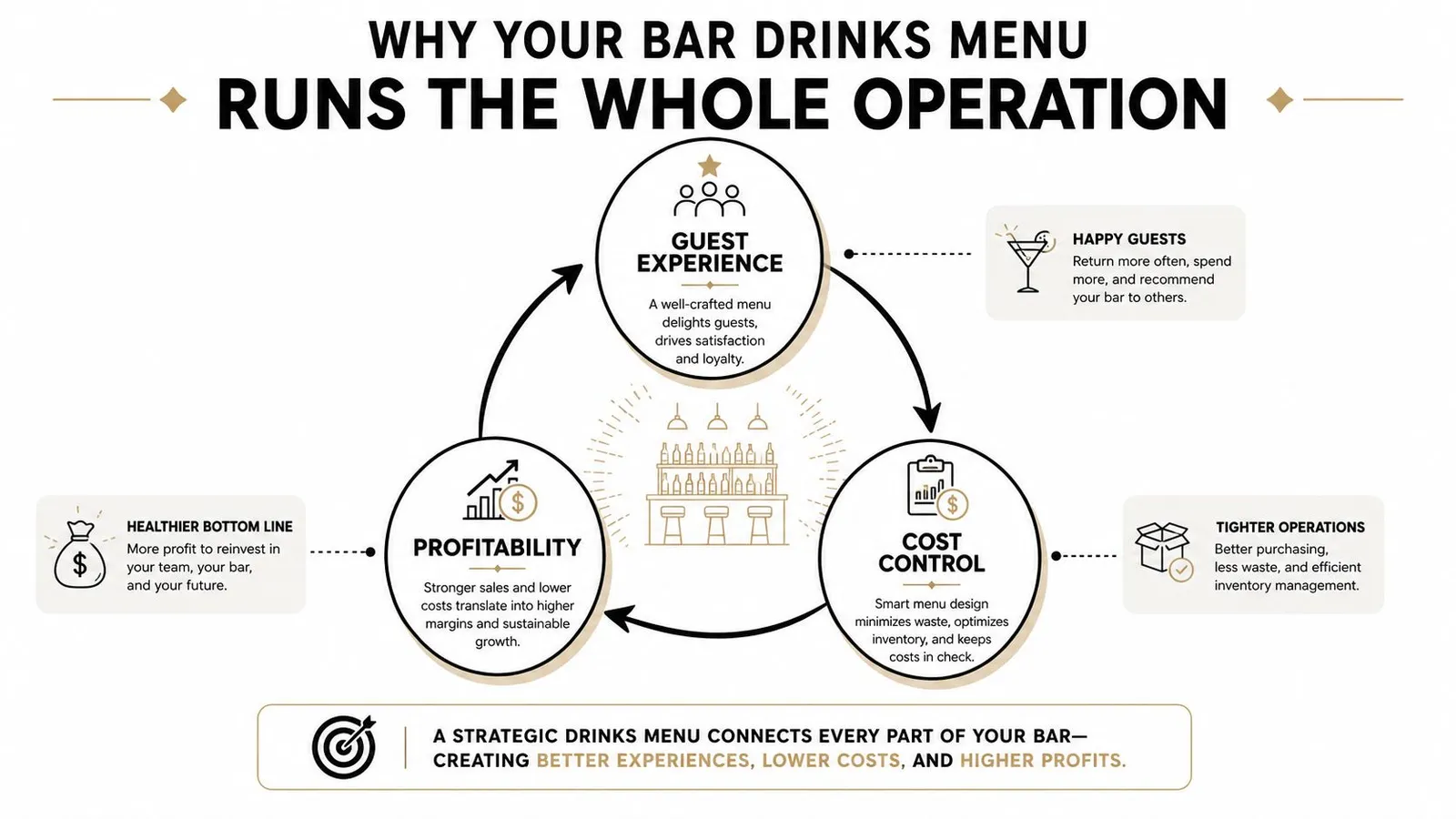
Treat the list as a control panel
A “cool” list can drive sales while damaging the operation. A drink with an elaborate garnish may photograph well but spoil in the reach-in, slow the well, and create inconsistent execution across shifts. A menu built around margin and throughput gives the team a clearer path from order to service.
The rebuild sequence is straightforward:
- Concept first: Decide who the bar serves and what promise the menu makes.
- Cost next: Measure every ingredient, garnish, batch, and waste point.
- Structure after that: Group drinks by guest need and production speed.
- Design with the station in mind: Make the printed or digital list support movement.
- Integrate operations: Connect recipes, POS buttons, labor planning, and tip workflows.
- Train and iterate: Review actual sales and execution instead of defending the original menu.
Define the Bar Concept and Target Guest First
A great cocktail is only useful when it fits the person ordering it, the occasion, and the room. Before writing a single drink, define the bar's concept, target guest, and service promise. Otherwise, the menu becomes a collection of recipes that may be individually sound but collectively impossible to operate.
Start with one practical guest profile. Note whether the typical customer is stopping in for a quick drink, settling into a long evening, meeting a hotel client, watching a game, or looking for an alcohol-free alternative. Then write one sentence that describes the promise, such as: “We serve fast, bright rum drinks for neighborhood gatherings,” or “We offer composed classics and thoughtful zero-proof drinks in a calm lobby setting.”
Let the concept make the hard decisions
A neighborhood rum-and-tonic bar might rely on highballs, fresh citrus, and shareable punches. That concept supports a compact spirit selection, quick builds, and glassware that can be staged in advance. A hotel lobby bar may lean toward classic stirred cocktails, polished presentation, and visible zero-proof choices because guests arrive with different expectations and occasions.
A late-night music venue needs a different system. Boozy, low-build two-ingredient drinks can protect speed when the bar is crowded and the team is serving guests who don't want to study a long list. The menu's identity then comes from spirit quality, naming, and a small number of signature variations rather than complex production.
The concept should also set boundaries around:
- Spirit selection: Choose bottles that support the promise instead of collecting every category.
- Glassware: Use shapes the station can stage, wash, and replace consistently.
- Garnishes: Favor ingredients that reinforce flavor and survive the expected sales pace.
- Price ceiling: Match perceived value to the occasion and the guest's willingness to spend.
- Service language: Give servers a simple explanation they can deliver without memorizing a lecture.
Seasonality can refine the promise without forcing a complete rewrite. Operators planning a cold-weather offer can use this resource on warm drinks for NZ venues to think through hot serves, service considerations, and the operational demands of seasonal beverage changes.
Practical rule: If a drink doesn't reinforce the bar's promise or fit its station, it doesn't belong simply because the recipe is fashionable.
How Do You Calculate True Pour Cost?
Start with the physical shelves, not the recipe binder. Count open and unopened bottles, compare depletion against POS sales, and investigate gaps that may come from overpouring, comping, breakage, or unrecorded staff drinks. The reconciliation often reveals that the menu's theoretical margin and the bar's actual margin are different problems.
For each drink, calculate the liquid cost from the measured pour. A bottle's cost becomes useful only after you divide it by the number of measured yields it provides. Then add the cost of citrus, syrups, bitters, mixers, garnish, and any batch components. Ice and dilution deserve a line in the worksheet too, even when their unit cost is small, because they represent production inputs and can expose waste or inconsistent builds.
The standard menu-engineering workflow for bars uses POS item-sales data alongside full recipe costing. Every item needs a units-sold count and a current gross-profit calculation that includes ingredients, garnishes, and mixers.
Build a cost sheet that reflects service
A whiskey sour may carry a familiar spirit pour, citrus, syrup, and garnish. Its cost isn't complete until the recipe accounts for every measured component and the team follows the same pour method on every shift. A batched paloma may use a higher-cost spirit, yet reduce individual build time and make citrus, dilution, and portioning more consistent.
The comparison below is intentionally operational. Insert your current supplier costs and measured yields rather than relying on illustrative assumptions.
| Component | Whiskey Sour | Paloma (Batched) |
|---|---|---|
| Base spirit | Measured whiskey pour multiplied by cost per yield | Measured tequila pour multiplied by cost per yield |
| Fresh component | Citrus portion cost | Citrus or clarified juice portion cost |
| Sweetener | Syrup portion cost | Agave or other sweetener portion cost |
| Bitters and seasoning | Bitters and garnish cost | Salt, bitters, or seasoning cost |
| Mixer | Usually limited or none | Grapefruit soda or other mixer cost |
| Ice and dilution | Shaking ice and measured dilution allowance | Batch dilution plus service ice |
| Waste allowance | Spoilage, overpouring, and failed builds | Batch loss, holding waste, and portion variance |
| Labor impact | Individual shake and garnish | Batch prep followed by rapid service pour |
Find the silent margin leaks
Free-pouring creates variance that a recipe sheet can't correct by itself. Orphan bottles tie up cash and often lead to slow-moving drinks with fragile garnishes. Build drinks can look inexpensive on paper while taking longer than their selling price justifies. A garnish that spoils before it sells is a cost, not a decorative detail.
Record both theoretical pour cost from the recipe and actual pour cost from inventory depletion. If the two diverge, check the measured pour, POS modifier behavior, comp entry, batch yield, and waste log before changing the menu price.
Set Pour Cost Targets and Apply Menu Engineering
A single pour-cost rule rarely fits every category. A vodka soda, a classic stirred cocktail, and a premium signature drink have different velocity, labor, and guest-value profiles. Set a target by category, then judge the entire menu against a weighted result rather than forcing every item into one identical box.
Hospitality guidance commonly frames alcoholic drink pour cost as ingredient cost divided by selling price excluding VAT, multiplied by 100. One practical guide recommends 18% to 25% for most alcoholic drinks and stresses that cocktails must include alcohol, mixers, and garnish in the calculation. Use those figures as a working reference, then adjust for your concept, local pricing, labor model, and measured execution.
Sort every item by popularity and margin
The four-quadrant model is useful because it turns a sales report into an action list:
- Star: High popularity and high contribution margin. Protect the house Old Fashioned, keep its recipe stable, and make it easy to find.
- Plowhorse: High popularity but thin margin. A Margarita may belong here. Rework the recipe, change the portion, or reprice without damaging its appeal.
- Puzzle: Low popularity but attractive margin. An over-built smoked cocktail may need better placement, clearer language, or retraining.
- Dog: Low popularity and weak margin. A dated lemon drop should usually be replaced rather than defended.
Pricing starts with the measured cost, not the desired menu position. If a drink's full ingredient cost is C and the target pour cost is T, the price before applicable tax is C divided by T. A drink costing 3.00 in ingredients at a target of 20% would require a price of 15.00 before tax. That example demonstrates the method without pretending the same price fits every market.
For broader restaurant pricing decisions, operators can use this restaurant pricing resource alongside the drink-level worksheet.
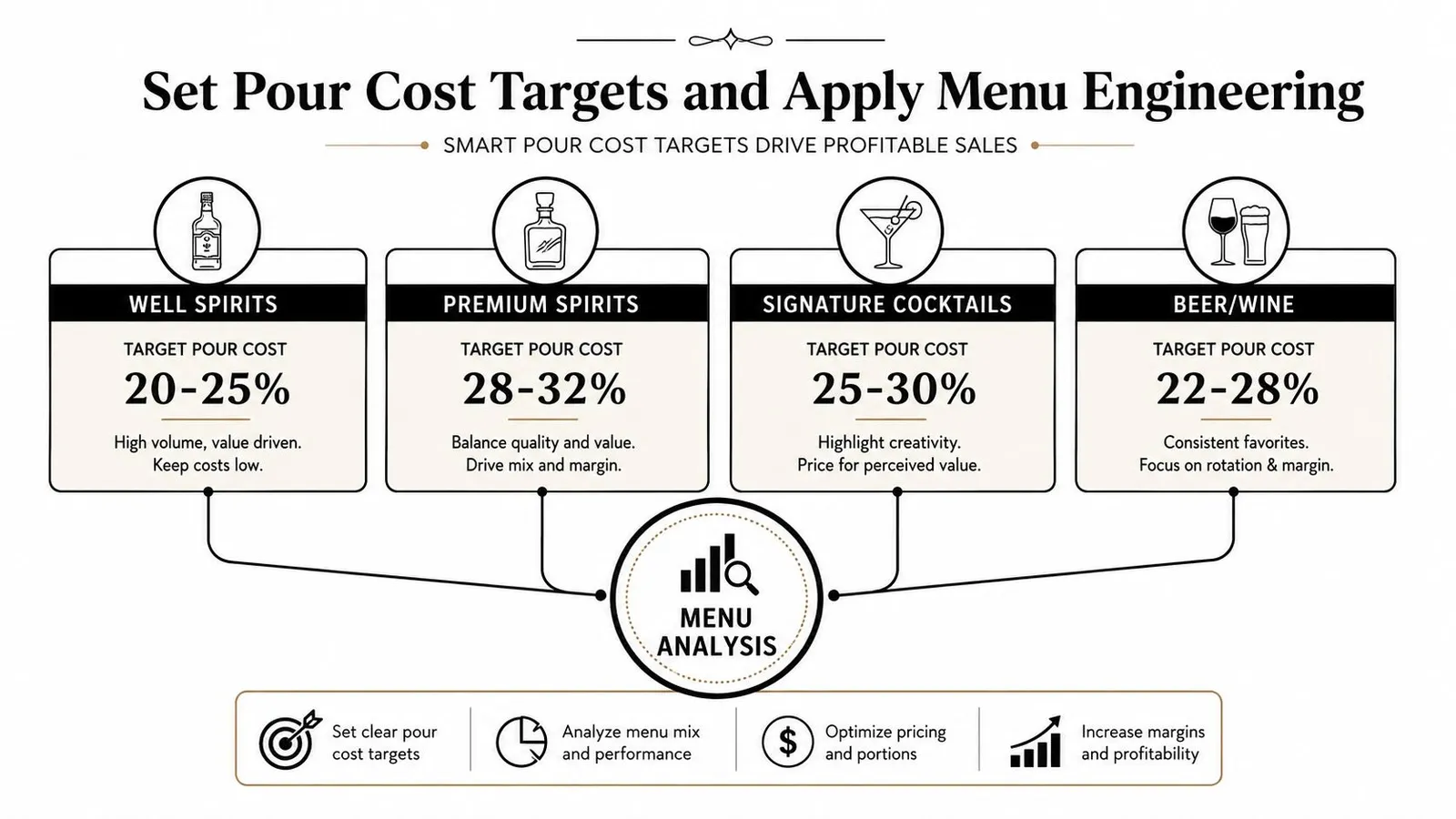
A matrix only works when POS buttons are clean. If modifiers, comps, voids, and size variants don't map to the correct recipes, popularity is distorted and margin classifications become unreliable.
Match Menu Design to Bar Layout and Throughput
The menu has to match the physical bar. A list that looks balanced on a screen may create a bottleneck at the well, send every bartender to the same garnish tray, or demand glassware the dishwasher can't turn fast enough. Design the list against the actual station map, not against the order of bottles on the back bar.
A high-volume sports bar should make speed obvious. Batched cocktails, beer, wine, highballs, and two-ingredient builds can carry the core of the list. The team can stage cold glassware, keep the speed rail disciplined, and place batch containers where the bartender can pour without crossing the station.
A cocktail lounge has more room for longer builds if staffing, prep, and ticket expectations support them. It can justify a stirred drink with a deliberate presentation, but it still needs a clear distinction between drinks that require attention and drinks that can leave the well quickly. Complexity becomes a choice, not a default.
A hotel bar often needs both systems. Batched classics support busy arrival periods, while a tight signature group gives the room personality. The menu should help a guest choose without requiring a bartender to narrate every ingredient.
Design around pace and occasion
Guests don't order according to the back bar's inventory map. They think in terms of what they want now. A useful structure might include:
- Beer and wine: Familiar, low-friction choices.
- Low-ABV and zero-proof: Visible options for moderation and guests avoiding alcohol.
- Classic cocktails: Recognizable anchors that reduce decision time.
- Highballs and batched drinks: Fast serves grouped together for easy execution.
- Signature cocktails: Distinctive drinks that express the concept without overwhelming the station.
Current industry coverage describes demand for low- and no-alcohol drinks, creative spritzes, flights, nostalgic ’90s martinis, and labor-saving formats such as counter service and pre-batched drinks in its discussion of bar trends for 2025. The useful operational question isn't whether every trend belongs on the list. It's whether the format can be produced consistently through the busiest daypart.
A smoked Old Fashioned is a good test. If the smoke presentation takes four minutes, compare that labor and station congestion with the contribution it produces. If guests don't pay for the experience or order it often enough to justify the delay, the drink is theater at the expense of throughput.
Pre-batching a Negroni can produce the opposite trade-off. A measured batch may reduce repeated bottle handling, make dilution consistent, and shorten service. It also introduces holding, labeling, yield, and spoilage controls. The batch earns its place when the team can forecast demand and protect the recipe from portion drift.
| Category | Target Pour Cost | Menu Placement | Description Style |
|---|---|---|---|
| Beer and wine | Set from measured product cost and format economics | Near the top for quick decisions | Producer, style, and serving format |
| Highballs and batched drinks | Set for velocity and controlled portions | Prominent speed-focused group | Base, mixer, and flavor cue |
| Classic cocktails | Use a category target based on measured recipe cost | Familiar section with recognizable names | Classic name plus key variation |
| Low-ABV drinks | Cost against the full recipe and intended occasion | Visible beside other cocktails | Strength cue and refreshing flavor |
| Zero-proof drinks | Price against equivalent value and labor | Dedicated, clearly labeled section | Flavor, texture, and spirit-free signal |
| Signature cocktails | Account for ingredients, garnish, prep, and labor | Separate feature section | Two-line explanation with a clear hook |
Make the menu faster to read
Names should help servers and guests act. “Smoke & Velvet” may sound atmospheric, but it tells nobody whether the drink is smoky, sour, strong, sweet, or spirit-forward. “Mezcal Sour with Grapefruit and Black Pepper” still sounds distinctive while giving the guest a useful expectation.
Use a two-line format:
Mezcal Sour with Grapefruit and Black Pepper
Mezcal, grapefruit, citrus, and black pepper, bright and smoky with a dry finish.
The first line identifies the drink. The second anchors the flavor, highlights a key ingredient, and signals the experience. Avoid the word “artisanal,” which adds little operational or sensory information. Say what the guest will taste and how the drink behaves.
Zero-proof options shouldn't be hidden below a long list of alcoholic cocktails. Give them their own visible section and price them at 80% to 90% of an equivalent cocktail, as a positioning choice that keeps the guest included without pretending the production economics are identical. The section should sell flavor and occasion, not apologize for the absence of alcohol.
Connect the Menu to Your POS and Labor Schedule
Ingredient margin is only half the equation. A 12-ingredient house cocktail built to order in 90 seconds consumes more bartender capacity than a four-ingredient pre-batched drink served in 30 seconds, even if both show the same theoretical pour cost. If the menu doesn't record build complexity, the schedule treats those drinks as equal when the shift doesn't.
Tie every menu item to a POS button and a recipe that debits the measured spirit, juice, syrup, mixer, and garnish. Weekly reports can then compare theoretical depletion with the physical count. Build modifiers carefully. “Make it spicy,” a spirit substitution, or a zero-proof conversion should change the recipe or trigger a controlled exception rather than disappear into an untracked note.
Put labor beside the recipe
Tag every drink with:
- Build style: Built, shaken, stirred, blended, or poured from batch.
- Build time: Use the bar's measured service time, not a guess.
- Skill level: Identify whether any trained bartender can execute it or whether it needs a specialist.
- Station demand: Note unusual glassware, garnish, smoke, blender, or ice requirements.
- Sales pattern: Compare the item's demand with the daypart and scheduled coverage.
A Friday sales mix that shifts toward sours may require a bartender comfortable with shaking, citrus management, and foam consistency. A low-volume hotel breakfast period may need a different labor plan from a late-night cocktail surge. Sales forecasting can help operators connect expected demand to staffing decisions, and this restaurant sales forecasting guide provides a useful framework for making that connection.
| Category | Build Style | Avg Build Time (sec) | POS Recipe Tie-In | Ideal Bartender Skill |
|---|---|---|---|---|
| Highball | Built over ice | Measured by the bar | Spirit, mixer, ice, garnish | Core service skills |
| Classic sour | Shaken and strained | Measured by the bar | Spirit, citrus, sweetener, garnish | Confident shaker |
| Batched Negroni | Portion and stir or pour | Measured by the bar | Batch yield and serving portion | Batch control |
| Signature smoke drink | Multi-stage presentation | Measured by the bar | Full recipe plus service modifier | Advanced execution |
| Zero-proof spritz | Built or batched | Measured by the bar | Spirit-free base, mixer, garnish | Core service skills |
Run a weekly POS-versus-actual variance review. A drink drifting more than two points above its target pour cost should trigger an investigation into measured pours, waste, recipe changes, and pricing. The fix belongs in the next menu revision, not in a spreadsheet that nobody revisits.
How Do You Roll Out a New Drinks Menu Without Chaos?
A new menu isn't a printer swap. It's a product launch that changes the team's muscle memory, guest conversations, prep list, and service rhythm.
A manager-led tasting should begin with the recipe sheets, but it can't end there. Have every bartender build each drink twice without looking at the finished example, time the pour, taste the result, and compare the measured ingredients with the costing sheet. The exercise exposes small problems early, such as a garnish that requires an awkward reach or a drink name that staff can't remember.
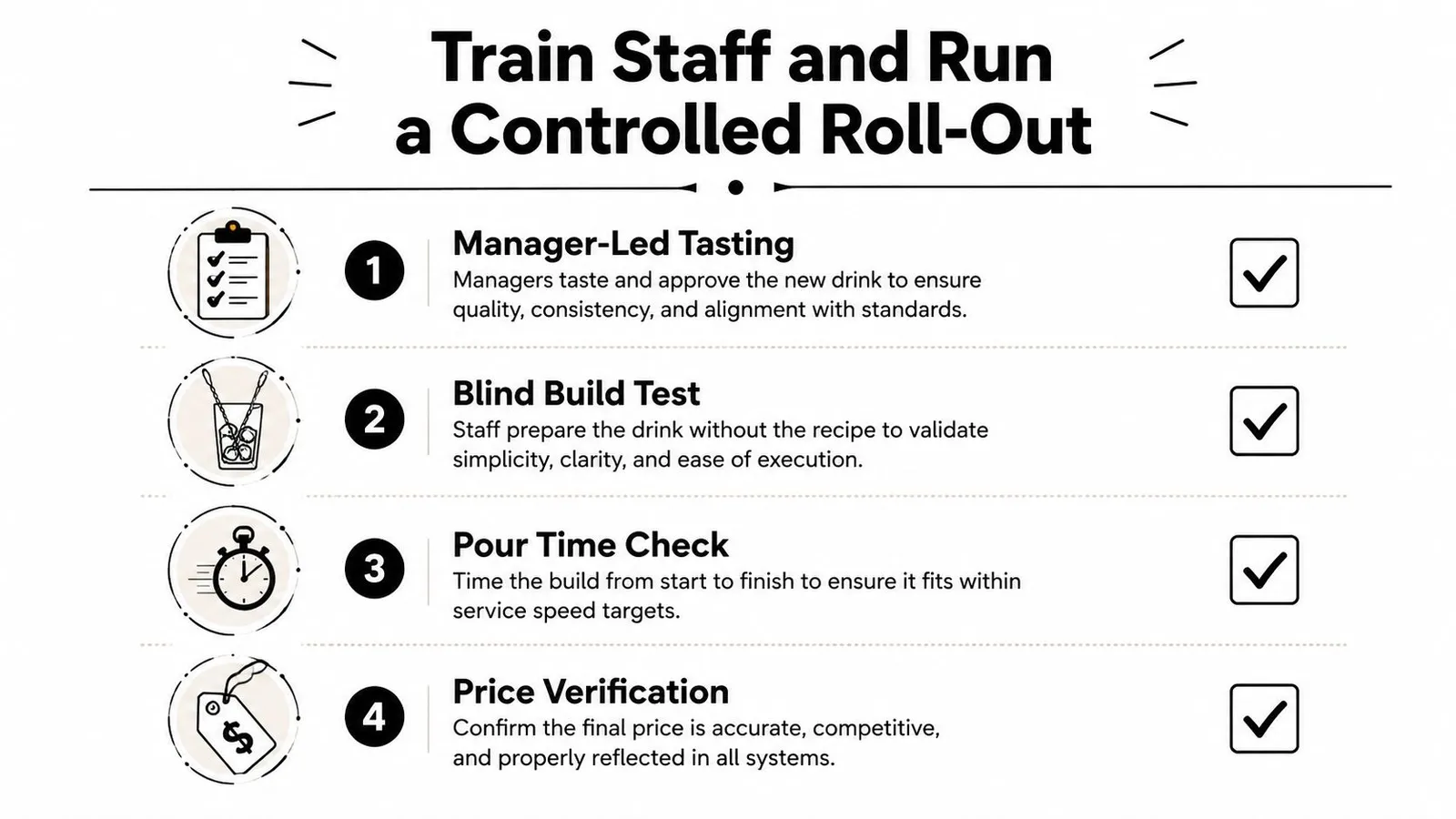
Give the team usable drink cards
Each one-page card should include:
- Drink name: Use the exact POS name.
- Two-sentence story: Explain flavor and occasion in language a server can repeat.
- Key ingredients: Highlight the components guests are most likely to ask about.
- Build method: State the glass, ice, garnish, and batch instruction.
- One upsell prompt: Pair the drink with a specific food item or offer a measured mezcal float when appropriate.
- Quality check: Define what an acceptable finished drink looks and tastes like.
A useful server line is direct: “If you like bright, smoky drinks, the Mezcal Sour has grapefruit and black pepper. It's a good match for the grilled dishes.” The prompt should guide a choice, not force a premium sale that doesn't fit the guest.
Managers building a repeatable program can use a step-by-step training curriculum design resource to organize learning objectives, practice, checks, and follow-up. The principle matters more than the template. Staff need repeated, observable practice tied to the actual service standard.
Use a soft launch to catch operational failures
Run the new menu beside the old one for four to seven nights. Track:
- 86 frequency: Which ingredients or drinks become unavailable.
- Build-time variance: Which recipes take longer than the standard.
- Recipe accuracy: Where measured pours and modifiers drift.
- Guest comments: What people ask, reject, or request again.
- Attach rate: Whether drinks connect with the intended food or occasion.
- Repeat-visit feedback: Whether regulars notice and respond to the changes.
Move to the full menu once error rates fall below 5%. During pre-shift huddles, rehearse one upsell line and one correction point rather than reviewing every recipe every day.
The review cadence should be fixed. Managers can check the mix report, pour-cost variance, and ticket time weekly, then examine the Star, Plowhorse, Puzzle, and Dog classifications monthly using clean POS data. A Puzzle under 5% sales share for three straight weeks should be reformulated, repositioned, or removed from its current placement. A Plowhorse above its target pour cost needs a recipe or price decision. A Dog should be replaced.
Regulars need a controlled transition. Pull no more than two drinks per menu cycle, rotate replacements instead of deleting every familiar favorite, and keep outgoing and incoming drinks together for two weeks when possible. Mention the change on the receipt backer and during greetings so loyal guests hear the reason before they discover a missing order. Use the staff scheduling workflow to align training coverage, soft-launch staffing, and the dayparts where the new builds will receive the most pressure.
AnchOps helps restaurant operators connect sales history, labor targets, schedules, time entries, payments, and tip workflows so the menu's labor impact is visible before and during service. Visit AnchOps to reduce manual scheduling and tip administration, surface labor drift in real time, and run more predictable bar shifts.
Your back-of-house partner is ready
AnchOps handles scheduling, tip calculations, labor costs, and timecards — so you can focus on your restaurant, not your paperwork.