Sales Forecasting to Control Restaurant Labor Costs
Published on
By Tony Newcome — Founder of AnchOps · Owner, Pizza Harbour
This article was drafted with AI assistance and reviewed by Tony Newcome, a working restaurant operator.
Restaurant sales forecasting means projecting sales by day and daypart from your POS history, then staffing, prepping, and purchasing to that number instead of a guess. Pick a method matched to your data, adjust for events, and connect the forecast to your labor tools so schedules track demand. Staffing for the wrong night — either direction — is a forecasting problem.
Most restaurant operators don't have a sales problem in moments like this. They have a forecasting problem.
That's why sales forecasting matters in restaurants. Not as a finance exercise. Not as a spreadsheet someone updates once a month. It matters because the forecast drives staffing, prep, purchasing, and the calls you make while the shift is still salvageable. If your forecast is wrong, everything downstream gets harder.
The operators who get this right don't treat forecasting as a weekly ritual. They use it to run tighter shifts, calmer kitchens, and more predictable labor.
Table of Contents
- The End of Guesswork in Restaurant Staffing
- The real cost of guessing
- Calm shifts start with better forecasts
- Why Sales Forecasting Is Your Most Powerful Profit Tool
- Forecasting protects profit where restaurants feel it fastest
- Why labor is where forecasting earns its keep
- Common Forecasting Methods Explained for Restaurants
- The methods that actually fit restaurant operations
- Choosing the right method for the daypart
- A Step-by-Step Guide to Building Your First Forecast
- Start with clean POS history
- Build the first version fast
- Tie the forecast to labor, not just revenue
- Use judgment, but document it
- Go Live: Connecting Forecasts to POS and Labor Tools
- The shift from planning to live control
- What live labor control looks like in practice
- Common Forecasting Pitfalls and How to Avoid Them
- Bad inputs create bad schedules
- Static forecasts fail during live service
- Frequently Asked Questions About Restaurant Forecasting
- How often should a restaurant update its sales forecast
- What's a good first forecasting method for a small restaurant
- Can you do effective sales forecasting without expensive software
- When should a restaurant move beyond spreadsheets
- Should managers still use judgment if they have a forecast
The End of Guesswork in Restaurant Staffing
A lot of managers still build schedules from memory. They remember that last Thursday felt busy, that payday weekends are stronger, and that the first warm night of spring usually wakes the patio back up. That kind of instinct matters, but instinct alone breaks down fast when sales patterns shift.
I've seen the same two mistakes over and over. A manager understaffs because last week's Tuesday lunch was soft. Then a school event, office lunch crowd, or local promotion changes the volume and the whole shift turns reactive. Or they overschedule “just to be safe,” and the team spends half the night standing around while labor creeps up.
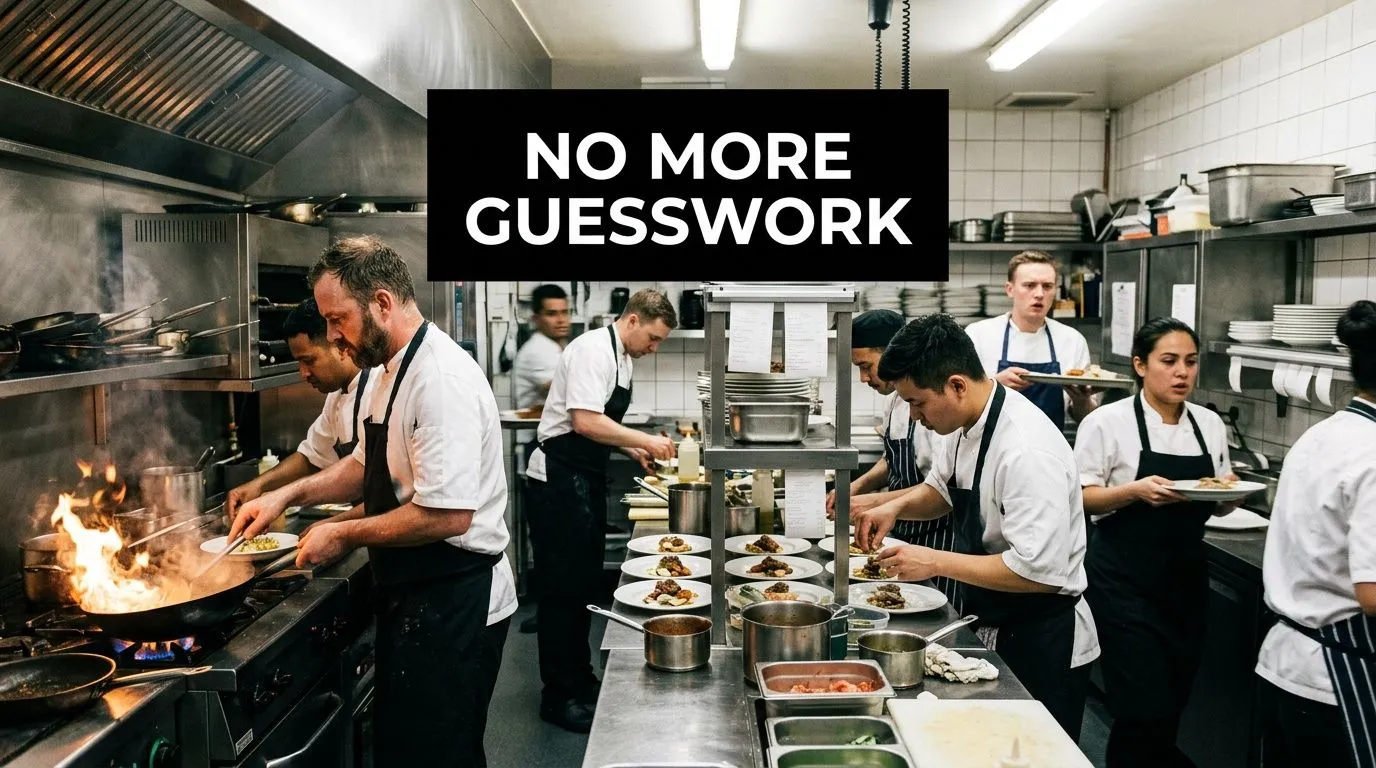
Sales forecasting fixes that by replacing gut feel with a repeatable estimate of what the shift is likely to produce. In restaurant terms, that means expected covers, order counts, ticket averages, and hourly sales pace. Once you know that, staffing gets more rational. Prep gets tighter. Managers stop making panicked calls an hour before service.
The real cost of guessing
Guesswork doesn't just create stress. It creates operational drag.
- Overstaffed shifts: You pay for coverage you didn't need, and the team feels the drag of a slow floor.
- Understaffed shifts: Tickets slow down, guest experience slips, and managers burn time patching holes instead of running the shift.
- Bad handoffs: Prep, line setup, and breaks all get harder when the expected sales volume is wrong.
Good sales forecasting doesn't eliminate surprises. It narrows the range of surprises you have to manage.
The point isn't to predict the future perfectly. The point is to make better staffing decisions before service starts, then stay close enough to the actual pace that you can adjust when reality changes.
Calm shifts start with better forecasts
A useful forecast should answer one practical question first: What should this shift look like if sales land where we expect?
From there, staffing becomes a decision instead of a gamble. You know when to schedule an extra closer, when to hold someone on call, when to cut early, and when not to. That's what makes sales forecasting worth your attention. It turns labor control from cleanup into planning.
Why Is Sales Forecasting Your Most Powerful Profit Tool?
Friday at 4:30 p.m. is when weak forecasting shows up. The dining room is about to turn, reservations are stacking up, takeout starts climbing, and one bad staffing call can wipe out the margin on the whole shift.
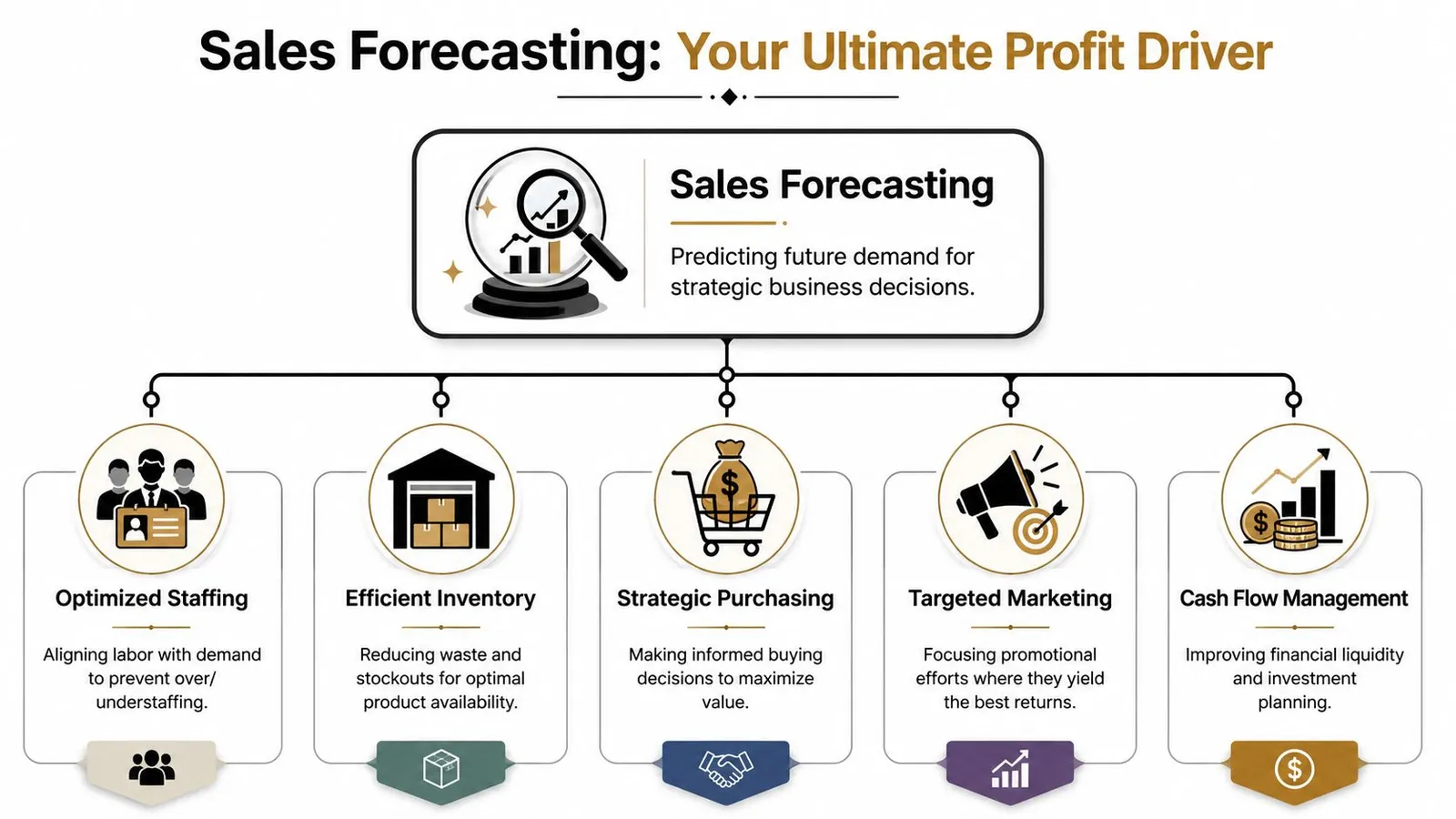
That is why sales forecasting matters so much in a restaurant. It gives operators a working plan for labor before service starts, then a standard to manage against once the shift is live.
Forecasting protects profit where restaurants feel it fastest
Restaurants do not lose money only through big mistakes. They lose it through small misses repeated every day. One extra server on a slow lunch. One missing line cook on a packed patio night. One manager who schedules to habit instead of expected sales.
Labor is usually the first place those misses hit. If you want a clearer view of how that pressure builds across a week, it helps to understand the drivers behind restaurant labor cost. Forecasting gives that cost structure context. Instead of asking whether payroll feels high, you can ask whether labor matched the sales opportunity in front of the team.
That shift in thinking matters. Revenue forecasts are useful, but in a restaurant, their biggest value is operational. They help managers decide coverage by hour, set prep levels with more discipline, and protect margin while there is still time to act.
Why labor is where forecasting earns its keep
Inventory can often be corrected later. Labor usually cannot. Once the shift starts, every staffing decision is either helping service or dragging profit.
A strong forecast helps answer questions that matter on the floor:
- Where will sales concentrate by hour?
- Which dayparts can run lean without hurting service?
- When does the kitchen need depth, not just coverage?
- At what sales pace should a manager hold, cut, or call in support?
Practical rule: If the forecast does not change staffing decisions before and during service, it is just a report.
I have seen plenty of operators build forecasts that looked good in a meeting and did nothing for the person running the shift. That is the wrong standard. A useful forecast should help a manager decide whether to keep the patio closer, stagger breaks, delay a cut, or bring someone in before the board gets buried.
The profit benefit comes from that live control. Pre-shift staffing plans matter, but the stronger system is one that keeps managers close to forecast during service so they can respond to pace changes before labor gets away from them. That is what turns sales forecasting from a finance exercise into an operating tool.
Which Forecasting Methods Work for Restaurants?
Most forecasting methods sound more technical than they are. In practice, you're choosing how much history to use, how much recent trend to respect, and whether outside factors matter enough to include.
The methods that actually fit restaurant operations
Here are the methods restaurant teams use most often, whether they call them by formal names or not.
| Method | Best For | Data Needed | Complexity |
|---|---|---|---|
| Historical averaging | Stable dayparts with repeatable patterns | Past sales by day, week, or period | Low |
| Moving averages | Short-term trend changes | Recent periods of sales history | Low |
| Time-series forecasting | Seasonal patterns and recurring cycles | Time-based sales data over consistent periods | Medium |
| Regression models | Volatile environments affected by outside variables | Sales data plus drivers like promotions, events, or weather | Higher |
Historical averaging is the simplest place to start. If your Tuesday lunch business is fairly stable, this method gives you a baseline from prior comparable periods. It's useful for concepts with repeat traffic and predictable sales rhythm.
Moving averages help when recent performance matters more than older history. If the last few weeks have shifted because school is back in session or nearby office traffic has changed, a moving average gives more weight to what's happening now.
Time-series forecasting goes a step further. It looks at data over time to spot seasonality, trend, and cycles. This is a strong fit for restaurants because daypart and weekday patterns often repeat. The verified guidance notes that time-series approaches are reliable for shorter-term projections where past patterns are likely to persist, especially when paired with methods like moving averages or exponential smoothing.
Choosing the right method for the daypart
Regression is where forecasting gets more realistic for restaurants. Basic history gives you a baseline, but restaurants don't operate in a vacuum. Promotions, local events, and weather shift volume. That's why Forecast Pro's discussion of statistical forecasting models notes that advanced dynamic regression models can outperform basic historical methods by incorporating variables like promotions, local events, and weather.
That matters because a Friday with a concert nearby is not the same as an ordinary Friday. A rainy patio night is not the same as a dry one. A forecast that ignores those conditions can still look disciplined on paper and be wrong where it counts.
A practical way to choose:
- Use historical averaging when traffic is steady and surprises are limited.
- Use moving averages when the recent trend is changing faster than older history reflects.
- Use time-series models when seasonality is obvious and repeatable.
- Use regression when outside drivers regularly move sales up or down.
The best method isn't the fanciest one. It's the one your team can maintain and trust.
One more method matters for some operators: pipeline or stage-based forecasting. In traditional sales teams, that means weighting likely deals by stage. In restaurant operations, the parallel is assigning confidence to forecast scenarios such as confirmed catering orders, booked private events, or known high-volume periods. It can be useful, but only if the underlying inputs are disciplined.
Bad method choice is common. So is overcomplicating the problem. A neighborhood cafe doesn't need a research-grade model to forecast breakfast. It does need a method that reflects actual demand patterns and gets reviewed often enough to stay relevant.
A Step-by-Step Guide to Building Your First Forecast
Friday lunch is on the books for six servers. By 11:30, the dining room is half full, online orders are light, and labor is already running hot. That problem usually starts the day before, when the forecast is built on a rough guess instead of a clean view of demand.
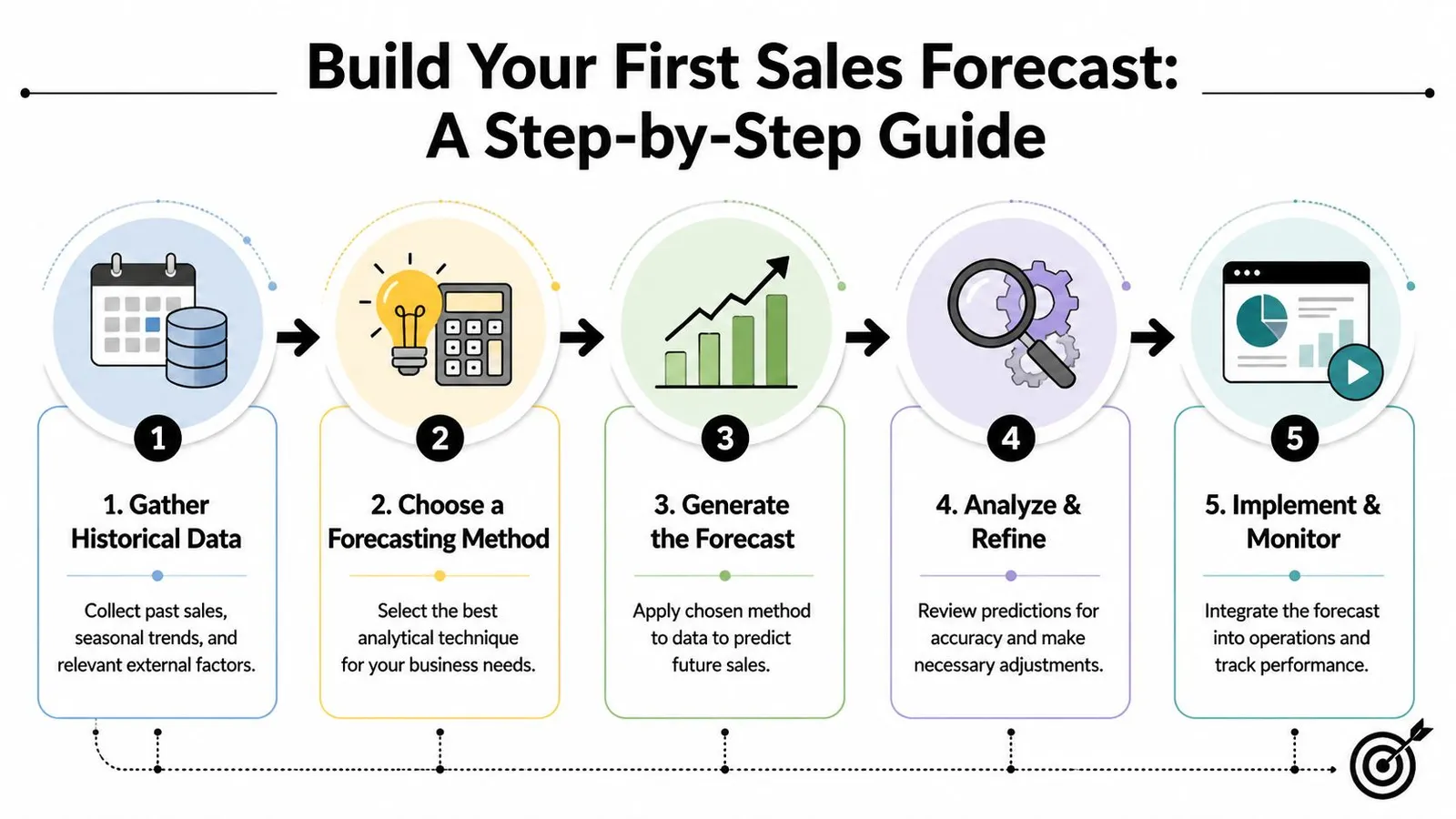
Initial forecasts should assist you in making defensible staffing decisions. Revenue is important, but in a restaurant, the primary benefit is improved labor control by the hour, rather than simply having a more accurate sales figure by the close of business.
Start with clean POS history
Pull sales by day, hour, and channel. Daily totals alone hide the part that drives labor decisions. A $6,000 day can be manageable with a steady flow or chaotic if 60 percent of it lands in a 90-minute rush.
Sort the data into groups that reflect how the restaurant runs:
- Day of week so Tuesday dinner is compared with other Tuesday dinners.
- Daypart so breakfast, lunch, happy hour, and dinner are treated separately.
- Comparable periods such as patio season, school weeks, holiday periods, or promotion windows.
- Sales channel if dine-in, takeout, delivery, and catering create different labor pressure.
If you're building in a spreadsheet, use a format that already has the bones in place. This sales forecast template excel is a practical starting point.
Build the first version fast
Keep the first model simple enough that a manager can update it in a few minutes.
Start with a baseline from recent comparable periods. Then adjust only for things you already know will affect traffic. Confirmed catering. A home game. A weather risk that changes patio covers. School vacation. Road construction near the parking lot. The goal is not perfect prediction. The goal is a forecast that improves the schedule before the shift starts.
Use this process:
- Set the baseline. Use a historical average or moving average for each daypart.
- Apply known adjustments. Add or subtract based on events, promotions, holidays, weather, and large reservations.
- Convert sales into hourly staffing targets. Decide what coverage the forecast supports by position and by hour.
- Check the labor math. Run the schedule against projected sales with a labor cost calculator for restaurant scheduling decisions.
- Review the miss. Compare forecast to actual after service and log why the gap happened.
That last step is where the forecast starts paying for itself.
Tie the forecast to labor, not just revenue
A lot of first-time forecasts stop at the sales number. That leaves money on the table. The stronger habit is translating expected sales into labor intent before managers build or adjust the floor plan.
For example, if lunch is forecast at a normal top-line number but the mix is shifting toward delivery and counter pickup, the labor plan should shift too. You may need fewer floor hours and more expo or pack-line coverage. Same sales. Different labor demand.
This is the operating angle that matters most. A good forecast is the starting point for labor control during the day, not just a pre-shift estimate.
Use judgment, but document it
Manager instinct has value. Unrecorded instinct does not.
Use judgment for factors the history does not fully capture yet:
- Street closures or access issues
- Community events that change traffic patterns
- A new promotion with no historical comparison
- Capacity constraints from staffing shortages or equipment problems
Write every adjustment down. I have seen plenty of managers call for an extra server because they were "sure" it would be busy, then forget the reason a week later. If the adjustment is documented, you can review whether it improved the forecast or just added labor cost.
Forecasting gets better through repetition, not complexity. Clean history, a simple method, written adjustments, and a weekly review habit will get a restaurant much farther than a fancy model nobody updates.
Go Live: Connecting Forecasts to POS and Labor Tools
A spreadsheet forecast is better than no forecast. But the big operational jump happens when the forecast connects to the tools your managers already use during service.

The shift from planning to live control
Sales forecasting stops being static at this point. With POS-connected workflows, forecasted sales don't just inform the schedule once. They keep informing labor decisions as actual orders come in.
That matters because pre-shift planning is only half the job. Mid-shift volatility is what usually breaks labor discipline. Lunch runs slow. A nearby event ends early and sends traffic your way. A patio surge changes the mix. If your tools can only tell you what you thought would happen this morning, you're still managing with stale information.
According to Scoop Analytics on predictive sales forecasting, integrating multivariable sales forecasting models with live Toast POS data can predict labor needs with 85-95% accuracy and reduce overstaffing by 15-20% through real-time mid-shift alerts. That's the part many operators miss. The value isn't only in making a better schedule. It's in correcting labor while the shift is still moving.
What live labor control looks like in practice
A connected setup usually follows a simple loop:
- Forecast before the schedule is built: Use recent sales patterns and known drivers to estimate expected demand.
- Map forecast to staffing: Turn that demand into planned coverage by role and hour.
- Watch live sales against plan: Compare actual pace to the expected pace as service unfolds.
- Adjust before the miss gets expensive: Cut early, hold breaks, redeploy staff, or keep coverage if the rush is real.
For operators managing more than one store, consistency matters as much as accuracy. That's where systems designed for RevMenue multi-location forecasting can be useful as a reference point when you're thinking about how to standardize forecasting logic across units without forcing every manager to reinvent the process.
If you're evaluating the labor side specifically, a scheduling system should help managers act on the forecast, not just view it. The practical benchmark is whether the tool supports restaurant scheduling that reflects projected sales before publish and can still support decisions once the shift begins.
A short walkthrough helps show what this looks like in the field:
The strongest forecasting setup isn't the one with the prettiest dashboard. It's the one that helps a manager make the right call at 2:15 p.m. when the shift has gone off script.
What doesn't work is separating forecast ownership from labor ownership. If one team builds the forecast and another team staffs in isolation, the value gets lost. In good operations, forecast, schedule, and live labor all sit in the same decision flow.
What Are the Common Forecasting Pitfalls, and How Do You Avoid Them?
Friday lunch is staffed for a rush that never shows. Saturday dinner gets scheduled like a normal night, then a nearby event fills the dining room and labor spikes anyway. Those misses usually do not come from using the wrong formula. They come from bad inputs, stale assumptions, and a forecast that stops being useful the moment the shift starts.
Bad inputs create bad schedules
Dirty data causes expensive mistakes.
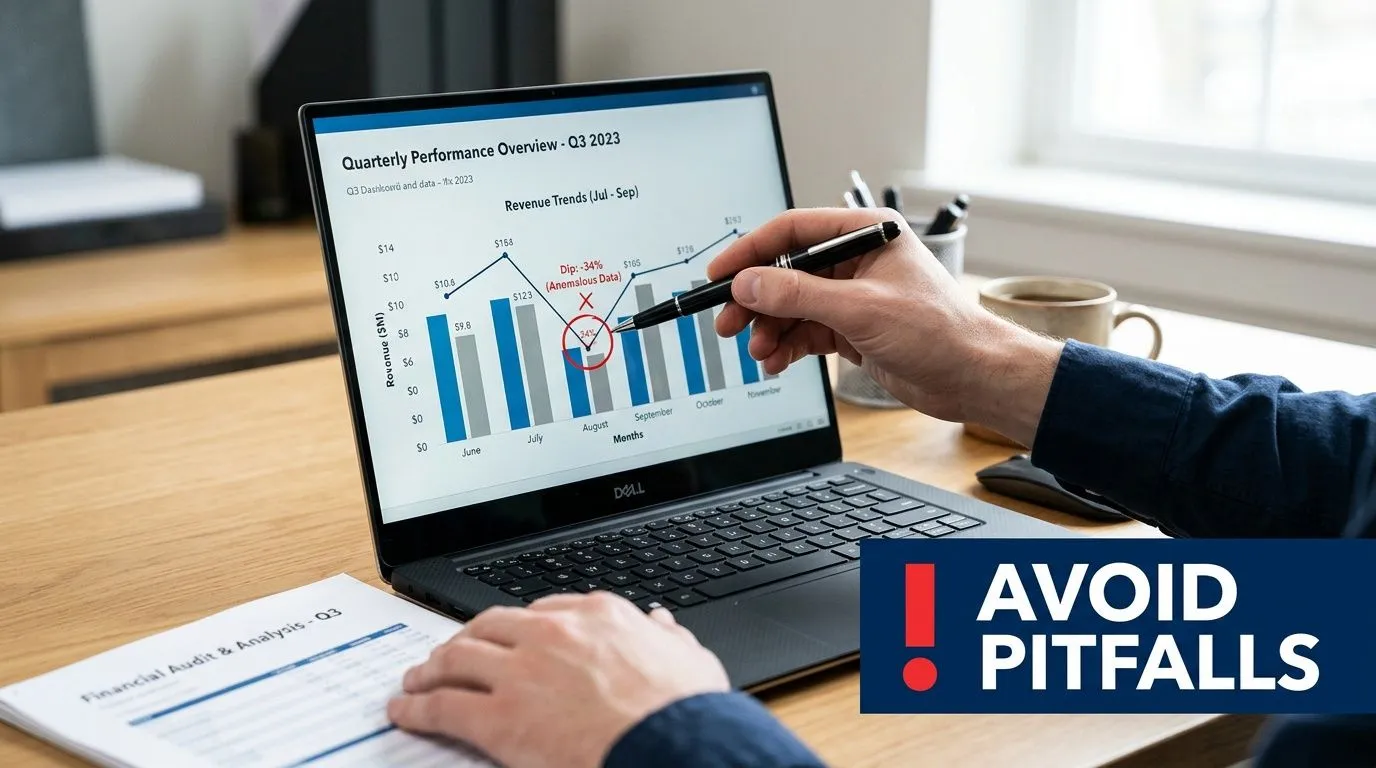
If your POS categories changed mid-quarter, if one manager coded catering sales differently from another, or if you are comparing holiday weeks to normal weeks without adjusting for it, the forecast can look polished and still produce the wrong labor plan. I have seen operators blame the model when the actual problem was a comparison set full of bad history.
Old data can hurt too. A pattern from last year may not mean much if traffic shifted, pricing changed, delivery mix grew, or a nearby competitor opened. Forecasting works best when the baseline reflects the business you are running now, not the one you had twelve months ago.
Watch for these signs:
- The same daypart misses every week: Your forecast is probably too broad by hour, channel, or daypart.
- Weather keeps catching the team off guard: Outside variables are missing from the process.
- Managers keep overriding the number: They see something in the operation that the inputs are missing.
- Sales look close, but labor is still off: The forecast may be acceptable at the daily level and useless at the hourly level.
That last point matters more than many operators realize. A daily sales forecast can be "right" and still fail the restaurant if the timing is wrong. Labor lives by the hour. If the forecast does not tell you when covers or tickets will hit, it will not help much with cuts, break timing, or surge coverage.
Static forecasts fail during live service
A second mistake is treating the forecast like a pre-shift exercise instead of a live operating tool.
Forecast misses are common in every industry, as noted earlier. The practical lesson for restaurants is not to chase perfection. It is to build a routine for catching the miss early and adjusting labor while there is still time to protect the shift.
Watch for this symptom: The opening schedule made sense at 10:00 a.m., but by 1:30 p.m. labor is already drifting and nobody has changed course.
That is an execution problem. The forecast did its first job. The operation missed the second one.
Restaurants make money on the adjustment. If lunch is pacing down, managers need clear rules for cutting a server, delaying a clock-in, or combining sections. If sales are pacing up, they need just as much clarity on when to hold support, call someone in, or protect the line from getting buried. This is the part many teams miss. Forecasting is not only about predicting revenue. Its best use is helping managers control labor in real time instead of hoping the pre-shift plan survives contact with the day.
A few fixes make a real difference:
- Clean the source data: Standardize sales categories, remove one-off anomalies, and compare similar periods.
- Forecast at the level you staff: Build by daypart or hour if labor decisions happen by daypart or hour.
- Add operating context: Promotions, weather, school calendars, local events, and channel mix all affect traffic.
- Review forecast versus actual every week: Write down why the miss happened so the next forecast improves.
- Set live decision rules: Define what managers should do when sales pace falls behind or runs ahead.
- Tie ownership together: The person reviewing the forecast should also be accountable for labor results.
Good forecasting gets sharper over time because each miss teaches you something specific. A weak Tuesday lunch, an event-driven patio spike, a delivery surge after 8 p.m. Those are not random surprises if the team logs the reason and updates the model. That is how forecasting stops being a reporting exercise and starts doing the job operators need most, keeping labor aligned with the business that is happening right now.
Frequently Asked Questions About Restaurant Forecasting
How often should a restaurant update its sales forecast
At minimum, update it weekly. Daily review is better for fast-moving concepts, especially quick-service and fast-casual operations where traffic patterns can shift quickly.
What's a good first forecasting method for a small restaurant
Start with historical averages or a moving average by daypart and day of week. That gives you a stable baseline without forcing you into a more complex model before your data is ready.
Can you do effective sales forecasting without expensive software
Yes. A spreadsheet and clean POS exports can get you started. The limit isn't cost at first. It's consistency. You need reliable inputs, comparable periods, and a routine for checking forecast versus actual.
When should a restaurant move beyond spreadsheets
Move when the spreadsheet stops helping managers make timely labor decisions. If your team needs faster updates, stronger visibility by hour, or a clearer way to react during the shift, connected tools become much more valuable.
Should managers still use judgment if they have a forecast
Absolutely. Forecasts should guide decisions, not replace operator awareness. The right approach is data first, judgment second, and documented reasons whenever you override the model.
If you want sales forecasting to do more than predict revenue, AnchOps is built for the operational side that matters most in restaurants. It helps teams connect sales expectations to schedules, labor targets, tip workflows, and mid-shift decisions so managers can run tighter, more profitable shifts without spending hours buried in admin.
Your back-of-house partner is ready
AnchOps handles scheduling, tip calculations, labor costs, and timecards — so you can focus on your restaurant, not your paperwork.