Write Up at Work: A Practical Guide for Managers
Published on
By Tony Newcome — Founder of AnchOps · Owner, Pizza Harbour
This article was drafted with AI assistance and reviewed by Tony Newcome, a working restaurant operator.
You've just published next week's schedule when the messages start arriving. One employee wants to swap a closing shift, another says they'll be late, and a third hasn't confirmed whether they can cover an opening. By the time you finish your coffee, you're trying to reconstruct what happened last week from texts, time-clock entries, and memory.
That's where a write up at work becomes more than a form. In a shift-based operation, attendance problems affect coverage, payroll, service, and the employees who stay late to fill gaps. The practical challenge isn't only writing a document correctly. It's deciding when formal action is justified, how to use the data fairly, and how to give the employee a genuine chance to respond.
Table of Contents
- Why Formal Documentation Matters
- A record protects more than the business
- Steps to Document and Issue a Write-Up
- Start with evidence, not a conclusion
- Coaching vs Formal Write-Up - When to Escalate
- Progressive discipline needs judgment
- Writing Clear, Factual Documentation
- Build the document from evidence
- Delivery, Follow-Up, and Appeals
- Keep the response in the record
- Leveraging Scheduling Data for Prevention
- Separate the problems before acting
- Building a Fair Culture Through Consistent Processes
- Make correction the purpose
Why Formal Documentation Matters
In a restaurant, informal correction feels efficient. You pull someone aside after service, say that another late arrival can't happen, and move on to the next problem. That conversation may be reasonable, but it leaves you with little to rely on if the same employee misses another shift or disputes what was said.
Attendance problems are often patterns, not isolated events. A large study of U.S. work schedules found that lateness of 10 minutes or more occurred in about 6% of shifts, while absenteeism occurred in about 10% of shifts, with mean shift-level rates of 5.9% for lateness and 9.7% for absenteeism. At scale, the research estimated approximately 4.6 million shifts with lateness and 10.7 million shifts with absenteeism. Those figures are reported in the study of lateness and absenteeism in shift-based work.
The point isn't to treat every late clock-in as misconduct. The point is that managers need a reliable way to distinguish a one-off problem from a recurring operational issue.
A record protects more than the business
A formal record gives the employee the same clarity it gives the manager. It identifies what happened, which standard applied, what explanation was provided, and what needs to change. Without that record, two employees who commit the same breach may receive very different treatment depending on which manager was working, how busy the shift was, or what the manager remembers later.
Health-related absence can also complicate attendance patterns. Research on shift workers found that 14.8% reported an absence in the previous four weeks. Among those absent because of health complaints, average absence was 5.0 days, with a standard deviation of 7.6 days. A separate analysis found that 13.2% of influenza-like illness or acute respiratory infection episodes led to at least one day absent, averaging 18.9 working hours per episode. These figures appear in the research on health-related absence among shift workers.
That's why a write-up shouldn't begin with a label such as unreliable. It should begin with verified facts and a check for context. Managers who want a broader overview of the responsibilities involved can use this practical HR compliance guide as a reference point.
Practical rule: Formal documentation isn't about making discipline harsher. It's about making expectations, evidence, and consequences visible to everyone.
Steps to Document and Issue a Write-Up
A defensible process follows a fixed sequence. Skipping a meeting or issuing a decision before checking the policy can turn a straightforward attendance issue into a dispute.
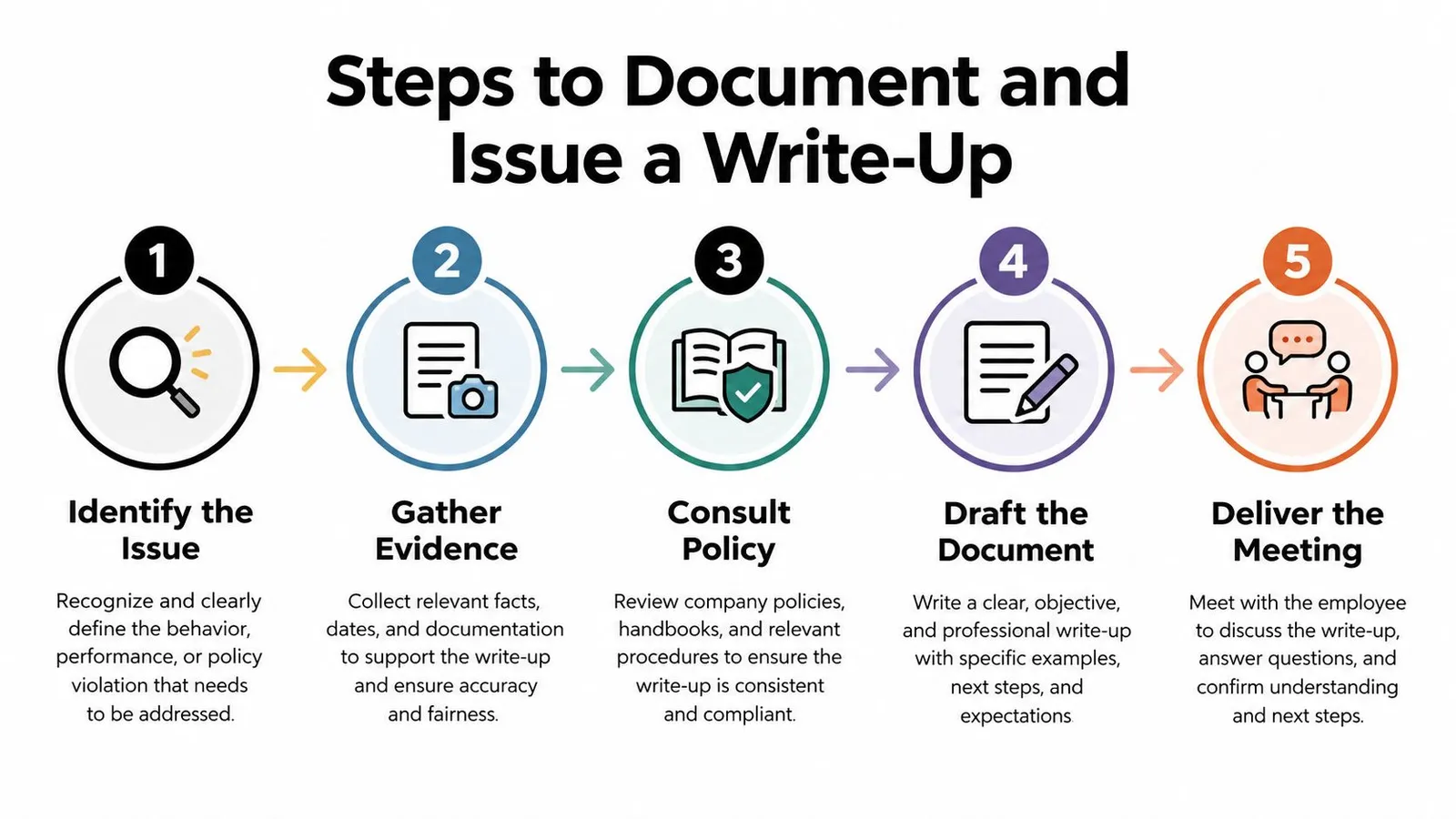
Start with evidence, not a conclusion
1. Document the issue in writing. Record the incident while the details are available. For attendance, that usually means the scheduled start time, actual arrival or clock-in time, whether the employee contacted anyone, the method and time of contact, and the manager who handled coverage.
2. Identify the policy breach. Quote or accurately summarize the relevant attendance, call-off, scheduling, or timekeeping rule. Don't rely on “you know the policy.” The employee should be able to see which standard applied and how the event departed from it.
3. Hold a formal meeting. Arrange a private conversation and provide enough information for the employee to understand the subject. Bring the schedule, time record, communication history, and prior coaching or warnings. The meeting is for fact-finding as well as delivery, so don't treat the employee's explanation as an interruption.
4. Issue the written decision. After reviewing the facts and response, state the finding, the corrective expectation, the next review point, and the consequence of another breach. The decision should be concise and written in neutral language.
5. Preserve an appeal path. Explain how the employee can challenge inaccurate facts or raise relevant context. The record should include the employee's response, whether they acknowledged receipt, and any follow-up that remains open.
Guidance from the U.S. Equal Employment Opportunity Commission on workplace discipline emphasizes written, accessible, non-discriminatory procedures and careful record handling. It's also sensible to obtain legal advice for jurisdiction-specific issues. For small operators working through difficult cases, this resource on HR write-ups defense for small businesses explains why factual records and consistent standards matter.
A practical manager should also keep the document separate from casual team communications. Text messages may help establish what happened, but they shouldn't replace a controlled personnel record. For additional operational examples, review this guide to discipline for employees.
Coaching vs Formal Write-Up - When to Escalate
The hardest decision is often not how to write the document. It's deciding whether the incident deserves a document at all.
A useful test is to assess severity, repetition, clarity, and impact. A first late arrival with a credible explanation may call for coaching. A repeated breach after a documented conversation points toward formal discipline. A serious incident, such as abandoning a shift without notice or falsifying time records, may justify moving directly to a written step, subject to the policy and applicable law.
| Situation | Appropriate first response | Move toward a write-up when |
|---|---|---|
| Isolated, low-impact lapse | Private coaching and a clear reminder | The same issue returns or the employee rejects the standard |
| First recurring pattern | Verbal warning with documented notes | The pattern continues after the expectation is explained |
| Repeated lateness or absence | Formal written warning under the attendance policy | The employee exceeds a stated threshold or ignores the corrective plan |
| Serious conduct or operational risk | Immediate investigation and formal review | The facts support a serious policy breach |
| Disputed or potentially protected absence | Pause discipline and verify the circumstances | The employer confirms the absence was unprotected and the policy applies |
Progressive discipline needs judgment
A common sequence is verbal warning, first written warning, final written warning, an optional improvement plan, and termination if the behavior doesn't change. That sequence provides structure, but it shouldn't become a mechanical ladder that ignores context.
Traditional progressive discipline usually advances after repeated violations such as tardiness or unexcused absence. Current guidance increasingly places more weight on objective facts, prior conversations, and circumstances rather than forcing every employee through an identical sequence. The discussion from SHRM on the traditional progressive discipline paradigm is useful because it highlights the trade-off. A rigid sequence feels consistent, but it can produce an unfair result when the facts differ materially.
Don't use coaching to avoid an uncomfortable conversation when the pattern is already clear. Don't issue a formal warning merely because a manager is frustrated after a difficult shift. The right escalation is the smallest formal step that accurately reflects the conduct and gives the employee a realistic opportunity to correct it.
Writing Clear, Factual Documentation
A strong write-up lets another manager understand the incident without hearing your version of the story first. That requires observable behavior, dated evidence, and a clear connection to the workplace standard.
Write “The employee was scheduled to begin at 5:00 p.m. and clocked in at 5:18 p.m. without contacting the manager before the shift” rather than “The employee is always late and doesn't care about the team.” The first sentence can be checked. The second is a conclusion about personality.
Build the document from evidence
Include these elements:
- Incident details: List the exact date, scheduled time, actual time, location, and type of event, such as late arrival, early departure, absence, or no-call/no-show.
- Pattern and frequency: State the relevant count and measurement period when the policy uses a threshold or rolling window.
- Policy connection: Name the specific section and explain how the documented conduct conflicts with it.
- Prior action: Record earlier coaching, verbal warnings, meetings, or support offered, including dates where available.
- Operational effect: Describe the concrete result, such as uncovered service, delayed opening work, missed preparation, or another employee absorbing the shift.
- Required correction: State what the employee must do next, including call-off timing, punctuality, approval for changes, or documentation requirements.
- Consequence: Explain what may happen if the behavior continues, using the actual disciplinary framework rather than an improvised threat.
Avoid “always,” “never,” “bad attitude,” and similar shorthand. They invite arguments about exceptions and distract from the incident you can prove.
Performance-review guidance recommends drafting in multiple passes, moving from evidence to rating, wording, and fairness. It also offers a practical length benchmark of about one to two pages, while noting that only 26% of employees strongly agree their reviews are accurate. Those figures and the documentation recommendations are discussed in guidance on writing a performance review.

A short, specific document is stronger than a long emotional narrative. Draft it once for completeness, again for neutral wording, and once more to check whether an employee unfamiliar with the situation could understand exactly what must change.
Delivery, Follow-Up, and Appeals
The meeting can either reinforce the fairness of the process or undermine it. Deliver the write-up privately, without an audience of coworkers and without turning a busy pre-service period into a public confrontation.
Open with the purpose and the decision. Then walk through the facts in order. Give the employee time to respond before debating the explanation. If the employee says the schedule was changed, check the schedule history. If they say they notified a supervisor, verify the message or call record. If they raise a health issue, accommodation request, or protected leave concern, pause and escalate through the appropriate HR or legal process rather than deciding the issue casually on the floor.
Keep the response in the record
The employee's explanation belongs in the file, even when it doesn't change the outcome. Summarize the response accurately, identify any evidence the employee offered, and state whether the decision is confirmed, modified, or pending further review.
Have the employee sign to acknowledge receipt, not necessarily agreement. If they refuse to sign, record that refusal according to your policy and provide a copy of the document. A signature shouldn't be used as a condition for being heard.
Set a specific follow-up point. That might be a scheduled review after the next group of shifts, a check-in after the employee has followed the call-off procedure, or a meeting to assess whether the attendance pattern has changed. Don't promise that the write-up will disappear unless your policy provides for that outcome.
Confidentiality matters. Share the document only with people who need it for supervision, payroll, HR, or legal review. Keep written warnings and case notes only as long as necessary under your retention rules. A defensible record is controlled, factual, and easy to retrieve, not a folder of screenshots circulated through group chats.
The employee doesn't have to agree with the write-up for the process to be fair. They do need a clear explanation, a chance to respond, and a route to challenge inaccurate facts.
Leveraging Scheduling Data for Prevention
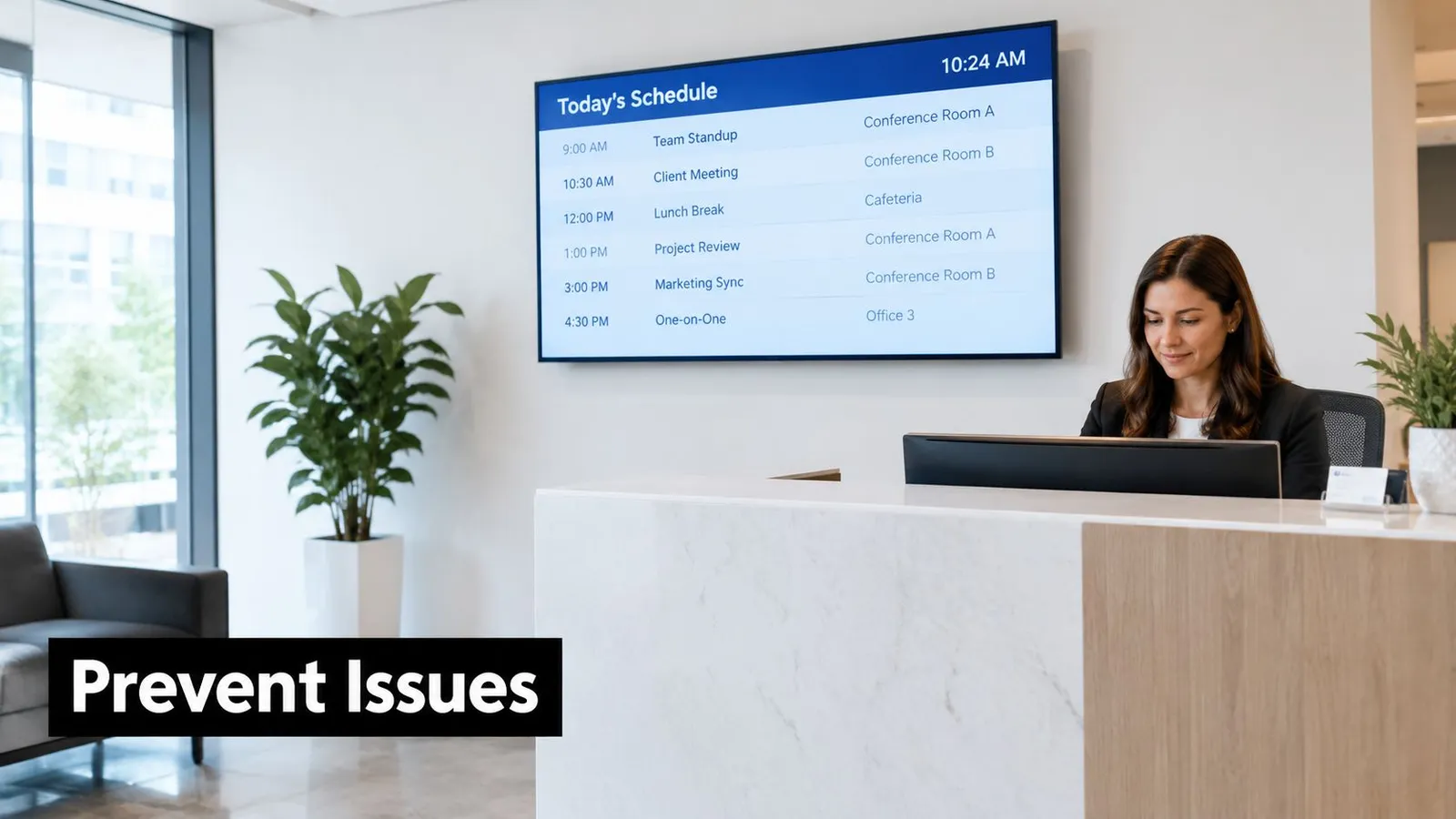
Every attendance dispute starts with the same question: what was the employee scheduled to work? If the answer depends on a manager's memory or a message buried in a phone, the write-up is weaker than it needs to be. Shift-based teams already generate the records needed to answer that question. The operational gap is usually deciding which schedule version is fair to use.
Use the published schedule as the baseline, then preserve approved swaps, call-offs, manager changes, and the employee's agreement to modifications. Compare that history with time-clock records showing start times, end times, and breaks. Together, these records help distinguish lateness, a missed shift, an unauthorized change, and a scheduling error.
Separate the problems before acting
A no-call/no-show requires a different review from arriving late after contacting the manager. Chronic lateness is different again from an absence connected to protected leave or an accommodation request. Configure the attendance system and the manager's review process to classify the event before counting it toward discipline.
Protected absences should not count against an employee in attendance discipline. The difficult part is identifying whether a particular event was protected when managers have incomplete information. The attendance write-up guidance from TeamSense on documenting attendance issues recommends recording the incident date, location, witnesses, and prior warnings. Managers should also check the legal context before treating the event as an unprotected violation.
Scheduling rules can change what qualifies as a breach. Seattle's secure scheduling ordinance requires schedules to be posted at least 14 days in advance, and employees may decline hours that were not on the originally posted schedule. The Seattle secure scheduling requirements illustrate why managers should retain the original schedule instead of treating every later change as binding.
Review reliability patterns during normal one-to-ones, before a formal warning is necessary. A scheduling system that includes availability, shift swaps, timecards, and coverage history can show where expectations are breaking down. AnchOps is one example of a platform that combines schedule drafting, open-shift outreach, timekeeping, shift swaps, and employee reliability tracking for shift-based teams.
The manager still makes the judgment. Records can identify a pattern, but they cannot determine whether an absence was protected, whether a schedule change was properly approved, or whether the employee had a reasonable chance to comply. Use the record to establish timing and consistency, then review the circumstances before acting.
Building a Fair Culture Through Consistent Processes
Employees notice inconsistency quickly. If one server receives a formal warning for repeated lateness while another gets only private reminders, the policy stops feeling like a standard and starts feeling like a manager preference.
Consistency doesn't mean identical outcomes in every case. It means managers use the same questions, the same records, and the same policy language before deciding whether discipline is appropriate. The employee's role, the seriousness of the incident, prior coaching, protected circumstances, and operational impact can all affect the result, but those differences should be documented rather than assumed.
Make correction the purpose
A write-up should answer three practical questions:
- What happened?
- What must change?
- What support or clarification will help the employee meet the standard?
That approach keeps discipline connected to retention and performance. It also gives employees a fair chance to recover instead of treating the first formal document as a prediction of failure. Managers looking for broader ideas to create a positive work environment should connect accountability with clear communication, recognition, and respectful supervision.
Review your attendance policy before a problem appears. Define how incidents are counted, which events are excluded, who approves schedule changes, how employees call off, and what each disciplinary step means. Then train supervisors to use the same workflow. A policy that exists only in an employee handbook won't produce consistent decisions on a busy restaurant floor.
Recognition also has a place beside correction. Simple staff appreciation activities can reinforce the reliability and teamwork you expect, while formal documentation handles repeated failures to meet the standard. The two practices aren't opposites. Employees are more likely to accept accountability when managers also notice the work that goes right.
A well-managed write-up isn't a punishment trophy. It's a controlled conversation about facts, expectations, and the next opportunity to improve. When managers document carefully, protect confidential information, check for protected circumstances, and apply the process consistently, they protect the operation without losing the human relationship behind the policy.
AnchOps helps shift-based operators draft schedules, fill open shifts, manage swaps, review timecards, and track reliability in one workflow. Visit AnchOps to see how it can give your managers a cleaner attendance record and more time to address issues before they require a formal write-up.
Your back-of-house partner is ready
AnchOps handles scheduling, tip calculations, labor costs, and timecards — so you can focus on your restaurant, not your paperwork.