Reliability Score: How It Works and How to Use It
Published on
By Tony Newcome — Founder of AnchOps · Owner, Pizza Harbour
This article was drafted with AI assistance and reviewed by Tony Newcome, a working restaurant operator.
It's Friday's dinner rush, tickets are stacking up, and two line cooks haven't arrived. You're calling replacements while wondering whether you could have spotted the risk before publishing the schedule. A reliability score can help, but only if it distinguishes a genuine attendance pattern from a changed start time, an approved absence, or too little evidence.
Table of Contents
- What a Reliability Score Measures and Why It Matters
- The attendance record behind the number
- What the score cannot tell you
- The Four Events That Feed the Score
- Record events, not impressions
- How to Calculate a Reliability Score Step by Step
- Build the calculation in a fixed order
- Use explicit formulas
- Keeping Scores Fair, Private and Transparent
- Apply exclusions before ranking
- Make correction practical and private
- Scoring Logic in Three Realistic Examples
- Interpret the record before assigning a label
- Compare team results carefully
- Using Scores to Make Staffing Decisions
- Preserve judgment at the point of assignment
- Check whether attendance is actually the bottleneck
- Confirm Your Scoring Rules and Apply Them in AnchOps
- Put the rules in writing
- Apply automation without surrendering review
What a Reliability Score Measures and Why It Matters
A reliability score is a running summary of how an employee has shown up for recent scheduled shifts. Think of it as a batting average for shifts, not a grade on personality, commitment, or effort.
For the manager trying to cover the line, it answers a practical question: Who has demonstrated dependable attendance under comparable scheduling conditions? That's useful evidence for the next assignment, although it isn't a guarantee that someone will arrive.

The attendance record behind the number
Four inputs describe different parts of attendance:
- On-time arrivals: The employee clocks in within the business's published grace window. For example, a policy might allow clock-ins up to five minutes after the scheduled start.
- Late arrivals: The employee clocks in after that window. Record the actual delay, not just a late label.
- Completed shifts or covers: The employee works the booked shift, including an extra shift or approved swap they accepted.
- No-shows: The employee misses a booked shift without a clock-in or a call.
These inputs replace scattered recollections with a record managers can inspect. Without that record, a memorable absence can overshadow otherwise consistent attendance, while someone's repeated small delays may go unnoticed.
What the score cannot tell you
A dependable cashier isn't automatically qualified to run the grill. Likewise, a lower attendance score doesn't explain whether transportation, an accommodation, or a manager's schedule changes contributed to the result.
Keep skills, availability, and attendance distinct. Treat the score as recent evidence that can change, not a permanent label or a disciplinary verdict.
A reliability score describes past attendance so you can plan the next schedule.
The Four Events That Feed the Score
Attendance events, how they are recorded and when to exclude them
| Event | How it is recorded | Effect on score | Exclude when |
|---|---|---|---|
| On-time arrival | Clock-in inside the grace window, such as five minutes after start | Positive; raises the on-time rate | Clock error or schedule changed after publication |
| Late arrival | Clock-in after the grace window, measured in minutes | Negative; weighted by minutes late | Approved leave or employer-caused schedule change |
| Completed shift (cover) | Shift worked in full, including a swap approved in advance | Positive; raises the completion rate | Not applicable |
| No-show | Booked shift missed with no clock-in and no call | Strongest penalty | Documented emergency or approved leave |
| Declined or swapped shift | Employee gives up a shift before it starts | Tracked separately from attendance failures | Employer cancels or moves the shift |
The table contains five event types, because declined or swapped shifts need their own record even though they aren't attendance failures. The four scored outcomes shouldn't absorb every scheduling interaction.
A no-show deserves the strongest attendance penalty because an employee accepted an assignment and didn't attend or communicate. Before applying it, reconcile the published schedule, timecard, messages, and approved exceptions. A consistent no-show response process helps managers distinguish a missing punch from a missed shift.
Record events, not impressions
In a study covering more than 28 million shift-level timecards, lateness or absenteeism occurred in approximately 16% of shifts, according to Harvard Business School. That shift-level approach is useful operationally: record what happened, when it happened, and which assignment it concerned.
Late arrivals need elapsed minutes because a brief delay and a substantially missed opening period aren't equivalent. On-time arrivals establish punctuality, while completed shifts establish fulfillment. An employee can arrive late and still complete the shift, so those records must remain distinguishable.
Approved swaps shouldn't become failures for the original employee. Once a replacement accepts responsibility through the approved process, attach attendance outcomes to the person assigned to work.
Finally, preserve the denominator, meaning the opportunities behind each rate. Keep scheduled shifts, completed shifts, and eligible open-shift offers separate. Otherwise, managers may mistake limited scheduling opportunities for poor reliability or reward employees because they receive more shifts.
How to Calculate a Reliability Score Step by Step
A score is only as fair as the rules behind it. Build a clear attendance record first, then summarize it in a rating readers can trace back to shifts and recorded events.
Build the calculation in a fixed order
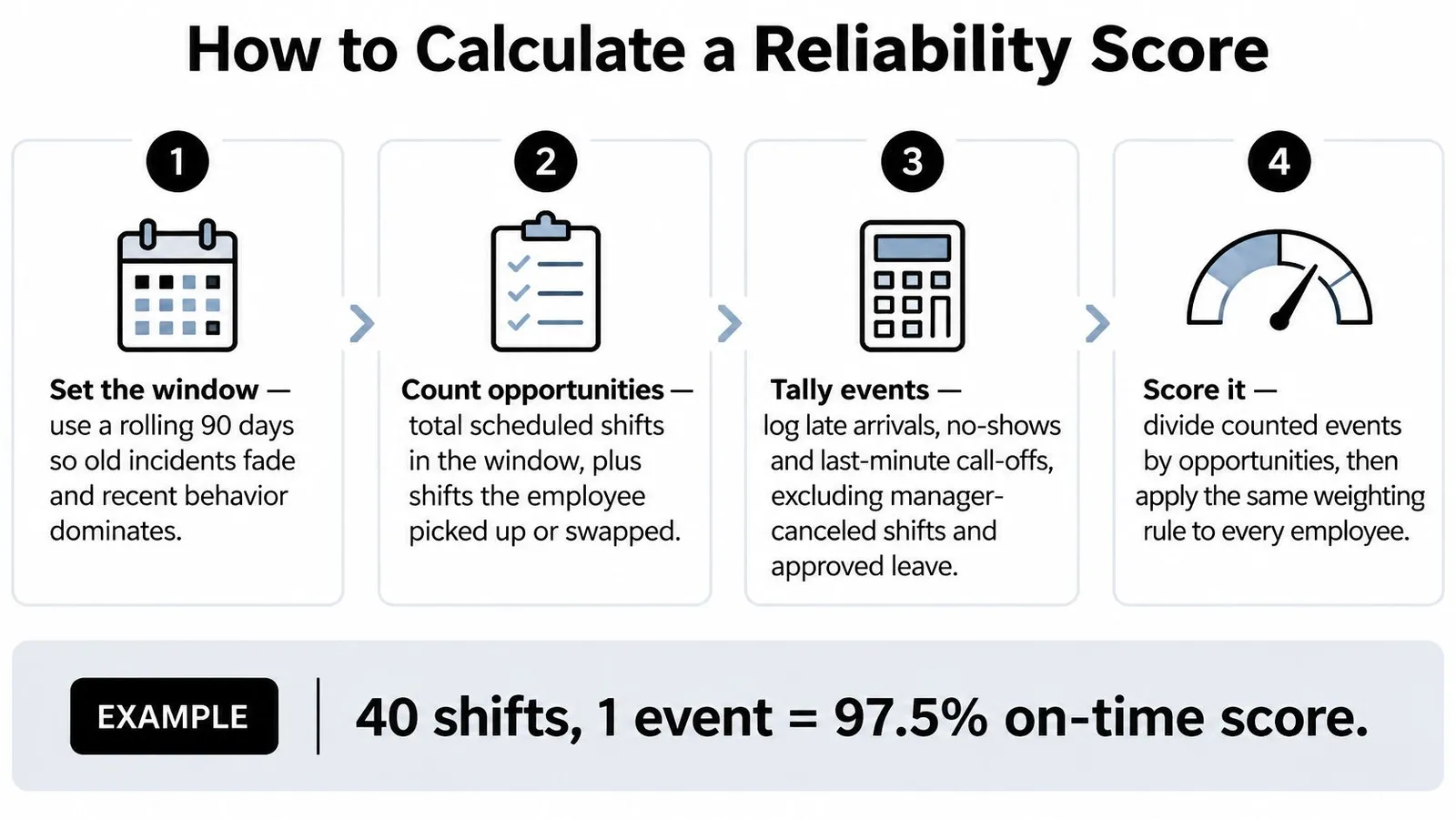
Set the window. Choose a consistent period for every employee, such as a rolling window. Apply identical start and end boundaries so that one person's older incidents do not count while another's do.
Count opportunities. Total the shifts assigned to each employee, including accepted pickups and approved swaps. Keep optional offers separate: an offer is not an agreement to work.
Classify and reconcile events. Match each assignment to its clock-in record and completion status, then apply documented exclusions. Preserve the original record and the reason for any adjustment.
Apply the attendance weights. Give no-shows the largest penalty, and weight lateness by minutes beyond the grace window. A hypothetical policy could make an arrival three minutes beyond that window count less than one twenty-five minutes beyond it.
Keep completion separate. A completed cover adds to the completion record. It should not cancel an unrelated no-show, because those events describe different shifts.
Require enough observations. Set a minimum number of eligible scheduled shifts before ranking employees. For example, a policy might require ten shifts, so a sparse record is not presented as precise evidence. If an employee has fewer observations, show the limited sample rather than treating the rating as settled.
Publish rates, uncertainty, and tiers. Display the attendance components beside the overall rating. Apply the same tier thresholds to everyone, and indicate uncertainty when a small sample could make the rate unstable.
Use explicit formulas
Calculate rates from eligible scheduled shifts, the scheduled shifts left after documented exclusions:
| Component | Calculation |
|---|---|
| On-time rate | On-time shifts ÷ eligible scheduled shifts |
| Completion rate | Completed shifts ÷ eligible scheduled shifts |
| No-show rate | No-shows ÷ eligible scheduled shifts |
| Late penalty | Minutes late after the grace window, capped at a published maximum and multiplied by a fixed weight |
Label each percentage as raw or adjusted. For lateness, publish the grace window, minute weight, and cap so managers apply one rule consistently.
Compare two incidents across four scheduled shifts with two incidents across forty shifts. The first record deserves review, but it offers little evidence about a lasting pattern. The second reflects a broader attendance history. Counts without denominators can make two very different records look identical.
A confidence band describes uncertainty around an estimated rate. Use a documented statistical method for binary outcomes, such as attended versus missed. For a composite score, flag sparse records rather than inventing precise bounds without a clear method.
Calculation check: Trace each result to the assignment, clock-in record, and exception decision before using it to rank employees.
Keeping Scores Fair, Private and Transparent
A score becomes unfair when managers count every absence, late arrival, and declined shift as an employee failure. That approach can penalize workers for changed schedules, canceled work, caregiving conflicts, transportation disruption, or hours they never agreed to work.
Among U.S. employees surveyed by Gallup, 41% had little or no control over their hours, days, or time-off timing, and more than one-quarter didn't know their schedule at least two weeks ahead, according to reporting on the Gallup survey. Managers need to examine their own scheduling practices before assigning responsibility to employees.
Apply exclusions before ranking
Use a written checklist:
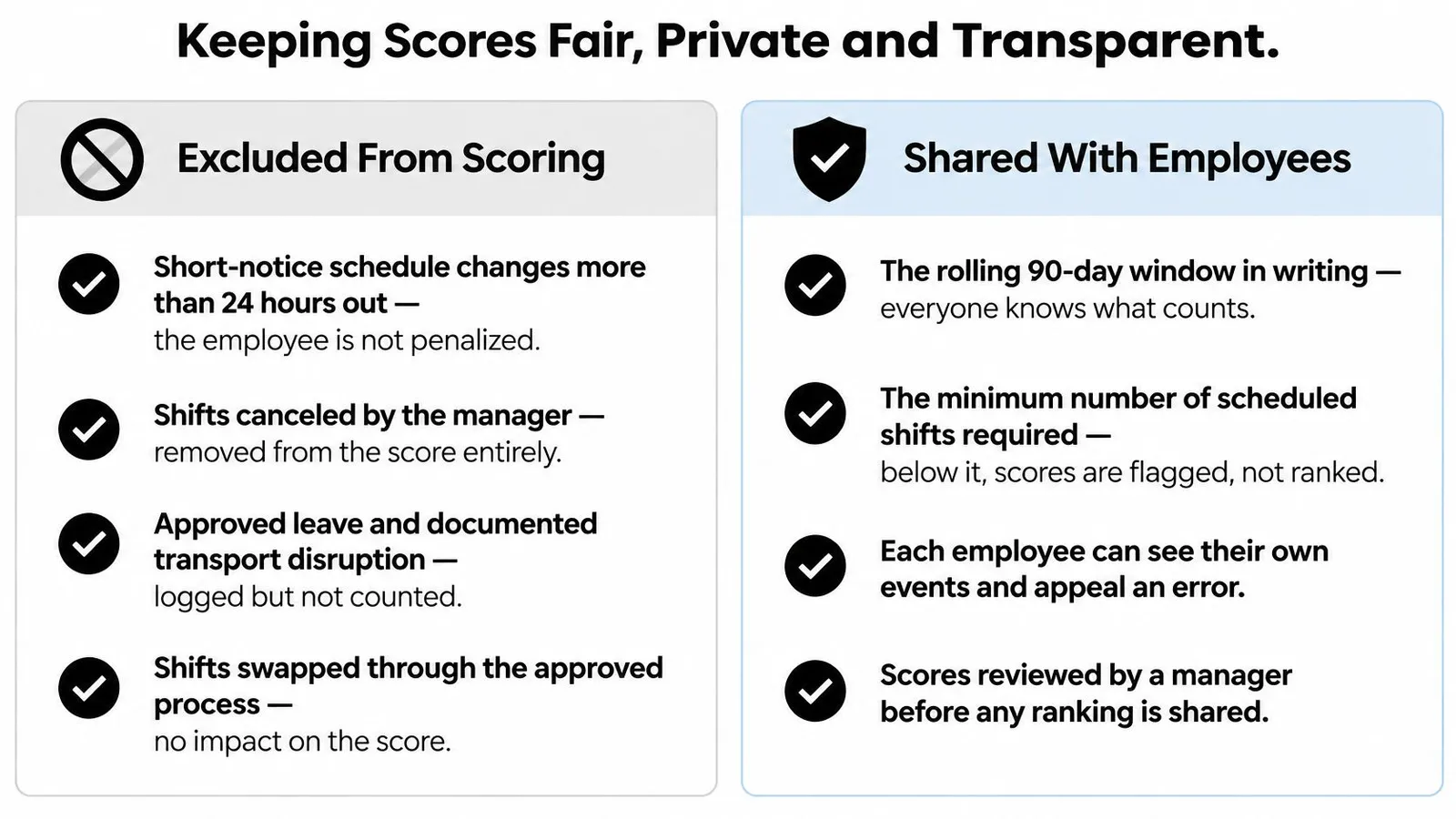
- Approved leave and emergencies: Remove approved leave and documented emergencies from attendance penalties.
- Employer changes: Exclude canceled or moved shifts, including changes made after publication.
- Disrupted start times: Flag late arrivals after start-time moves of more than an hour for contextual review rather than automatic employee penalties.
- Voluntary declines: Keep optional shift declines separate from no-shows.
- Approved swaps: Transfer the assignment through the approved workflow without recording an attendance failure for the original employee.
Transportation and caregiving issues need a consistent review policy, not improvised sympathy for some workers and penalties for others. Record only the information needed to resolve the event.
Make correction practical and private
Part-time employees have fewer opportunities to establish a pattern. Below the published observation threshold, show insufficient evidence rather than placing them at the bottom of a ranking.
Each employee should see their own score, included events, excluded events, and exclusion reasons. Coworkers don't need access to personal attendance records, emergency details, or accommodation information. Put these access rules in your restaurant employee policies alongside the attendance policy.
Give employees a clear appeal route: identify the disputed event, submit a correction request, receive manager review, and see the recorded outcome. The audit trail should retain scheduled time, actual clock-in, grace period, source record, manager edits, and the reason for each decision.
Run recurring bias checks by role, location, shift time, accommodation status, transportation access, and protected leave, using restricted access for sensitive information. Investigate gaps in assignments as well as gaps in scores, because fewer opportunities can prevent someone from rebuilding their record.
A score alone should never trigger discipline or a pay decision.
Scoring Logic in Three Realistic Examples
The same attendance rules can produce different conclusions depending on how many shifts an employee has worked and how stable their schedule has been. These examples show why fairness requires more than sorting employees by a raw rate.
Raw and adjusted reads for three employees
| Employee | Scheduled shifts | Events in window | Raw read | Adjusted read |
|---|---|---|---|---|
| Maya | 40 | One arrival four minutes after start; no no-shows | High on-time rate; the arrival is within the grace window, so it carries no penalty | Highly reliable |
| Dev | 4 | One no-show | Alarming raw rate | Low confidence; wait for more shifts before ranking |
| Priya | 12 | Three late arrivals, two after start-time moves of more than one hour | Low on-time rate | Flag schedule-induced lateness; show raw and adjusted reads side by side |
Interpret the record before assigning a label
Maya's example shows why the written grace rule matters. With a five-minute grace window, clocking in four minutes after the scheduled start counts as on time. It should not be recorded as a late arrival or given a penalty.
Dev's missed shift needs follow-up, but four scheduled shifts provide little evidence about a lasting pattern. Investigate the incident, while withholding a comparative rank until the minimum observation requirement is met. A low sample size should lower confidence, not automatically lower the employee's standing.
Priya's schedule changes call for context before interpretation. Compare the original publication time with the revised start time, notice given, prior shift end, and any recurring day-of-week pattern. Her adjusted read can flag possible schedule-induced lateness, but the raw events should remain visible so the two views are not confused.

Schedule volatility can affect attendance. In the reported analysis, changing a recurring start time by more than one hour was associated with a 32.9-percentage-point increase in absenteeism and a 21.3-percentage-point increase in lateness, according to the Harvard Business School working paper. Those findings describe the analysis, not adjustment weights to subtract from one employee's score.
Compare team results carefully
TeamSense analyzed more than 100,000 shift-based workers tracked from June 2024 through May 2025 and reported an average absentee rate of 2.4%, according to coverage of its attendance benchmark. Treat the figure as a prompt to examine unusual team results, not as a universal target or an individual cutoff.
At Pizza Harbour, on-time arrivals averaged 87% before Show-Up Scores reached employees and 93% in the last three weeks of data captured September 19, 2026. The no-show rate fell from 2.3% to 0.4%, an 81% drop, comparing the eight weeks before with the nine weeks after employees received scores. These observations come from one restaurant; they do not prove that scoring alone caused the changes.
Test the rules against your own recent attendance records. Check who changes position when exclusions, grace-window errors, schedule changes, and sparse samples are handled fairly.
Using Scores to Make Staffing Decisions
Use reliability scores to decide who to contact first, not who deserves employment. An outreach order gives managers a practical response to an open shift without turning a summary number into a hard cutoff.
First confirm qualifications, availability, and relevant scheduling constraints. Then prioritize reliable eligible employees, moving through the list until someone accepts. In our coverage process, open shifts are offered to the most reliable employees first.
Staffing actions by reliability band
| Band | Staffing action | Check before acting |
|---|---|---|
| Strong | First pick of open shifts and extra hours | Sample size met and schedule context reviewed |
| Steady | Normal rotation | Recent incidents checked for schedule causes |
| Needs support | Schedule conversation before the score drives any decision | Confirm incidents were within the employee's control |
Set band thresholds in writing and test them against actual attendance outcomes. Don't invent a universal passing score or assume neighboring locations have comparable conditions.
Preserve judgment at the point of assignment
A strong attendance record doesn't substitute for food-safety training, station competence, or supervisory authorization. A reliable prep cook may still be the wrong replacement for the only qualified closing supervisor.
Likewise, a difficult week shouldn't automatically remove someone from the rota. Ask whether the employee needs a stable start time, corrected availability, or a conversation about accepting shifts they can realistically work. Keep those decisions within a broader labor-planning process, rather than letting an attendance ranking determine staffing levels.
The governance stakes are substantial: 88% of U.S. employers use algorithmic-management tools to monitor work completion, according to the OECD's report on algorithmic management in the workplace. Its discussion of implementation and worker consultation supports a practical distinction: showing people a number isn't the same as giving them a meaningful way to challenge its use.
Check whether attendance is actually the bottleneck
If everyone arrives but delivery orders still sit waiting, attendance scoring won't fix the handoff. OrderOut's guidance to speed up the order handoff chain is useful when the problem lies between kitchen completion, packing, and driver collection.
Before offering a shift, confirm that the sample is adequate, the relevant events were within the employee's control, and the proposed schedule doesn't recreate the problem.
Rank by score for outreach, confirm with the schedule context, then decide.
Confirm Your Scoring Rules and Apply Them in AnchOps
Write the operating rules before employees receive rankings. Automatic calculation can remove repetitive work, but managers still own the decisions they make from the result.
Put the rules in writing
Your policy should answer these questions:
- Events and exclusions: Which attendance events count, and what documentation supports an exception?
- Rolling window: Which records enter the calculation, and when do they leave?
- Minimum observations: When can employees see a provisional score, and when is there enough evidence to rank them?
- Outreach order: How do staffing bands affect open-shift offers without overriding qualifications?
- Appeals: Who reviews a disputed attendance record, and how is the correction documented?
Distinguish displaying a provisional number from using it competitively. Employees should understand why a score may be visible while remaining ineligible for ranking.

Apply automation without surrendering review
AnchOps assigns each employee a Show-Up Score based on on-time percentage, completed shifts, call-outs, and no-shows, broken down by day of the week. Scores build automatically from the business's own punch data, with no setup or judgment calls required for score generation.
Employees can view their own score in the mobile app. For shift coverage, eligible staff are matched automatically by role and availability, and reliability determines the outreach order.
Automatic score generation isn't the same as automatic personnel judgment. Review disputed source records and scheduling context before relying on the number, and don't assume that calculation alone supplies your exclusion policy, privacy controls, or appeal procedure.
Use a controlled rollout:
- Write the rules. Assign a named manager to own their application.
- Test historical records. Review the last ninety days before using rankings for outreach.
- Inspect exclusions. Have a manager reconcile questionable events against published schedules and approvals.
- Pilot with one team. Check the available audit records and maintain an appeal log before extending the process.
AnchOps combines attendance-based Show-Up Scores with scheduling and targeted shift coverage, giving managers a practical way to prioritize eligible employees for open work. Visit AnchOps to explore how those tools can support your team's scoring rules and coverage process.
Your back-of-house partner is ready
AnchOps handles scheduling, tip calculations, labor costs, and timecards — so you can focus on your restaurant, not your paperwork.