4 on 4 Off Schedule: How It Works for Restaurants
Published on
By Tony Newcome — Founder of AnchOps · Owner, Pizza Harbour
This article was drafted with AI assistance and reviewed by Tony Newcome, a working restaurant operator.
You published Friday's schedule on Monday. By Wednesday, three people want to swap, your closing cook needs the weekend off, and you're deciding whether to cover the gap yourself or approve more overtime. A 4 on 4 off schedule looks appealing because it replaces constant calendar editing with a repeating pattern. The catch is that you're also committing to long shifts, rotating weekends, and a payroll cycle that doesn't match the roster.
Table of Contents
- Why Restaurants Are Trying 4-on/4-off Schedules
- Start with the right restaurant format
- How the 4-on/4-off Schedule Works
- Build crews, not just names in boxes
- Publish dates, not weekday promises
- Pros and Cons for Restaurant Teams
- What employees and managers gain
- What the restaurant takes on
- Shift Templates and Rotation Patterns
- Pick consistency before rotation
- Make sleep opportunity a constraint
- Labor Cost and Overtime Compliance
- Calculate dollars from the actual roster
- Add jurisdiction and sales
- Managing Fatigue, Swaps and Call-Offs
- Protect the duty block
- Approve safe swaps, not just willing swaps
- Real-World Examples from Restaurant Schedules
- A continuous-service diner
- A burger restaurant with overnight prep
- A bakery ghost kitchen
- Implementing the Schedule in AnchOps Step by Step
Why Restaurants Are Trying 4-on/4-off Schedules
For an extended-hours restaurant, predictable blocks can be more useful than another round of weekly availability negotiations. Employees know when they're working and when they're free. Managers can build stable crews rather than reconstructing every service from scratch.
This is one option for nontraditional hours, not a documented restaurant-industry trend. The U.S. Bureau of Labor Statistics reports that 15% of U.S. wage and salary workers usually worked a non-daytime schedule in 2024–2025, including evening, night, rotating, and other arrangements.
The bargain: Long, predictable recovery blocks in exchange for long workdays and weekends that rotate.
Start with the right restaurant format
- Good candidates: Around-the-clock diners, overnight ghost kitchens, hotel and airport outlets, and production teams with sustained workloads.
- Conditional candidates: Brewery taprooms and late-volume restaurants, provided opening prep and closing work justify the full duty window.
- Poor candidates: A lunch-only cafe with a brief rush and little productive work outside service.
The decision needs more than an attractive calendar. Exact shift times, rotation choices, fatigue controls, and payroll projections determine whether the arrangement works. A usable template and a compliance checklist should lead to a clear answer: adopt it for a specific coverage problem, or keep a more flexible roster.
How the 4-on/4-off Schedule Works
A standard pattern means four consecutive 12-hour shifts followed by four full days off, repeating from a fixed anchor date. The FirstHR scheduling guide describes an eight-day cycle totaling 48 hours, averaging 42 hours per week, with four complete crews needed for uninterrupted coverage.
4-on/4-off schedule template for one employee (day-shift example)
| Cycle day | Status | Shift window | Hours |
|---|---|---|---|
| Day 1 | Work | 6:00 AM to 6:00 PM | 12 |
| Day 2 | Work | 6:00 AM to 6:00 PM | 12 |
| Day 3 | Work | 6:00 AM to 6:00 PM | 12 |
| Day 4 | Work | 6:00 AM to 6:00 PM | 12 |
| Day 5 | Off | - | 0 |
| Day 6 | Off | - | 0 |
| Day 7 | Off | - | 0 |
| Day 8 | Off | - | 0 |
| Day 9 onward | Repeat | Same four-on four-off pattern | 48 per cycle |
These are illustrative clock times. Define whether the window includes paid breaks, unpaid meals, opening preparation, and the handoff. A cook scheduled until closing hasn't finished work if cleaning, cooling, and temperature records remain undone.
Build crews, not just names in boxes
For continuous service, a typical arrangement has a day crew working, a night crew working, and the remaining crews resting. Each crew must contain the required skills, not merely enough people to reach a headcount.
- Kitchen coverage: Include station competence, food-safety responsibility, and someone authorized to handle production decisions.
- Front-of-house coverage: Account for cash handling, service supervision, and opening or closing authority.
- Relief coverage: Identify who can replace an absent employee without dismantling another crew.
A complete crew is not necessarily a four-person crew. Its size comes from demand and the work that must happen during the entire shift.
Publish dates, not weekday promises
Because the cycle advances independently of the calendar week, weekend assignments move. Don't promise that someone working this Saturday will automatically have next Saturday off. Their position within the work block determines that.
Publish calendar dates alongside cycle days. Staff should be able to find their next work block without counting squares.
A hypothetical shorter-shift version uses four 10-hour duties, totaling 40 hours per eight-day cycle, or 35 hours per week on average. That leaves additional daily coverage to arrange and doesn't eliminate the basic four-crew structure for continuous operations. It also doesn't guarantee exemption from weekly or daily overtime.
Before adopting either version, confirm that your staffing and relief plan work without routinely recalling employees during their recovery blocks.
Pros and Cons for Restaurant Teams
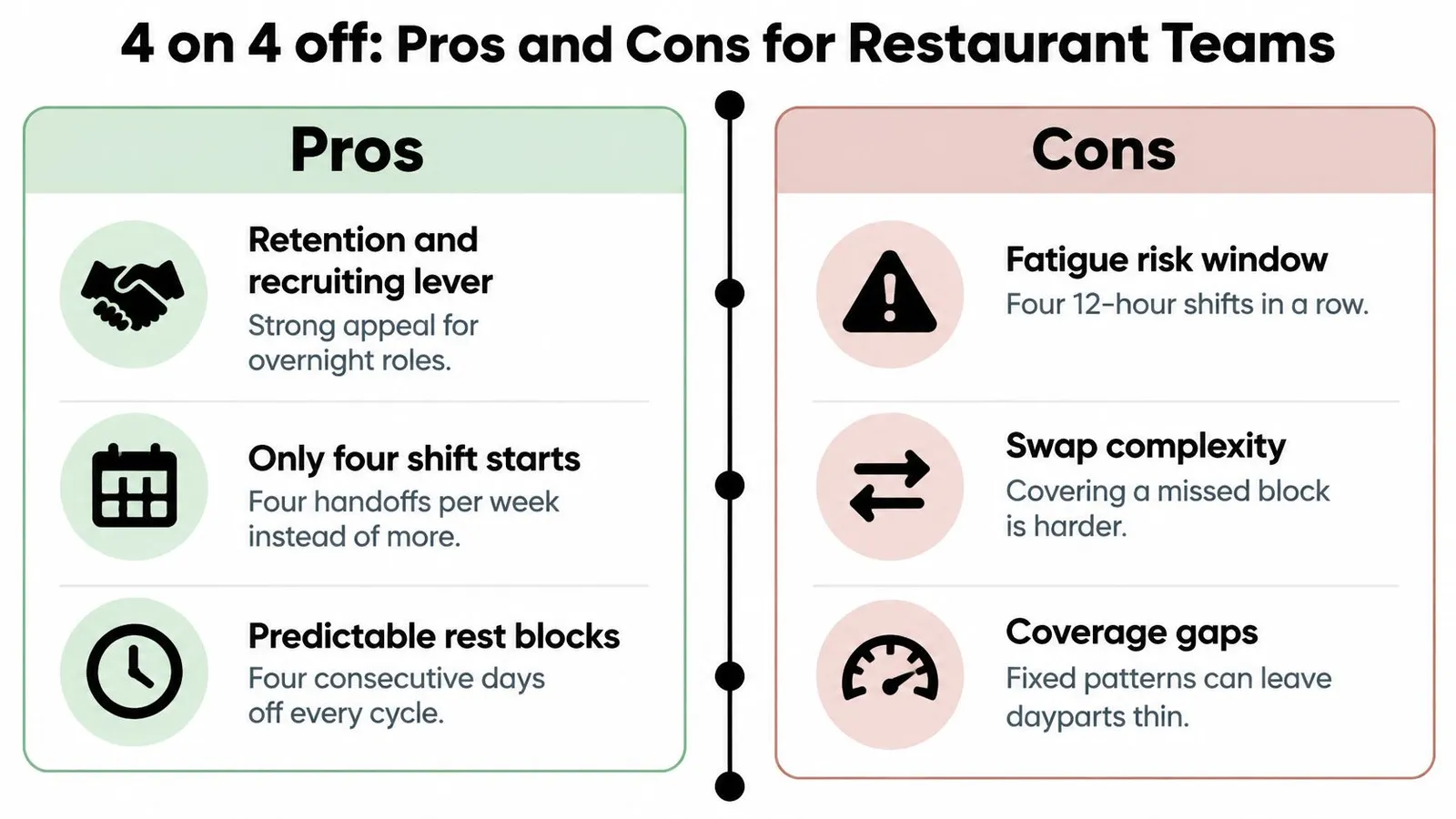
The strongest selling point is uninterrupted personal time. The biggest operational weakness is concentrating demanding restaurant work into long consecutive duties. Neither side should be hidden during recruitment.
What employees and managers gain
- A concrete recruiting offer: Predictable recovery blocks may appeal to overnight applicants more than a schedule that changes constantly. Treat that as a proposition to test, not a guaranteed retention improvement.
- Fewer starts per work block: Employees make fewer separate trips to work than under a roster with more, shorter duties. Count this per cycle, not per calendar week.
- Less routine editing: A stable template lets managers focus on exceptions instead of rebuilding the base roster.
- More planning certainty: Employees can arrange appointments and family commitments around published blocks, provided managers protect those blocks.
Childcare deserves a candid conversation. Knowing a shift far ahead helps, but arranging care across a long working day may still be harder than covering a conventional service shift. A second job can also consume the very recovery time the pattern is supposed to provide.
What the restaurant takes on
- Physical strain: Heat, standing, lifting, and repetitive prep make a long kitchen duty different from a long desk shift.
- Late-block vulnerability: Managers need to watch for slower checks, missed cleaning tasks, and poor handoffs rather than assuming everyone remains equally alert.
- Rotating weekends: Employees can plan ahead, but they won't necessarily keep the same social schedule.
- Expensive exceptions: Absences, extensions, and extra coverage can undermine the economics of an otherwise tidy roster.
Evidence doesn't support calling compressed schedules universally healthier or safer. The ILO review of working-time arrangements found mixed results across 20 studies, including both improved outcomes and greater sleepiness or reduced alertness on compressed schedules.
For continuous and overnight-heavy operations, the pattern deserves a controlled trial when there's enough productive work throughout the duty window.
For breakfast, lunch, or peak-only concepts, shorter overlapping shifts usually offer a better match. Paying someone through a quiet afternoon to preserve the template isn't a staffing benefit.
Shift Templates and Rotation Patterns
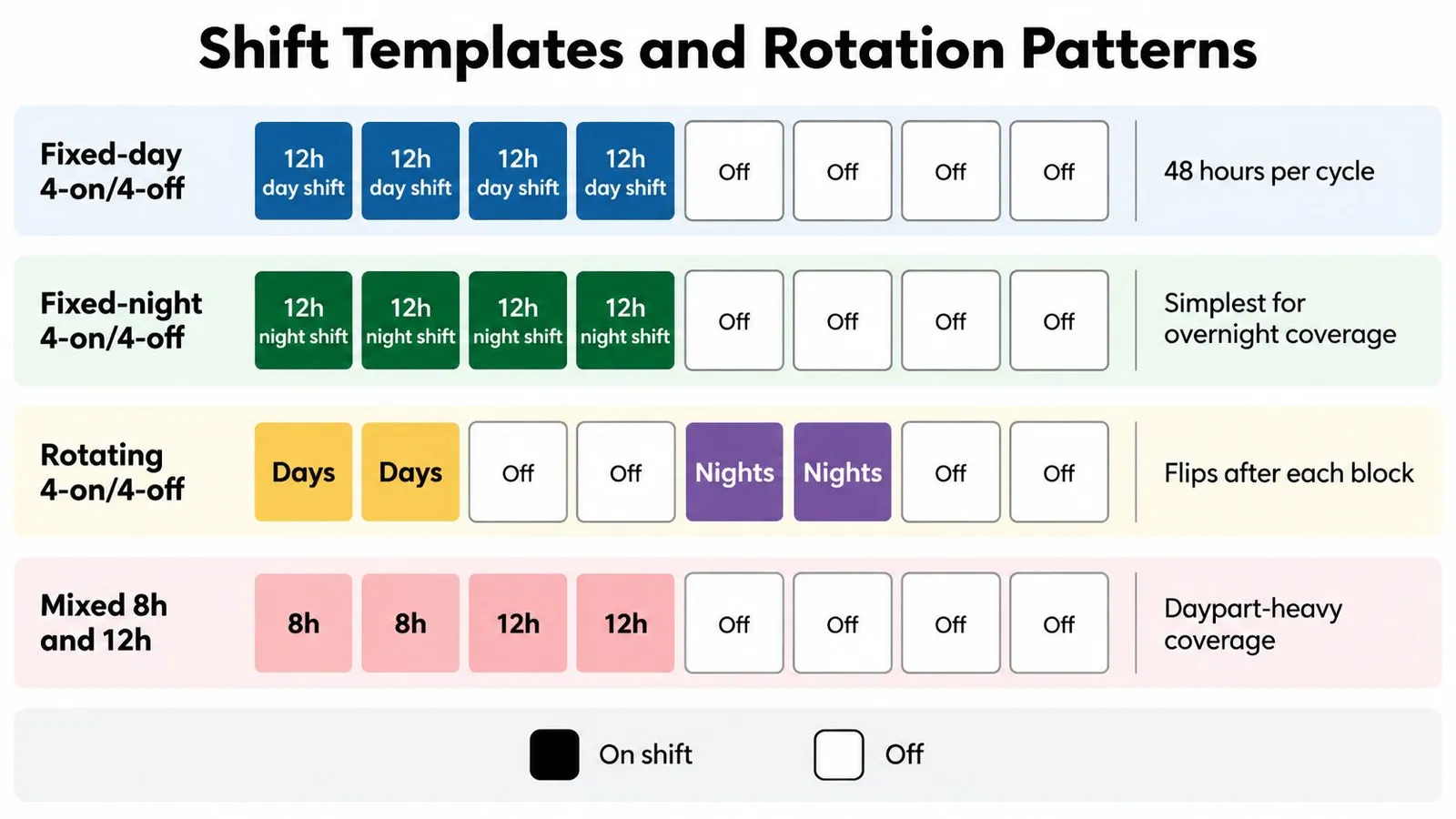
Choose the assignment model before assigning employees. Fixed days, fixed nights, and alternating blocks create different sleep and family-life demands even when their average hours match.
Working 4-on/4-off templates compared
| Template | Cycle structure | Average hours | Coverage | Best fit |
|---|---|---|---|---|
| Fixed day | 4 day shifts on, 4 off, 8-day cycle | 42 per week | Daytime only | Daypart-heavy casual dining, hotel outlets |
| Fixed night | 4 night shifts on, 4 off, 8-day cycle | 42 per week | Overnight only | 24-hour diners, ghost kitchens, overnight prep |
| Rotating 4x4x4 | 4 days on, 4 off, 4 nights on, 4 off, 16-day cycle | 42 per week | Day and night, shared across crews | 24/7 restaurants with four crews |
| Pitman 2-2-3 | 2 on, 2 off, 3 on, 2 off, 2 on, 3 off, 14-day cycle | 42 per week | 24/7 with four crews | Teams wanting shorter work runs |
The table's hours assume 12-hour working shifts. Pitman is an alternative compressed roster, not a version of the same eight-day cycle.
Pick consistency before rotation
Fixed-day assignments are simplest where daytime production justifies the hours. Fixed nights avoid repeated switches between daytime and overnight work, though employees still need realistic daytime sleep opportunities.
Rotating blocks distribute unpopular assignments. They don't make those assignments equally tolerable for every employee. For a broader comparison of compressed arrangements, the LeaveWizard compressed hours guide helps distinguish fewer working days from fewer working hours.
Use the staff schedule creation workflow to establish roles, availability, and coverage requirements before placing people into the repeating blocks.
Make sleep opportunity a constraint
A 2024 observational study of 44 male oil-company workers in Argentina found that workers on the rotating 4x4x4 arrangement averaged 5 hours 10 minutes of nocturnal sleep on workdays, compared with 6 hours 19 minutes among fixed-shift workers. It wasn't a restaurant trial, but it's a relevant caution against treating off-day totals as proof of recovery.
- Rotate forward: Prefer day-to-night movement when rotation is necessary, with recovery between blocks.
- Prevent immediate reversals: A night duty ending in the morning must never become a day duty starting that same morning.
- Publish transitions explicitly: Show the date and start time, not just a day or night label.
- Stabilize the sequence: For a pilot, aim to publish a hypothetical 12-week calendar while retaining a process for genuine emergencies.
Track shift length, transition history, and employees' ability to sleep. Fairly distributing nights is useful; distributing exhaustion isn't.
Labor Cost and Overtime Compliance
Average weekly hours aren't the payroll calculation. The FLSA uses a fixed seven-day workweek for covered nonexempt employees, and employers can't average a heavy week against a light one, as the Asure shift-rotation guide explains.
There's also an important arithmetic check: a strict repeating four-on/four-off roster cannot contain five shift starts within seven days. A claimed heavy week must therefore be checked against actual timestamps, extra duties, and the employer's workweek boundary.
Overtime impact of an eight-day cycle under a seven-day FLSA workweek
| Workweek start | Week pattern | Hours that week | Overtime |
|---|---|---|---|
| Sunday-Saturday | Light week with 3 shifts | 36 | 0 federal weekly overtime |
| Sunday-Saturday | Heavy week with 4 shifts | 48 | 8 that week, or 8 across this illustrated pair |
| Offset start mid-cycle | Claimed heavy overlap week requiring validation | 60 | 20 if those hours were actually worked |
| Offset start mid-cycle | Claimed light week requiring validation | 24 | 0 federal weekly overtime |
The last pair should not be treated as an automatic result of changing the workweek start. It isn't a valid whole-shift projection for an otherwise unchanged four-on/four-off pattern. Nor should the illustrated light-heavy pair be assumed to alternate indefinitely: the cycle continues moving through payroll weeks.
Calculate dollars from the actual roster
For a hypothetical employee earning $20 an hour, assume a $30 overtime rate solely for this worked example. A 48-hour week would cost $1,040: $800 for regular hours plus $240 for overtime. Straight-time budgeting would show $960, understating wages by $80 before payroll-related costs.
Your payroll administrator must determine the applicable regular rate, including any compensation that belongs in that calculation. Don't assume the base wage always supplies the correct overtime rate.
Budget the roster you will pay, not the average printed beside the template.
Add jurisdiction and sales
Where applicable state rules require daily overtime after eight hours, a 12-hour duty can create overtime even in a light payroll week. Meal-period rules, exceptions, and possible premiums also need local review. Don't assume a compressed roster automatically qualifies for an alternative-workweek exemption.
Use overtime tracking against scheduled and actual hours, including training, meetings, and closing overruns. For the accounting view, Blue Sage Tax & Accounting Inc.’s guidance on tracking COGS, payroll and tips connects wage decisions to the broader restaurant books.
Finally, compare projected payroll with sales by daypart. A manageable labor percentage across the full cycle can hide an expensive production block or a service period that doesn't earn its staffing.
Managing Fatigue, Swaps and Call-Offs
A repeating roster needs exception rules before the first absence. Otherwise, managers preserve coverage by spending the recovery time employees were promised.
Protect the duty block
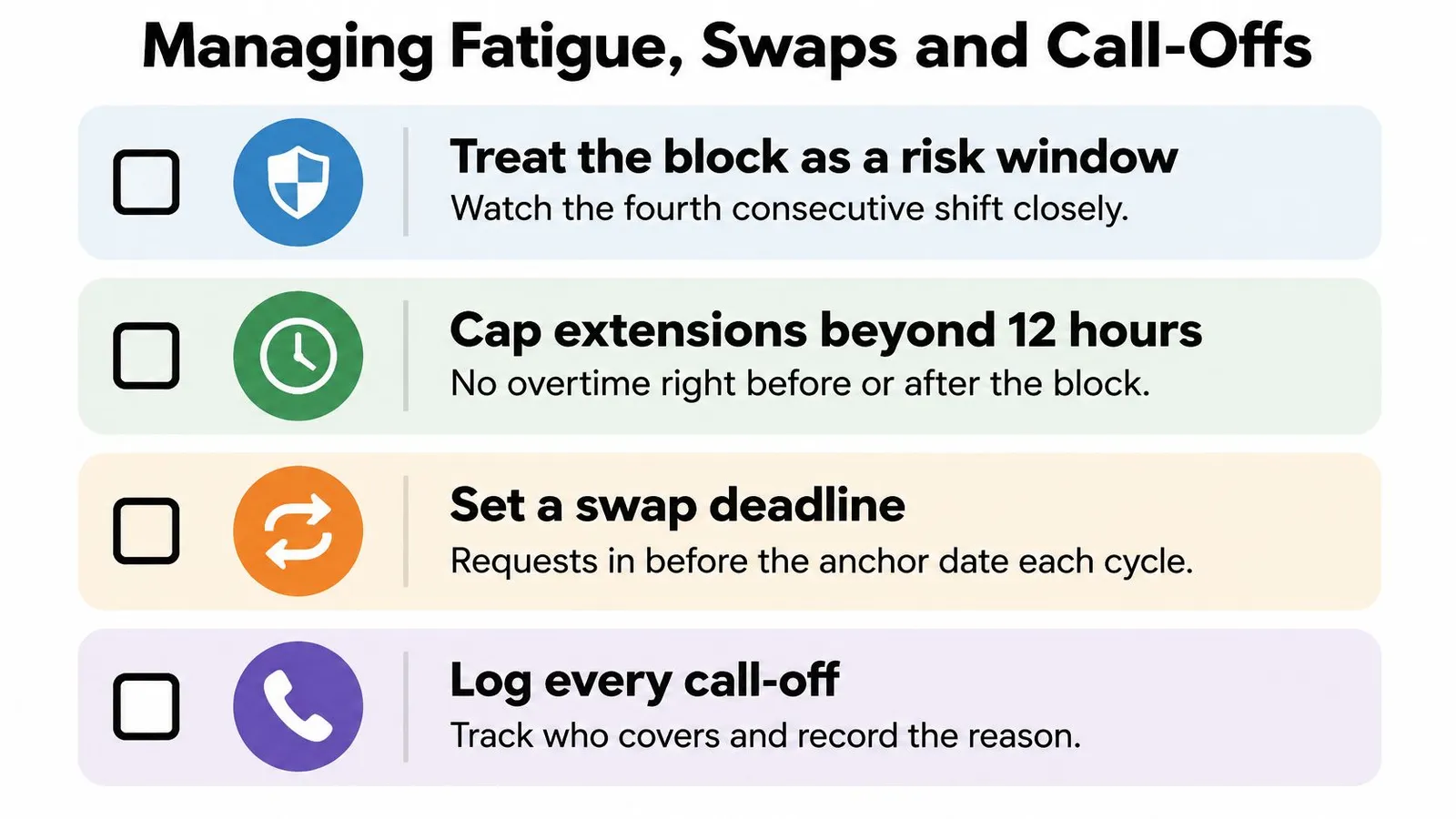
NASA's work-scheduling guidance associates more than four consecutive 12-hour shifts with excessive fatigue. Make refusing an extra consecutive duty a scheduling safeguard, not an attendance problem.
Set these operating rules:
- Control extensions: Don't routinely add opening or closing work outside the published duty window. Avoid attaching overtime immediately before or after the block.
- Protect breaks: Assign station relief so employees can leave the line. A break written on a roster but repeatedly interrupted isn't protected.
- Check the final duty: Have the supervisor review alertness, food-safety records, cash exceptions, and handoff completeness without treating fatigue disclosure as misconduct.
A review of occupational fatigue evidence reports that breaks at two-hour intervals reduce accident and error risk more effectively than longer intervals. Use that as a planning cue for relief, hydration, and recovery opportunities, alongside applicable meal requirements.
Approve safe swaps, not just willing swaps
A sleep and fatigue management review summarizes recommendations including at least 10 hours between consecutive shifts. Use that as a minimum roster safeguard, not a universal legal threshold or proof that someone is rested.
Require matching qualifications, adequate rest, and no extra consecutive long duty. Make manager sign-off part of your pilot policy, and consider a trade final only when the official roster reflects it. The restaurant shift-swap playbook is useful for putting ownership and confirmation rules in writing.
A willing replacement isn't automatically a safe replacement.
For a call-off, contact qualified backups, starting with available employees who have demonstrated dependable attendance. Fill the slot on confirmed acceptance, stop further outreach, and record who worked.
Say a closing cook calls out near the end of a block. A rested cook with the right station skills is a better option than a day employee facing a quick return, even if the latter answers first.
Set time-off request windows and rotate holiday priority. Review emergencies separately from repeated unexplained attendance failures. The objective is usable coverage and real recovery, not a perfectly symmetrical calendar.
Real-World Examples from Restaurant Schedules
These are illustrative composite scenarios, not reported restaurant case studies or measured outcomes. Their purpose is to test whether a pattern fits the work before anyone promises savings.
A continuous-service diner
Suppose a diner builds four crews of six, each containing three cooks and three front-of-house employees. It uses rotating day and night blocks across a 16-day sequence and publishes 12 weeks of dated assignments.
The manager checks each crew's supervisory and station skills rather than assuming equal headcount means equal capability. Relief employees remain outside the minimum service roster so an absence doesn't immediately require a resting crew member to return.
Transferable lesson: Continuous coverage requires complete crews and relief capacity, not just a repeating calendar.
A burger restaurant with overnight prep
Consider a fast-casual burger concept that keeps its daytime employees on conventional five-day rosters. It assigns its two-person overnight close-and-prep function to fixed-night four-on/four-off blocks.
That requires a counterpart pair to cover the resting block, plus a backup plan. The manager separates productive overnight prep from tasks that should remain with the closing service team, then checks whether the overnight workload fills the scheduled window.
Transferable lesson: Use the pattern for the hard-to-cover daypart instead of restructuring the whole restaurant.
A bakery ghost kitchen
Suppose a bakery uses 10-hour duties for overnight mixing, proofing, baking, and packing. Each employee's illustrative work block totals 40 hours across the eight-day cycle, averaging about 35 hours per calendar week.
The manager still covers the gaps outside that production window and verifies whether local daily-overtime rules apply. A shorter duty doesn't justify skipping meal relief, and the oven schedule must leave enough time for safe cleanup.
Transferable lesson: Match the employee's duty window to the production sequence, not to an attractive round number.
Before copying any scenario, map the tasks onto actual clock times. If productive work ends well before the shift does, shorten or overlap duties rather than inventing work to preserve the pattern.
Implementing the Schedule in AnchOps Step by Step
Start with a limited pilot and retain control over exceptions. Our schedules draft, fill, and publish themselves using restaurant sales history and team availability; the operator still needs to establish a safe roster policy.
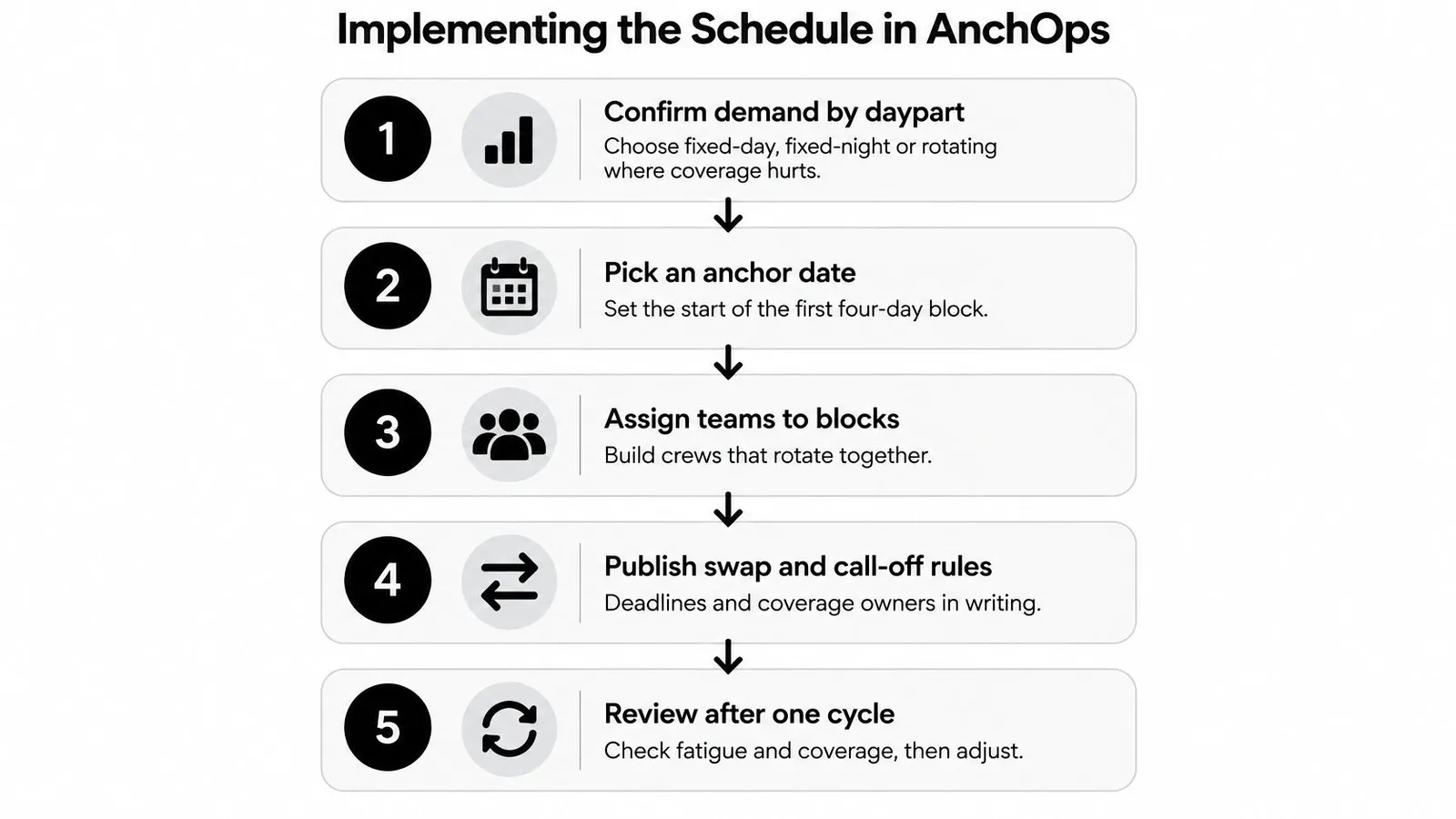
- Confirm demand by daypart. Choose fixed days, fixed nights, or rotation based on the coverage problem, not employee preference alone.
- Pick an anchor date. Build the repeating block and verify its dates across payroll boundaries. Don't assume a weekly template natively represents an eight-day rotation.
- Load availability and qualifications. Review the draft against complete-crew requirements, breaks, and actual shift windows.
- Set the labor budget. Inspect projected labor before publishing and independently validate the payroll calculation.
- Establish time-off windows. Identify difficult coverage blocks and publish fair request priorities.
- Document swap approval. Require managerial review during the pilot; distinguish that policy from peer-approved swap functionality.
- Publish and review. Send the dated roster with push notifications, then inspect coverage and overtime after two full cycles.
For the team-adoption side, Pebb's guide to digital shift scheduling offers useful context for moving away from informal scheduling messages.
Our weekly templates cut a 45-minute schedule build to under five minutes, but that weekly-template result isn't a promise about configuring this rotation. The scheduler, labor budgets, and food-cost variance are included at the same flat price as the inventory-only setup.
Run a hypothetical eight-week pilot with one crew, keeping other rosters unchanged. Compare labor percentage, call-offs, swaps, and employee recovery before deciding whether to expand.
AnchOps brings schedule drafting, qualified replacement outreach, and labor projections into the same operating workflow. Visit AnchOps to evaluate a controlled 4-on/4-off pilot with your sales history, employee availability, and labor budget before changing the whole house.
Your back-of-house partner is ready
AnchOps handles scheduling, tip calculations, labor costs, and timecards — so you can focus on your restaurant, not your paperwork.