15 Quick Games for Team Building: Boost Hospitality Teams
Published on
By Tony Newcome — Founder of AnchOps · Owner, Pizza Harbour
This article was drafted with AI assistance and reviewed by Tony Newcome, a working restaurant operator.
The best team-building games for hospitality teams rehearse the skills a hard shift demands — communication, trust, role clarity, fast decisions — in a low-stakes setting. The 15 games below, from escape rooms to scheduling-station relay races, each list time estimates and group sizes so a manager can run one before service without derailing prep, and connected teams cover call-outs faster.
That's why the best games for team building aren't random entertainment. They rehearse the same skills that restaurant teams use during a difficult shift, including communication, trust, role clarity, fast decisions, and adaptability. They also give managers a practical way to discuss availability, shift swaps, reliability, and labor coverage without turning every conversation into a policy lecture.
Game-based activities have become a mainstream workplace engagement tool in part because global engagement remains low. Gallup's 2025 State of the Global Workplace research, summarized in this team-building activities guide, places worldwide employee engagement at about 21%, while disengagement is estimated to cost the global economy $438 billion in lost productivity annually. For hospitality operators, even a short, well-designed exercise can create a useful reset.
Use these activities during onboarding, manager training, quiet shifts, pre-service meetings, or post-service debriefs. Each one connects a familiar team challenge to a real restaurant scheduling problem and an AnchOps workflow. For additional inspiration beyond the workplace, explore these unique team building experiences.
Table of Contents
- 1. Escape Room Challenge
- 2. Improv Comedy Workshops
- Turn improv into coverage practice
- 3. Relay Races with Scheduling Stations
- Reward accuracy, not just speed
- 4. Mystery Dinner Theater Role-Play
- Build empathy without exposing employees
- 5. Two Truths and a Lie Professional Edition
- Turn conversation into schedule accuracy
- 6. Shift Swap Simulation Games
- Use AnchOps as the operating reference
- 7. Diversity and Inclusion Jeopardy
- Make the information useful
- 8. Cross-Functional Rotation Challenge
- Add a reflection log
- 9. Reliability Score Challenge and Gamification
- Reward the behavior behind the score
- 10. Peer Mentorship Pods and Schedule Feedback Circles
- Make feedback produce action
- 11. Availability Bingo
- Capture the information immediately
- 12. Cover the Shift Auction
- Turn bids into better incentives
- 13. Schedule Jigsaw Puzzle
- Use the puzzle for onboarding
- 14. Blindfold Taste Test Relay
- 15. Menu Hackathon
- Connect creativity to coverage
- 15 Team-Building Games: Side-by-Side Comparison
- From Play to Peak Performance
- Match the game to the shift
- Measure behavior after the activity
- Connect play to daily operations
1. Escape Room Challenge
An escape room turns a coverage problem into a shared puzzle. Teams search for clues, test assumptions, and coordinate under a fixed time limit. That pressure resembles a Saturday call-out, when a supervisor has to identify qualified employees, assess availability, and fill a gap before service suffers.
Assign workplace-style roles before the game starts. One person can act as the manager, another as the communicator, another as the timekeeper, and another as the note-taker. The structure matters because loose participation often lets the fastest or loudest person dominate, while defined roles create a clearer parallel with restaurant operations.
Choose a theme connected to logistics, time management, or hospitality. After the game, ask participants to explain which clues helped them move forward and which information they ignored. Then connect those answers to event escape room ideas and to AnchOps tasks such as identifying reliable coverage, approving a shift swap, or contacting qualified staff.
Practical rule: The debrief is where the scheduling lesson happens. Without it, the activity may build energy but won't necessarily change how people handle coverage.
Track the team's solution process rather than treating speed as the only measure. Did participants communicate clearly? Did they confirm information before acting? Did they use each person's strengths? Those observations can become coaching points for supervisors and future team challenges.
2. Improv Comedy Workshops
A good improv workshop teaches hospitality employees to respond constructively when the original plan stops working. Facilitators introduce exercises built around accepting a colleague's contribution and adding useful information, rather than blocking the conversation. That approach fits a shift environment where a call-out, late arrival, or sudden rush demands immediate cooperation.
The activity works best when a professional local improv coach establishes the tone. Managers should explain that nobody is being evaluated as a performer. Employees need permission to be awkward, try again, and participate at a level that feels safe. Forcing reluctant employees into solo performances can create the opposite of trust.
Turn improv into coverage practice
Follow the workshop with short scheduling scenarios. One employee plays a supervisor calling about an open shift, while another plays a worker with transportation limits, a second job, or a family commitment. The supervisor practices acknowledging the constraint and continuing the conversation instead of treating a declined request as a personal rejection.
That role-play can lead directly into AnchOps' targeted outreach model. Rather than sending a broad message to everyone, managers can contact qualified employees who have the right role and availability. The team can then discuss what respectful outreach sounds like, how peer-to-peer shift swaps should work, and when a manager needs to intervene.
A quarterly workshop may suit a multi-unit group, while a quick-response exercise fits a pre-service meeting. The trade-off is simple. Improv can build flexibility and confidence, but it requires psychological safety and a facilitator who understands the difference between playful practice and public embarrassment.
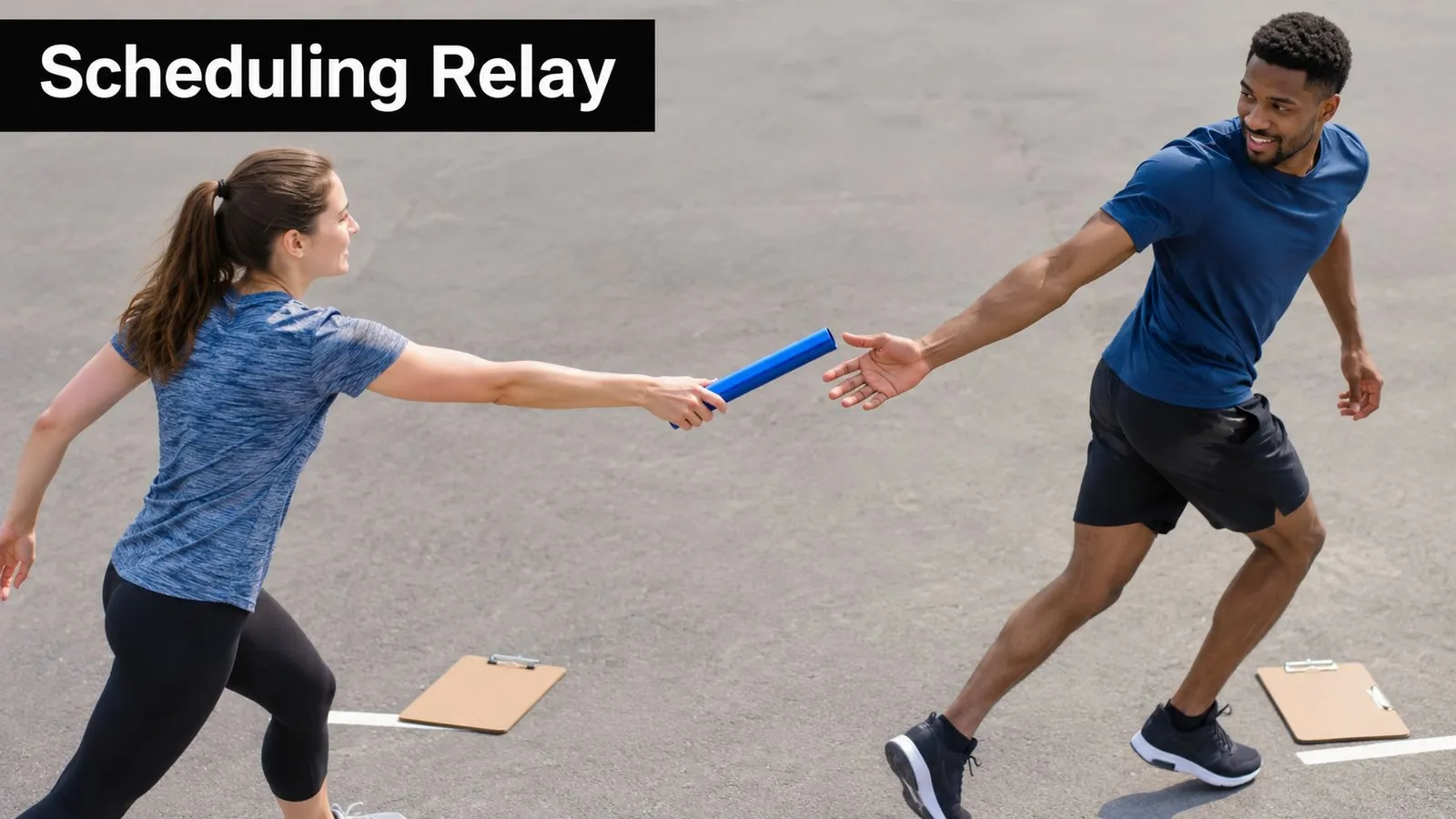
3. Relay Races with Scheduling Stations
A relay race becomes more relevant when every station represents a real scheduling decision. Instead of running for its own sake, teams move through tasks such as confirming availability, resolving a conflict, identifying a dependable replacement, and checking whether the proposed coverage fits the labor plan.
Use printed scenarios or a shared screen with anonymized staff profiles. Each team can receive an open shift, several possible employees, an availability record, and a labor constraint. The first station might ask participants to identify qualified people. The next can introduce a shift-swap request. A later station can require them to choose between a fast answer and a more reliable answer.
Reward accuracy, not just speed
Judges should verify every answer before allowing a team to continue. A fast team that assigns an unqualified employee or ignores availability hasn't demonstrated scheduling skill. That makes the exercise a useful introduction to AnchOps features such as availability settings, reliability-informed assignment decisions, labor projections, and shift coverage outreach.
Use actual operational patterns without exposing sensitive employee information. Past call-out scenarios, recurring weekend gaps, and common role conflicts are more valuable than fictional problems because managers recognize the consequences immediately. Keep the opening station easy enough to build confidence, then increase complexity.
The activity also works well at a manager summit or onboarding session. Rotate station captains so different participants practice leadership and explanation. During the debrief, ask which teams communicated best between stations. The fastest runner rarely determines the outcome by themselves. Smooth handoffs do.
For broader calendar coordination after the exercise, a shared team calendar guide can help managers discuss how availability information should remain visible and current.
4. Mystery Dinner Theater Role-Play
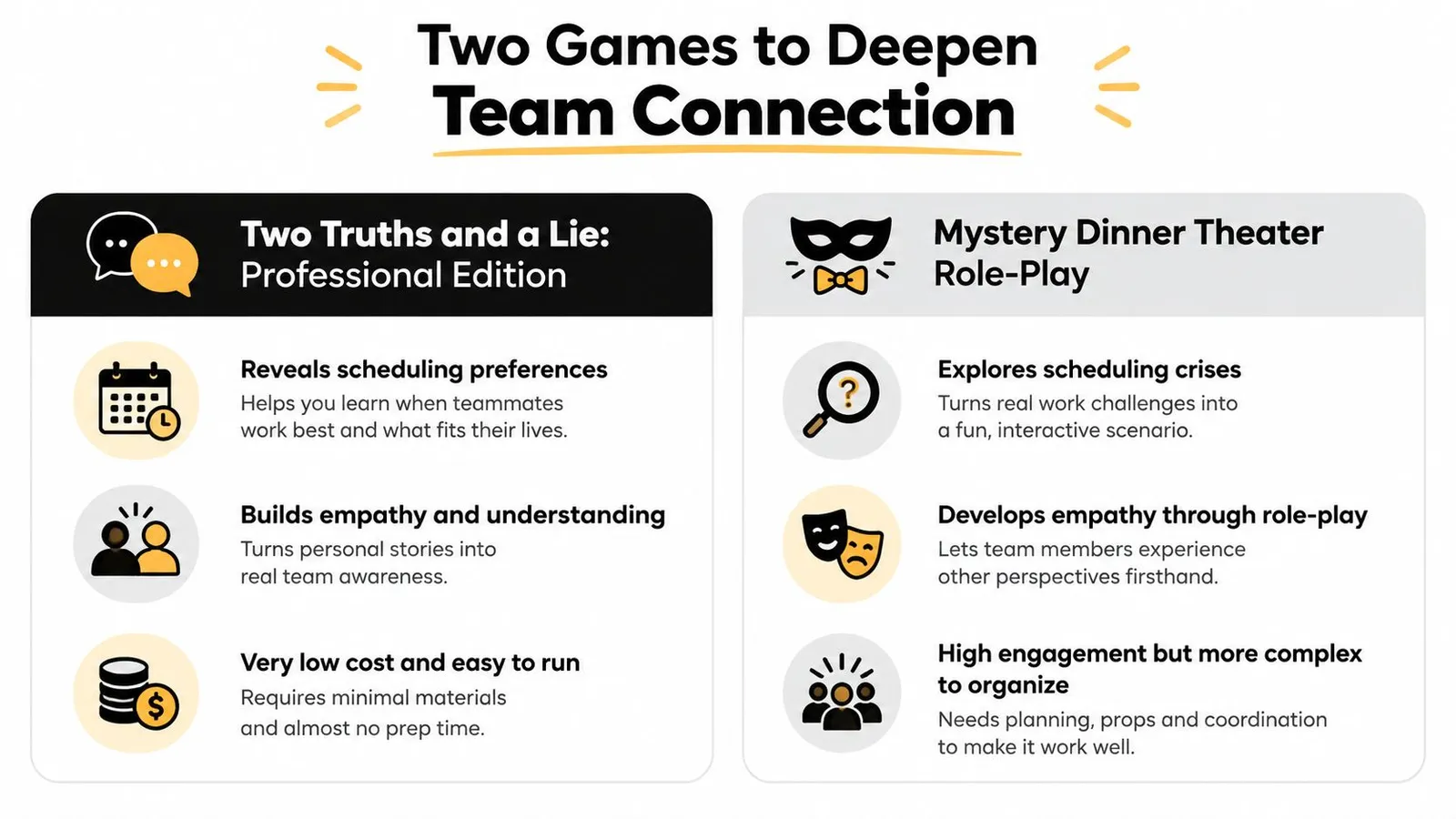
A mystery dinner can expose the human causes behind a coverage failure. Create a scenario such as “Who's covering Saturday?” and give participants different roles, including a scheduler, a shift supervisor, a new hire, a parent with a fixed pickup time, and an employee who regularly accepts extra shifts.
Each character receives partial information. One person may know that availability was entered incorrectly. Another may believe a swap was approved. A third may have accepted a shift but lacked transportation. The team investigates the problem, compares records, and proposes a response.
Build empathy without exposing employees
Use anonymized details if the scenario draws from a real incident. Including realistic scheduling data helps the activity feel relevant, but naming a real employee or reenacting a sensitive conflict can damage trust. The objective is to understand how constraints interact, not to identify someone to blame.
Give teams investigation stations with availability records, reliability history, coverage messages, and labor considerations. AnchOps can support the operational follow-up by keeping schedules, availability, shift changes, and reliability information in one system. The game should help managers see why incomplete information creates bad decisions.
After the mystery resolves, ask two questions. What did your character know that others didn't? Which decision looked unreasonable until you understood that person's constraints? Those questions move the conversation from “people are unreliable” toward a more useful analysis of process, communication, and support.
This format takes more preparation than a quick icebreaker, but it produces richer discussion. It's especially useful for annual management training, cross-location meetings, and teams that keep repeating the same coverage mistakes.
5. Two Truths and a Lie Professional Edition
Traditional two truths and a lie becomes operationally useful when the statements focus on work preferences and scheduling constraints. Each employee shares three statements, two true and one false, about upcoming availability, transportation, school commitments, preferred shift types, or factors that affect reliability.
For example, a participant might say that they can work late on weekends, need advance notice for early openings, and can't work Tuesdays. Colleagues guess the false statement, then the employee explains their actual constraints. Keep the prompts voluntary and avoid asking people to disclose medical or private family information.
Turn conversation into schedule accuracy
The value comes after the guessing. Managers should record only information employees agree to share and use it to improve the source data in AnchOps. If an employee says they can't work Tuesdays, that constraint belongs in availability settings, not in a manager's memory or an informal group chat.
This game can fit into onboarding, a monthly staff meeting, or a manager introduction for a new location. Facilitators should model the format first with harmless examples. That reduces pressure and shows employees that the activity isn't an investigation into their private lives.
The trade-off is that the game can reveal useful information quickly, but it doesn't replace a formal availability process. Participants may forget details, misunderstand the prompt, or give answers that apply only temporarily. Treat the discussion as a prompt to verify records, not as the record itself.
A short follow-up in the mobile app can confirm availability, time-off needs, and shift preferences. That connection keeps the game from becoming a pleasant conversation that disappears before the next schedule is drafted.
6. Shift Swap Simulation Games
A shift-swap simulation compresses a difficult scheduling period into a tabletop exercise. Participants receive alerts about call-outs, availability changes, open shifts, and competing coverage needs. They must decide whether to approve a swap, contact another employee, adjust the schedule, or accept a labor consequence.
Score decisions across coverage, labor cost, and fairness. A solution that fills every shift but repeatedly burdens the same reliable employee isn't sustainable. A solution that protects the budget but leaves a station uncovered isn't successful either. The point is to make trade-offs visible.
Use AnchOps as the operating reference
Build the scenario from realistic patterns, but remove identifiable employee information. Give teams role qualifications, availability, reliability signals, and labor targets. After each round, show the result. Participants should see how a poor assignment creates another problem later, such as an uncovered station, an overtime risk, or an unfair distribution of extra work.
Before running the simulation, managers can review how to handle shift swaps in a restaurant. AnchOps supports peer-to-peer swaps with coworker approval and updates the schedule automatically, which gives the exercise a practical link to daily operations.
A simulation works best when participants explain their decisions aloud. Ask when they chose proven-reliable staff, when they accepted risk, and what information would have changed their choice. Don't score only the winner. Capture the decision patterns worth sharing across locations.
Use a simpler version for a monthly staff meeting and a more detailed version for manager training. The activity takes preparation, but it gives supervisors a safe place to practice before the next real call-out arrives.
7. Diversity and Inclusion Jeopardy
Diversity and Inclusion Jeopardy helps teams learn the practical differences that affect scheduling and collaboration. Categories might include scheduling constraints, working styles, career goals, and life outside work. Questions should come from voluntary staff interviews, not assumptions about a person's background.
A question might ask which team member prefers written instructions, who is pursuing a leadership path, or which scheduling pattern creates a recurring transportation problem. Employees answer as a group, then the person involved can add context if they choose. That creates familiarity without demanding personal disclosure.
Make the information useful
Use several difficulty levels so the game rewards listening rather than specialized knowledge. More important, translate learning into a concrete operational action. If a participant explains that they must leave by a specific time for childcare, verify the availability record and schedule accordingly. AnchOps can keep that information connected to the scheduling process instead of leaving it in a manager's notebook.
The activity should never turn an employee's identity or personal situation into a trivia prize. Avoid questions about protected characteristics, health, immigration status, religion, or anything someone hasn't explicitly chosen to share. Inclusion depends on control, consent, and respectful handling of information.
This game fits a quarterly leadership session or a cross-location call. It can also reveal where managers use stereotypes instead of records. Someone who prefers closing shifts isn't necessarily available every night, and someone who asks for a predictable schedule isn't less committed. Better questions lead to better scheduling decisions.
8. Cross-Functional Rotation Challenge
Cross-functional rotation lets participants experience the same schedule from different positions. A manager may draft the schedule, then review it as a shift supervisor, and finally examine it as an employee deciding whether the schedule is workable.
Keep the role definitions explicit. The scheduler must balance qualifications, availability, coverage, and labor. The supervisor must manage service realities and handoffs. The employee needs to understand where to find the schedule, how to request time off, and how to propose a swap.
Add a reflection log
At the end of each rotation, ask participants to record what surprised them, what felt frustrating, and which assumption changed. A manager may discover that a schedule that looks balanced on paper creates an impractical arrival pattern. A staff member acting as scheduler may discover how quickly one missing availability detail creates several downstream gaps.
AnchOps gives the rotation a realistic environment. Participants can draft schedules, review availability, examine reliability information, and consider labor projections before publishing. They don't need access to private information to learn the workflow. Use a sample location or anonymized scenarios when necessary.
The trade-off is time. This isn't a five-minute energizer, but the longer format makes it useful for manager development, new-location launches, and process redesign. End with a group commitment such as improving availability collection, clarifying swap approval, or changing how supervisors communicate schedule changes.
9. Reliability Score Challenge and Gamification
Reliability becomes easier to discuss when teams treat it as a shared improvement challenge rather than a disciplinary label. Set a realistic team target based on the current baseline, then track progress through punctuality, completed covers, late arrivals, and no-shows.
AnchOps can show each employee their personal reliability score in the mobile app while managers monitor team progress. That visibility needs careful framing. Employees should understand what the score measures, how they can improve it, and where to ask questions. A leaderboard without context can create embarrassment and defensiveness.
Reward the behavior behind the score
Celebrate milestones with recognition, preferred development opportunities, or a team reward that the group values. Add peer recognition so employees can acknowledge the colleague who accepted a difficult cover, communicated early, or helped a new hire understand the swap process.
Don't make the target impossible. If the team starts from a weak baseline, a modest improvement is more credible than a demand for perfection. Managers should also investigate barriers before blaming individuals. Transportation problems, unclear schedules, poor handoffs, and unrecorded availability changes can all affect attendance behavior.
The best use of gamification is supportive. It makes progress visible and creates a shared reason to communicate early. It shouldn't encourage employees to hide a problem or accept unsafe work to protect a score.
10. Peer Mentorship Pods and Schedule Feedback Circles
Pair experienced, dependable employees with newer or struggling colleagues, then add a regular feedback circle where staff can discuss scheduling friction. Mentors can explain how to read the schedule, request time off, propose a swap, communicate a conflict, and prepare for a difficult shift.
Keep pods small enough for conversation and give mentors a simple guide. A first meeting might focus on availability and schedule visibility. A later meeting can cover coverage requests and respectful communication. Another can address what to do when a planned swap changes.
Make feedback produce action
The feedback circle needs a round-robin structure so the most vocal employees don't consume the meeting. Ask each person for one scheduling issue and one practical suggestion. Record action items with an owner and a date, then report back on what changed.
AnchOps can help managers test whether a complaint reflects a system problem. If staff say availability isn't being honored, compare the schedule with the recorded settings. If coverage messages are confusing, review how targeted outreach and swap approvals are handled. The game-like element comes from the pod structure and shared progress, not from scoring people.
Mentorship can fail when managers assign a “top performer” who doesn't want to teach. Ask for volunteers, provide coaching, and recognize the mentor's time. The arrangement should feel like professional support, not unpaid supervision.
11. Availability Bingo
Availability Bingo turns a staff huddle into a quick discovery exercise. Create cards with blocks such as early mornings, weekend evenings, midweek lunches, school pickup periods, second-job conflicts, or long commute windows. Employees speak with colleagues to find matches and fill the card.
The game surfaces patterns that managers often miss. A person may be available for Saturday lunch but not Saturday dinner. Another may be willing to close only when they aren't scheduled for an opening the next morning. These details matter when a supervisor is trying to fill coverage quickly.
Capture the information immediately
Assign a manager to record confirmed, voluntary information in AnchOps after the activity. Staff should verify any temporary or sensitive constraint through the normal availability process. The bingo card is a conversation tool, not a substitute for documented availability.
Use different cards across teams so the same people aren't always approached. A digital version can work for remote managers or hybrid groups, but it should remain easy to complete on a phone. Keep the activity short enough that employees don't feel their break has been taken over.
After someone wins, ask what surprised the group. The discussion often reveals why broad availability assumptions create last-minute swaps. Managers can then use this guide to create a staff schedule while checking the information employees have formally provided.
12. Cover the Shift Auction
A shift auction makes undesirable or high-demand shifts visible. Give employees play currency and ask them to bid on open shifts. The bids create a useful conversation about peak periods, holiday coverage, closing work, commute difficulty, and the incentives that might make a shift fairer.
Use fictional currency during the game, but base the scenario on actual patterns. A Saturday dinner shift may attract interest because of tips, while an early opening may receive fewer bids because of transportation or sleep constraints. Don't treat the highest bid as a commitment to work. It represents preference, not a confirmed assignment.
Turn bids into better incentives
Record which shifts attract strong interest and which don't. Then ask what could make a low-demand shift more workable. Options might include a premium, a more predictable rotation, training credit, or pairing with a preferred coworker. AnchOps can hold shift details and staff availability, while managers use the discussion to improve the structure around open coverage.
Rotate the auctioneer role. That gives different employees a chance to explain a shift and practice facilitating a decision. Keep the debrief focused on fairness rather than financial pressure. Employees shouldn't feel that the game exposes who needs extra income or who can't afford to decline a shift.
The auction is especially effective at a manager retreat or before a seasonal scheduling period. It doesn't solve coverage alone, but it shows where the schedule conflicts with employee preferences and where a small operational change could reduce repeated outreach.
13. Schedule Jigsaw Puzzle
Print a blank weekly schedule and cut it into pieces. Add role tiles for hosts, servers, cooks, and supervisors, then ask small teams to assemble a workable schedule. The challenge is to place each role in the correct time slot while preserving coverage and qualifications.
Start with a simple template for new hires. Add more complexity for managers, including a call-out wildcard, a role restriction, or a change in demand. Participants learn quickly that a schedule isn't a collection of isolated shifts. Moving one piece can create a gap somewhere else.
Use the puzzle for onboarding
This exercise helps new managers understand how coverage fits together before they work in a live schedule. Ask teams to explain why they placed each role where they did. If two teams choose different solutions, discuss which assumptions drove the difference.
The activity connects naturally to AnchOps' schedule-drafting workflow. Participants can compare the physical puzzle with how availability, qualifications, labor projections, and reliability information influence a digital schedule. The puzzle teaches structure, while the platform supports the operational execution.
Don't turn completion speed into the only measure. Accuracy, explanation, and awareness of hidden gaps matter more. A team that finishes first but leaves the closing station uncovered needs a different coaching conversation than a team that works carefully and checks every role.
14. Blindfold Taste Test Relay
This hospitality-specific relay uses safe, allergen-free samples and controlled movement to practice clear descriptions and listening. One partner describes an ingredient or flavor while the other follows instructions, handles a plate, or identifies the sample. Rotate roles so every participant practices speaking and receiving information.
Safety comes first. Ask about dietary restrictions, avoid hazardous pathways, and never use blindfolds near hot equipment, sharp tools, wet floors, or active service. A seated tasting version is often safer and just as useful for communication practice.
Clear instructions beat louder instructions.
The restaurant connection is immediate. A kitchen handoff, a station call, and a last-minute coverage request all depend on precise language. After each round, compare what the describer intended with what the listener understood. Ask which words reduced confusion and which assumptions created it.
Use the relay before a dinner shift only if the team has enough space and time. Otherwise, run it during training or a quiet meeting. The activity can strengthen trust, but it won't work if employees feel rushed, unsafe, or pressured to disclose dietary information.
15. Menu Hackathon
A menu hackathon asks teams to create a pop-up item with limited ingredients, a defined budget, and a short decision window. Assign roles such as concept lead, ingredient planner, service representative, and cost reviewer. The structure mirrors restaurant work, where creativity must coexist with inventory, labor, speed, and margin constraints.
Use AnchOps labor cost data to set realistic boundaries for the exercise. Teams should explain how their item affects prep time, station workload, service flow, and staffing. Peer voting can identify the most appealing concept, but the final decision should also consider operational feasibility.
Connect creativity to coverage
A dish that looks profitable may require an extra prep shift or create a bottleneck during peak service. A simple item may be easier to execute with the current team and equipment. Ask participants to map their menu decision to schedule needs, including who preps, who cooks, who serves, and how a call-out would affect the plan.
A café can run a short version during an opening meeting. A hotel food and beverage team may use a remote format with photos and written proposals. A gastropub can test winning ideas in a controlled way, but the game shouldn't imply that every creative suggestion will become a permanent menu item.
For operators balancing menu decisions with labor planning, this restaurant and sports bar menu guide provides a useful operational connection. The strongest hackathon teaches teams that guest experience, labor allocation, and execution quality are one decision, not separate departments.
15 Team-Building Games: Side-by-Side Comparison
| Activity | 🔄 Implementation Complexity | ⚡ Resource Requirements | 📊 Expected Outcomes | Ideal Use Cases | 💡 Key Advantages (⭐ effectiveness) |
|---|---|---|---|---|---|
| Escape Room Challenge | 🔄 Medium, external booking or custom scenario prep | ⚡ Moderate time (1–2 hours), cost per person, venue or virtual host | 📊 Improves teamwork, decision-making under pressure; measurable schedule accuracy gains | Team bonding, crisis-communication practice, manager retreats | 💡 Themed relevance + instant debriefs. ⭐⭐⭐⭐ |
| Improv Comedy Workshops | 🔄 Medium, needs skilled facilitator and psychological safety | ⚡ 90–120 minutes, facilitator fee, low materials | 📊 Boosts spontaneous communication, confidence in rapid scheduling calls | Training for last-minute coverage, communication skill-building | 💡 Pair with role-play calls for transfer. ⭐⭐⭐⭐ |
| Relay Races with Scheduling Stations | 🔄 Medium, course design and safety planning | ⚡ Short (30–45 min), space required, minimal equipment | 📊 Teaches scheduling mechanics, speed+accuracy trade-offs; measurable time/accuracy metrics | Large groups, engagement-focused training, manager summits | 💡 Use real scenarios at stations; judge accuracy. ⭐⭐⭐⭐ |
| Mystery Dinner Theater Role-Play | 🔄 High, scripted scenario and facilitator or actors needed | ⚡ 2–4 hours, high prep cost, potential external talent | 📊 Deep empathy, perspective-taking; strong qualitative insight into root causes | Deep-dive empathy training, leadership retreats | 💡 Use anonymized real data for relevance. ⭐⭐⭐ |
| Two Truths and a Lie: Professional Edition | 🔄 Low, minimal facilitation needed | ⚡ 15–30 minutes, no cost, works virtual/in-person | 📊 Surfaces availability constraints and preferences; builds rapport | Quick huddles, onboarding, remote teams | 💡 Record findings into scheduling system. ⭐⭐⭐ |
| Shift Swap Simulation Games | 🔄 High, custom simulation and knowledgeable facilitator | ⚡ 2–3 hours, design effort, small group scale (4–12) | 📊 Directly trains scheduling decisions; measurable reductions in unfilled shifts | Manager training, decision-making practice, pilot cohorts | 💡 Use real data & surprise events. ⭐⭐⭐⭐⭐ |
| Diversity and Inclusion Jeopardy | 🔄 Medium, requires staff interviews and question prep | ⚡ 60–90 minutes, prep time, facilitator | 📊 Raises empathy, reduces bias; hard-to-measure long-term scheduling impact | Culture-building, empathy workshops, large-group engagement | 💡 Anonymize sensitive inputs; translate answers into schedule notes. ⭐⭐⭐ |
| Cross-Functional Rotation Challenge | 🔄 High, multi-week coordination and role coverage | ⚡ Weeks-long commitment, coverage planning, training | 📊 Deep systemic empathy and operational insight; durable behavior change | Leadership development, systemic process improvement | 💡 Couple with reflective debriefs and documented actions. ⭐⭐⭐⭐ |
| Reliability Score Challenge & Gamification | 🔄 Low–Medium, needs ongoing facilitation and fair framing | ⚡ 30–90 day campaigns, use AnchOps data, minimal cost for rewards | 📊 Direct measurable lift in reliability and fewer no-shows | Teams seeking measurable reliability improvements | 💡 Keep goals realistic; celebrate milestones. ⭐⭐⭐⭐⭐ |
| Peer Mentorship Pods & Feedback Circles | 🔄 Medium, mentor selection/training and scheduling | ⚡ 4–8 week program, facilitator support, documentation time | 📊 Improves retention, reliability, and knowledge transfer | New-hire integration, culture change, continuous improvement | 💡 Train mentors; publish action items. ⭐⭐⭐⭐ |
| Availability Bingo | 🔄 Low, simple design and brief facilitation | ⚡ 15–30 minutes, printed/digital cards, quick debrief | 📊 Rapidly surfaces availability patterns for schedule inputs | Pre-shift huddles, onboarding, hybrid teams | 💡 Include childcare/commute blocks; update system after play. ⭐⭐⭐ |
| Cover the Shift Auction | 🔄 Medium, auction facilitation and realistic shift prep | ⚡ 30–40 minutes, play currency, facilitator | 📊 Reveals shift desirability and guides incentive design | Incentive structuring, holiday/peak staffing planning | 💡 Translate bids into premium pay or perks. ⭐⭐⭐ |
| Schedule Jigsaw Puzzle | 🔄 Low–Medium, puzzle creation and role mapping | ⚡ 25–40 minutes, printed puzzle sets, reference templates | 📊 Reinforces role-coverage needs and template use | Onboarding, quick hands-on training, small groups | 💡 Add wildcard pieces to simulate call-offs. ⭐⭐⭐ |
| Blindfold Taste Test Relay | 🔄 Low, simple setup but safety considerations | ⚡ 15–20 minutes, safe samples, clear pathing | 📊 Strengthens concise communication and trust | Quick warm-ups, kitchen line communication training | 💡 Screen allergies; constrain movement area. ⭐⭐⭐ |
| Menu Hackathon | 🔄 Medium, ingredient prep and budget setup | ⚡ 45–60 minutes, ingredient costs if tasting, presentation time | 📊 Boosts creative resource management and budget discipline | Cross-functional teams, budget-awareness training | 💡 Use labor-cost data to set realistic budgets. ⭐⭐⭐ |
What Makes a Team-Building Game Actually Work?
Games for team building work best when they resemble the pressure employees experience. A generic icebreaker may create a few laughs, but a coverage simulation, availability exercise, or role rotation gives the team language for a problem they'll face during the next shift. The activity becomes valuable when employees can recognize the connection between the game and the work.
Start with the problem you want to improve. If supervisors struggle to communicate during call-outs, use improv, the escape room format, or the blindfold communication relay. If employees misunderstand one another's availability, use Two Truths and a Lie or Availability Bingo. If managers make inconsistent coverage decisions, use the shift-swap simulation or schedule jigsaw puzzle.
Keep the format realistic for hospitality. A restaurant team can't always attend a long off-site session, and shift-based employees may never share the same schedule. Practical resources often place workplace games in short time boxes, with many activities fitting between 15 and 45 minutes, while some use small groups of 7 to 12 people or one-minute conversation rounds. These activity constraints are summarized in this team-building activities resource. For fragmented teams, repeatable short sessions are usually more workable than one large event.
Match the game to the shift
Run a two-minute prompt during a pre-service huddle when the objective is awareness. Use a structured challenge during a quiet shift when the team can practice a workflow. Schedule a deeper simulation for manager training, onboarding, or a location meeting. If people can't attend at the same time, use an async version with written scenarios, short mobile responses, and a later debrief.
Attendance matters, but forced participation can undermine trust. Explain the purpose, offer alternatives for physical or performance-based activities, and avoid games that rely on speed, extroversion, loudness, or physical ability. Accessibility-first design is becoming more visible in gaming, including industry-backed accessibility tags introduced in 2025, as described by Microsoft's accessible games initiative. Hospitality teams should apply the same principle by making participation requirements clear before the activity begins.
A game also needs a debrief. Ask what happened, which behaviors helped, and where the team created friction. Then select one operating change, such as updating availability, clarifying swap approval, assigning roles during a call-out, or reviewing how managers choose replacement staff. Without that step, the team may remember the entertainment but miss the lesson.
Measure behavior after the activity
Don't promise that one game will fix engagement or attendance. Meta-analytic evidence covering 51 articles, 72 interventions, 194 effect sizes, and 8,439 participants found positive, statistically significant, medium-sized improvements in teamwork behaviors and team performance, with stronger results from interventions emphasizing role clarification and goal setting. The findings are summarized by the University of Bath research portal. That supports a practical approach. Design each activity around a behavior, then follow up on that behavior.
A randomized controlled study of team video games offers another useful example. In a geocaching task, teams using the video-game intervention improved by 49.6% on average compared with 20.3% for control groups, a 29.3 percentage-point difference, and the study reported a positive team-flow effect two weeks later. The results are available in the published geocaching intervention study. The lesson isn't to buy a video game for every team. It's to choose an activity that requires direct communication and coordinated action, then check whether the effect lasts.
A structured intervention using a 10-minute warm-up, 35-minute cooperative game, and guided debrief reported improved cohesion and communication quality sustained for at least six months. The format is described in this team-building game intervention. That sequence is easy to adapt for a restaurant: warm up with a quick availability prompt, run a coverage challenge, and finish by committing to one schedule-process improvement.
Connect play to daily operations
AnchOps gives managers a way to carry the lesson into the workday. Autonomous schedule drafts can use sales history and employee availability. Targeted outreach can contact qualified employees about open shifts, while the first confirmation fills the slot. Managers can choose draft-only assistance, approval-based publishing, or more autonomous workflows depending on the location.
Employees can use native iOS and Android tools to view schedules, submit availability and time-off information, track tips, and participate in peer-to-peer shift swaps. AnchOps also includes a built-in time clock, POS-synced timecards, batch approval, and payroll export. For restaurants using Toast POS, the platform can calculate tip pools, tip-outs, delivery, and cash declarations from sales data.
Those features don't replace good management. They reduce the administrative noise that prevents managers from coaching, debriefing, and supporting their teams. Reliability scoring can inform assignment decisions, while labor projections and mid-shift alerts help managers see when actual labor is moving beyond target. The game creates the conversation. The operating system helps the team apply it.
Use a simple rhythm. Choose one activity, define the behavior it targets, run the exercise, debrief immediately, and review the relevant AnchOps signal later. That might mean checking whether availability was updated, whether open shifts were filled with less confusion, whether swaps were approved correctly, or whether supervisors communicated earlier about a risk.
A structured team-building habit can also support a broader engagement strategy. Workplace event reporting summarized by this team-building survey says nearly three-quarters of respondents named relationship building or relaxation as primary outing goals, while 30% cited communication improvement. The same reporting identifies scavenger hunts and escape rooms among the most frequently successful activity types, and broader 2026 compilations report that 63% of companies use gamification in team building to support engagement and learning. For a hospitality operator, the practical takeaway is to protect the social benefit while making the activity relevant to service and scheduling.
Start small. Run Availability Bingo before a huddle, a schedule jigsaw during manager onboarding, or a short shift-swap scenario during a quiet period. Capture what the team learns, update the relevant information, and revisit the result during the next training rotation. Fun team building pays off when it produces clearer communication, fairer coverage decisions, fewer preventable surprises, and a stronger service culture.
AnchOps helps shift-based teams automate scheduling, fill open shifts, manage swaps, track reliability, control labor, and keep schedules accessible through web and mobile tools. Connect each game to a real operating improvement, then invite your team to explore AnchOps and put those lessons into practice.
Your back-of-house partner is ready
AnchOps handles scheduling, tip calculations, labor costs, and timecards — so you can focus on your restaurant, not your paperwork.