Food Cart Regulations: A City-by-City Compliance Guide
Published on
By Tony Newcome — Founder of AnchOps · Owner, Pizza Harbour
This article was drafted with AI assistance and reviewed by Tony Newcome, a working restaurant operator.
An official New York City vending-cart license was reported to cost $200 for two years, while permit scarcity helped produce a secondary market in which permits could sell for as much as $25,000, according to City Journal's account of New York street food vending. That gap is the key lesson in food cart regulations. You're not buying one permission. You're coordinating a permit for the cart, credentials for the people on it, approval for each stop, and equipment that passes inspection on a busy day, not just on paper.
Get one layer wrong and the others don't save you. A licensed operator can still be moved off a narrow sidewalk. A permitted cart can fail because its wastewater tank is too small. I would map every stop before spending money on a build.
Table of Contents
- Permits and Licenses Every Food Cart Needs
- Why Approvals Stack Instead of Substituting
- Using the Table Before You Buy
- Pre-Application Compliance Check
- The Pre-Inspection Walk
- Equipment Specs for Water, Waste and Temperature
- Why the Waste Tank Is Bigger
- Temperature and Close-Down Duties
- Location, Zoning and Street Rules for Each Stop
- The New York City Tape Measure Test
- When Private Permission Is Not Enough
- Permit Caps, Waiting Lists and Fees
- What a Cap Does to a Launch Date
- Fees Outside Capped Systems
- City-by-City Differences and Overlapping Permits
- The Boundary Problem
- Rules Move Under Your Route
- Common Pitfalls and Next Steps
- Five Pitfalls to Avoid
- Your Next Four Calls
Permits and Licenses Every Food Cart Needs
Scan this table stop by stop, not just business by business. The same cart can clear the health department and still fail at the curb.
| Permit or approval | What it covers | Example from research | Typical issuer |
|---|---|---|---|
| Vendor or personal licence | Operator and worker credentials | NYC: vendor permit plus eight-hour personal-vending course | City licensing office |
| Health or food permit | Food handling and cart design | LA County: exempt if 25 sq ft or less and prepackaged or whole produce only | County health department |
| Street or vending permit | Use of public right of way | Seattle: Street Use vending permit alongside Public Health permit | City street-use or transport office |
| Zoning and property approval | Where the cart may stop | Toronto: zoning compliance and property-owner permission | City planning office and property owner |
| Commissary agreement | Where food is prepared and waste is disposed | Seattle: approved commissary in King County unless exempted | Health department |
| Restroom access | Staff toilet and handwashing access | Seattle: restroom within 500 feet with water at least 100°F | Health department |
| Fire and safety approval | Fire suppression and any gas or generator use | Set by local fire code for your fuel and equipment setup | Local fire authority |
| Insurance and tax registration | Liability cover and sales tax | Set by your insurer, landlord or event, and tax jurisdiction | Insurer and state or city tax agency |
Why Approvals Stack Instead of Substituting
A vendor permit doesn't prove your sink works. A health permit doesn't give you the sidewalk. Property-owner consent doesn't waive zoning, and a commissary agreement doesn't satisfy a restroom rule at a distant stop. Treat each row as a separate yes you need to collect, in writing, with an expiry date.
That stacking is why a cart that's legal at a commissary-adjacent lunch spot can become noncompliant two neighborhoods away. The menu hasn't changed. The restroom distance, sidewalk width, property line and municipal boundary have.
Don't ask a city, "What permit do I need?" Ask, "For this cart, this menu, at this address, during these hours, which approvals apply?"
Using the Table Before You Buy
Bring the table to the licensing office, health department and street-use office separately. Note who answered, when, and what document they want first. If you're comparing a cart with a larger mobile setup, reviewing the permits for starting a mobile kitchen helps you see where truck rules diverge before you commit to a format.
Workers need their own paper trail too. Pair the cart permit file with your team's food credentials, and check whether your operation needs a broader food certification license for the people handling food. I would not sign a cart purchase until every row has a named issuer, a fee or quote, and a realistic issue date for your first planned stop.
Pre-Application Compliance Check
Don't start with the application form. Start with the route, because food cart regulations attach to places and hours as much as to your business name.
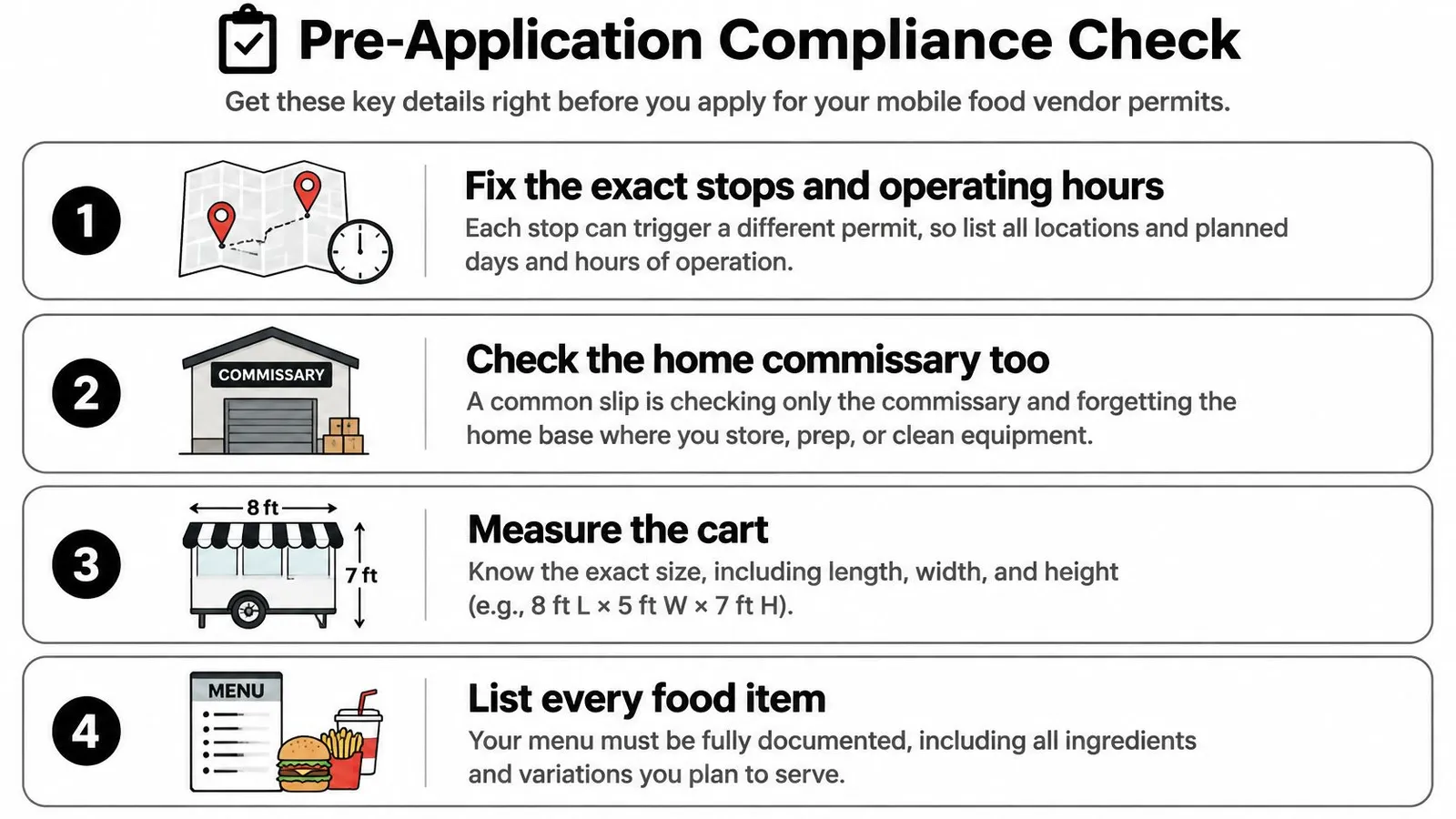
Fix the exact stops and operating hours. Write the address, side of street, arrival time and closing time for each stop. Each one can trigger a different street, zoning or property rule. The common slip is checking only the home commissary. That's your base, not your operating site, and inspectors judge you where you're selling.
Measure the cart and list every food item. Record footprint, height and any attached coolers, then list each menu item as packaged, whole produce, or unpackaged and prepared. Small doesn't automatically mean exempt. Your exemption, if any, depends on both size and exactly what you sell, so don't round the measurement or leave a sauce or cut item off the list.
Confirm two separate sink capabilities. A cart handling unpackaged food generally needs a dedicated hand-washing sink with pressurized hot and cold water, plus an on-cart three-compartment warewashing sink or documented daily access to an approved one at another licensed facility, as the BHC Public Health mobile food unit requirements explain. A hand sink alone doesn't satisfy warewashing. One removes pathogens from hands. The other cleans, rinses and sanitizes utensils.
Check tank sizes, heater and fit before you buy. Confirm clean-water capacity, wastewater capacity, water-heater recovery and whether every cooler, table and container physically fits on the cart. Get plan review before buying, building or modifying where your city offers it. Retrofitting a finished cart around a bigger tank or sink is where cheap carts stop being cheap.
Secure a signed commissary agreement that matches your hours. It needs to cover storage, prep, warewashing if you're relying on it, water filling and waste disposal at the times you'll return. A commissary that closes before your evening service ends creates a same-day compliance problem, even if the agreement looks fine in a folder.
Build a site card for each stop. Measure placement distances, restroom distance and sidewalk width. Add the permit that applies there, display requirements and the property owner's written consent. Keep one card per stop on the cart so a substitute operator can set up in the same legal spot without guessing.
Keep an approvals file with expiry dates. Store originals safely and keep inspection-ready copies on the cart. Track renewal dates alongside staff credentials. The same discipline matters if you're learning how to open a bakery, because a fixed site still lives or dies on document dates.
Assign sanitation tasks to named shifts. Someone must own handwashing checks, temperature logs, waste removal and sidewalk clearance every day. We built AnchOps so schedules draft, fill, and publish themselves using the restaurant's sales history and team availability, which makes it easier to attach those duties to real shifts. It costs $59.99 per location per month, flat, including scheduling, inventory, food cost, and tips with unlimited employees.
The Pre-Inspection Walk
Finish with water running, not paperwork alone. Test both sink functions, check pressure and hot water, label tanks, confirm wastewater can drain where it should, and place documents where an inspector can see them. Drive the route from commissary to first stop. If you can't fill, sell, dump and clean in that order without improvising, you're not ready to apply.
Equipment Specs for Water, Waste and Temperature
A cart can pass a paperwork check and still fail inspection because its sinks, tanks, and holding equipment do not work as a connected system. The stop's service length and menu affect how much water and waste capacity the cart needs, while city rules set the minimum equipment specs.
| Requirement | Limit or specification | City source |
|---|---|---|
| Potable water tank | Enclosed and sloped to drain | Houston, Texas |
| Potable fill connection | Permanently installed and labelled, no larger than three-quarter inch | Houston, Texas |
| Waste tank | Leak-proof, permanently installed, 15% larger than potable tank | Houston, Texas |
| Clean-water tank for handwashing sink | At least 5 gallons | Minneapolis, Minnesota |
| Cold holding | 41°F (5°C) or below | Houston, Texas |
| Hot holding | 135°F or above | Houston, Texas |
| Sidewalk clearance | Keep area within 15 feet of vehicle clean | Media, Pennsylvania |
| Overnight storage | No food vehicle left unattended or unsecured | Media, Pennsylvania |
| Liquid waste | Approved sanitary sewer; grease to approved interceptor | La Porte, Texas |
Why the Waste Tank Is Bigger
Houston requires an enclosed potable-water tank sloped to drain, a permanently installed and labelled fill connection no larger than three-quarter inch, and a leak-proof waste tank with 15% greater capacity than the potable tank, according to Houston's mobile food unit requirements. A 50-gallon potable tank therefore needs a waste tank with at least 57.5 gallons of capacity.
That difference is a reserve, not spare space to ignore. Handwashing, rinsing, and ice melt all add wastewater during service. Size the tanks for the busiest plausible shift, especially if the cart will work a long event without returning to the commissary. For upkeep, see how to maintain a poly water tank.
Temperature and Close-Down Duties
Houston also requires equipment capable of keeping time and temperature control foods at 41°F or below when cold-held and 135°F or above when hot-held. Check food with a calibrated probe rather than relying only on the unit display. Test after repeated lid openings, too: equipment that recovers slowly can lose temperature control during a rush.
Tank capacity and temperature equipment shape the close-down routine. The cart needs enough sealed capacity for waste and liquids, and grease must go to an approved interceptor. Plan how food will be secured overnight and how the area around the cart will be cleaned. A nearby dumpster is not a substitute for approved disposal or storage. Make sure the equipment, waste route, and service schedule work together before inspection.
Location, Zoning and Street Rules for Each Stop
One measurement can make a permitted cart unusable at a stop. Check the space, the rules for that property and the cart's actual footprint together, before promising a location to an event or landlord.
The New York City Tape Measure Test
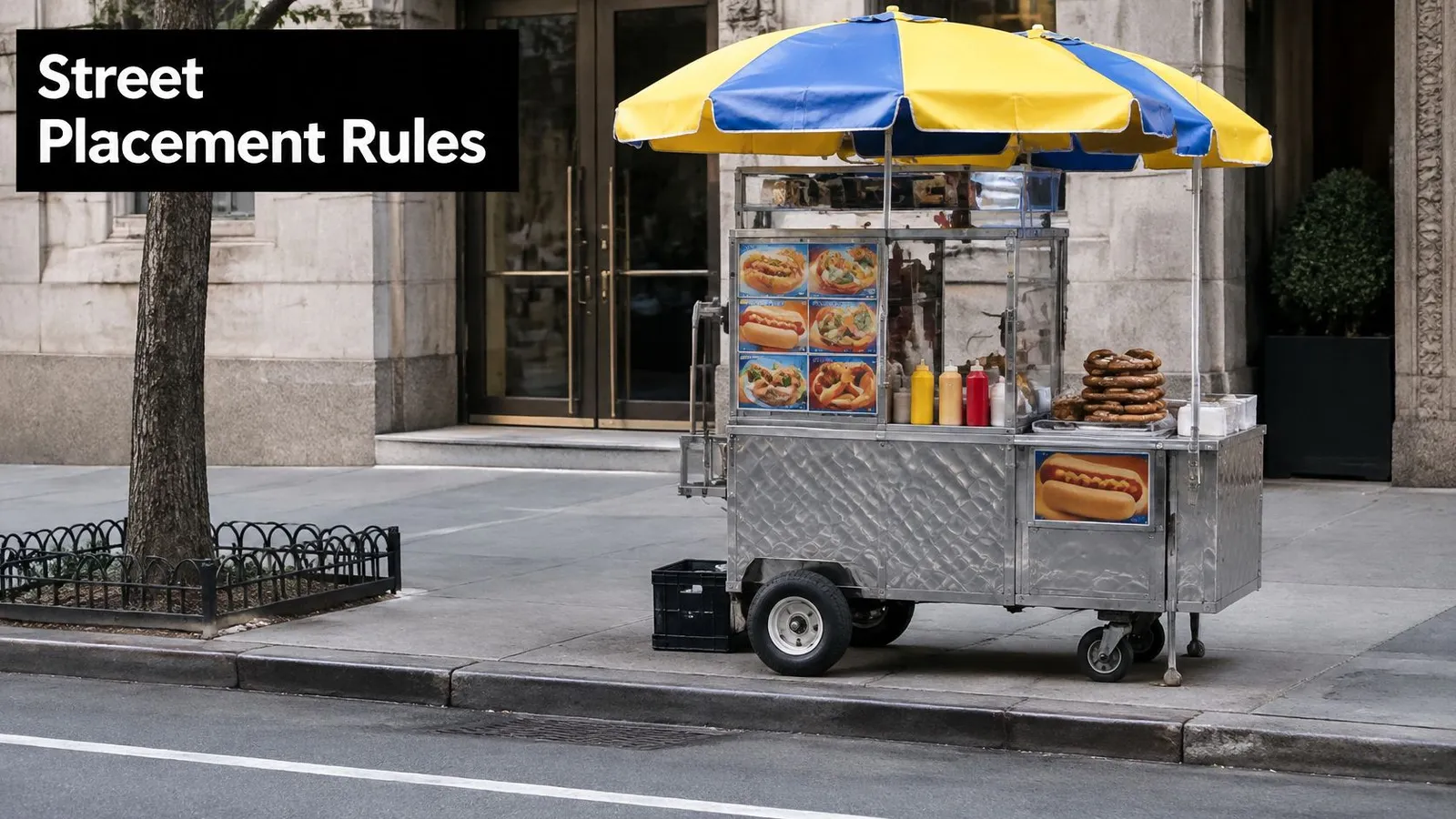
New York requires a food-vendor license for the operator and a separate cart permit through the Department of Health and Mental Hygiene. Sidewalk vending is prohibited on sidewalks narrower than 12 feet. The cart must be next to the curb, at least 20 feet from building entrances, and at least 10 feet from crosswalks, subway entrances, and driveways, according to New York City's street vending enforcement guidance. Operators must also keep a 2-foot perimeter around the cart free of litter and dispose of waste, grease and liquids at the commissary at day's end.
A valid permit, commissary agreement and worker license do not make every sidewalk a workable stop. If the only open space at lunch measures nine feet, the cart cannot vend there. Moving it to satisfy one distance may put it too close to an entrance or crosswalk, so measure the full setup before committing.
Measure from the cart's outermost edge, including handles and coolers, and account for the queue space you plan to use. The usable footprint matters as much as the cart's position.
When Private Permission Is Not Enough
A property owner's approval does not settle zoning or public-way requirements. In Toronto, a cart may have zoning compliance and the owner's permission but still need the appropriate owner licence; vending on city property may also require a sidewalk-vending permit for a designated location. Distances from restaurants and other vendors can further limit which sites are usable. A space that appears open early may not remain clear through lunch.
Los Angeles has a separate jurisdictional split: county registration and a City of Los Angeles sidewalk or park permit are different authorizations. A route crossing a boundary may require both. Approval for a private lot does not authorize vending on a public way, and public-way authorization does not give permission to use the adjoining private lot.
Keep a site card for each stop. Record measured distances, the permit covering that exact location, written owner consent where needed, and a photo of the cart in its intended position. Those details help staff set up consistently and give an inspector a clear account of the placement. Because city rules and available spaces can change, check the requirements for each stop before service.
Permit Caps, Waiting Lists and Fees
A low permit fee does not guarantee a timely launch. In a capped market, the wait can cost more than the application, especially if you commit to a cart or commissary before confirming that your permit category is available.
What a Cap Does to a Launch Date
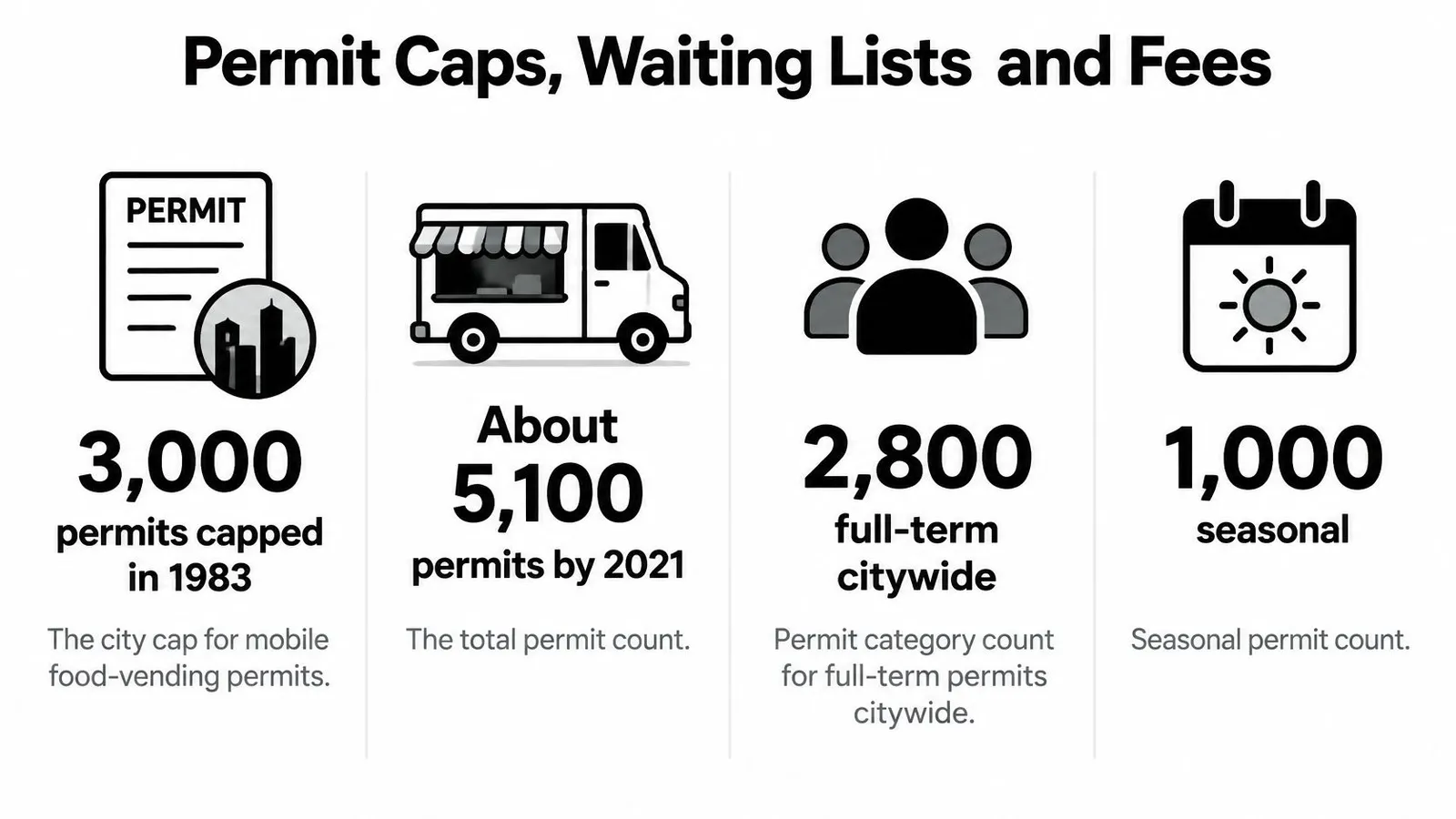
New York capped mobile food-vending permits at 3,000 in 1983. By 2021, the system included approximately 5,100 permits: 2,800 full-term citywide, 1,000 seasonal, 200 borough-specific, 100 for veterans or people with disabilities, and 1,000 green-cart permits, according to the New York City Independent Budget Office fiscal impact analysis. Even after permits are added, that total does not mean every category is open or that an application will lead to an immediate start.
A permit tied to one season or borough cannot automatically cover another stop. Before valuing a permit offered with a cart, check its geographic limits, duration, and whether it can legally transfer. The permit must match the place and dates you intend to operate, or the equipment and site may be ready while your launch remains on hold.
Fees Outside Capped Systems
Where permits are more readily available, fees may be modest, but renewal timing still affects operating plans. A downtown lane-closure permit can have a low fee per cycle and still require frequent renewal. An annual roadway-site fee is easier to calendar, but may sit alongside separate health, fire, and business charges. Rules and fees can change, so confirm current requirements before committing money.
Before signing a commissary lease or buying a cart, ask four questions: Is there a cap? How long is the queue for the exact permit category? Where is the permit valid? Can it transfer legally, and to whom?
- Permit type: Confirm whether it is seasonal, borough-specific, citywide, or site-specific.
- Queue reality: Ask how many permits were issued in the current cycle, not only how to join the list.
- Total carrying cost: Include commissary rent and insurance during the wait, not just the city fee.
A long queue is a reason to reconsider the city, format, or launch date. Treating it as a paperwork delay can leave you paying for a cart and operating space before you have the right to vend.
City-by-City Differences and Overlapping Permits
A permitted cart can still lose a stop because a restroom is too far away, equipment does not fit, or a street-use approval is missing. Compare rules at the actual location, not just by permit name. A single stop may depend on health approval, cart specifications and street access at once, and those rules can change.
| City | Main permit or rule | Specific requirement |
|---|---|---|
| New York City | Vendor permit and personal licence | Eight-hour course; 2,800 full-term cart permits citywide |
| Seattle | Public Health permit plus Street Use permit | Restroom within 500 feet with water at least 100°F; King County commissary |
| Minneapolis | Food-plan review before purchase | Clean-water tank of at least 5 gallons; all equipment must fit on the cart |
| Los Angeles County | Health permit exemption | 25 sq ft or less and prepackaged or whole produce only |
| Toronto | Owner licence and zoning compliance | At least 25 metres from an operating restaurant or another food vendor |
| Houston | Water and waste system rules | Waste tank 15% larger than potable tank |
| La Porte, Texas | Restroom and waste rules | Restroom within 300 feet when operating in one place for more than two hours |
| Media, Pennsylvania | Sidewalk and overnight rules | Keep 15 feet clean; remove all waste daily |
| Nashville, Tennessee | Mobile food vendor pilot | $55 fee for downtown-core lane closure, renewed every 2 months (2024) |
| Washington, D.C. | Mobile roadway vending-site permit | $150 annual fee (2024) |
The Boundary Problem
Seattle illustrates how street access and health requirements can collide at one stop. Food carts using the public right of way generally need a Public Health permit or exemption and a Street Use vending permit. Vendors must also operate within 500 feet of a usable restroom with hot water of at least 100°F, soap and towels or a dryer, according to Seattle's mobile food vending guidance. Portable toilets do not qualify. If the nearest acceptable restroom will not provide access, the corner may be unusable even when the cart itself meets its equipment requirements.
Minneapolis makes equipment review part of the purchase decision. Operators submit a food-plan review before buying, building or modifying a sidewalk cart. During operation, all food and equipment must fit on the cart, as the Minneapolis sidewalk food cart licensing page explains. Confirm the footprint and layout before committing to a build; a cart that cannot hold its required equipment cannot serve that location as planned.
Los Angeles County's compact-operation exemption depends on both footprint and menu. A health permit is not required when the operation occupies 25 square feet or less and sells only prepackaged, non-potentially hazardous, nonperishable foods or whole uncooked produce, according to Los Angeles County Public Health's compact mobile food operation FAQ. Add prepared food or expand the footprint and the exemption no longer fits. City rules may still apply, so a county exemption does not by itself settle whether a sidewalk stop is allowed.
Rules Move Under Your Route
Toronto's stated spacing rule puts carts at least 25 metres from an operating restaurant and another food vendor. Some wards have also been closed to new applications. Check current ward status directly before planning a route, since a city rule or application window can change. For places where county and city authority overlap, Los Angeles County's sidewalk vending cart guidance on overlapping jurisdictions explains why checking both levels matters. Recheck the rules before each season and after changing a menu, cart or route.
Fees and renewal schedules also affect whether a stop makes financial sense. Nashville's 2024 pilot required a $55 permit fee for a downtown-core lane closure, renewed every 2 months, according to the Nashville Department of Transportation mobile food vendor page. In 2024, the District of Columbia set the annual fee for a mobile roadway vending-site permit at $150, under the D.C. Code fee schedule. These are different costs and renewal risks to include when assessing each stop.
Media, Pennsylvania, ties cleanup and overnight security to sidewalk operation. Its 2025 ordinance requires vendors to keep the sidewalk within 15 feet of the vehicle clean, remove generated waste daily, provide a public waste container, and avoid leaving a food-containing vehicle unattended or unsecured overnight, under Media Borough Ordinance 1174 of 2025. Those obligations affect closing duties and whether a second daily stop is practical. Check the current local requirements before setting a route or staffing plan.
Common Pitfalls and Next Steps
A cart can pass inspection and still be unable to serve at its planned stop. The costly mistakes usually come from committing to a build or route before checking how equipment specifications, permits, and site rules fit together.
Five Pitfalls to Avoid
- Treating the health permit as the whole approval. Street use, zoning, and property consent can each block a stop independently. Check all of them for the same location.
- Buying before plan review. A completed build may fail on sink separation, tank size, or equipment that exceeds the cart footprint. Confirm specifications before paying for the build.
- Ignoring the queue and transfer terms. A permit offered with a used cart may be limited by category or location, or may not transfer at all. Verify the terms with the issuing office, not the seller.
- Sizing for average days. Water, wastewater, cold storage, and trash capacity must match peak service needs. A shortfall can force an illegal dump or shutdown.
- Assuming last year's route is still legal. Ward closures, pilot renewals, boundary rules, and restroom arrangements change. Check each stop again, whether you operate one cart or are exploring a coffee food truck franchise.
Your Next Four Calls
Get the current requirements from the city licensing office and county health department for every jurisdiction on your route. Request pre-application or plan review before purchase, where available. Call the local fire authority and an insurer about suppression, gas or generator use, and liability coverage. Those answers depend on your equipment. Ask the street-use office what right-of-way authorization is needed and where permits must be displayed.
Record each answer with the date, the person's name, and the document they cited. Use that record to compare guidance across offices and catch conflicts before inspection day.
Once the stops, permits, and close-down duties are mapped, set up the staffing process too. AnchOps scheduling for food-service teams drafts, fills, and publishes shifts using sales history and team availability, with employee communication handled in the app instead of group texts.
Your back-of-house partner is ready
AnchOps handles scheduling, tip calculations, labor costs, and timecards — so you can focus on your restaurant, not your paperwork.