Florida 4COP Liquor License: A Complete Guide for 2026
Published on
By Tony Newcome — Founder of AnchOps · Owner, Pizza Harbour
This article was drafted with AI assistance and reviewed by Tony Newcome, a working restaurant operator.
A Florida 4COP liquor license is a quota-controlled market right tied to county population, not merely a permit. In many major counties, buyers must enter a thin secondary market because no new quota licenses are available through a state drawing.
You may be in that position now. The restaurant space is ready, the menu is tested, staff recruiting has started, and customers already expect cocktails. Then someone asks for proof that you can legally pour spirits, and the entire opening schedule suddenly depends on a license you treated like routine paperwork.
That mistake is expensive. A 4COP license sits between hospitality operations, state regulation, county inventory, and business-sale mechanics. The right question is not just “Am I eligible?” It's, “Which county inventory can I access, through which path, and how will I keep the business operating while approval is pending?”
Table of Contents
- The Real Problem With Florida Liquor Licenses
- Why quota matters more than permit
- What a Florida 4COP License Actually Is
- The mechanics in plain language
- County Quotas and Market Scarcity
- Read the county before reading the application
- The scheduling consequence
- State Fees Versus Secondary Market Prices
- A practical cost comparison
- Budget the transaction, not just the license
- How to Apply Through the State Drawing
- Follow the sequence, not the hope
- Build a fallback before entering
- How to Buy a 4COP License on the Secondary Market
- Structure the deal around approval
- Common Pitfalls That Delay or Derail Applications
- The operational failure points
- Where to Start and Where to Get Help
The Real Problem With Florida Liquor Licenses
A restaurant operator signs a lease for a promising corner location. The concept is strong, the kitchen equipment is arriving, and the bar design includes a full cocktail program. Only after the lease is signed does the operator discover that the intended full-liquor license may not be available through a routine application.
That operator doesn't have a paperwork problem. They have an asset-access problem.
A Florida 4COP liquor license can determine whether the business serves only beer and wine or builds revenue around spirits, cocktails, and package sales. The license therefore affects the menu, staffing plan, inventory, opening date, and financial model. Treating it as an administrative checkbox leaves the most important constraint until the end.
Why quota matters more than permit
A standard permit suggests that a qualified applicant can apply, pay a fee, satisfy the rules, and receive approval. A quota license works differently. Florida limits quota licenses by county population, so a qualified operator may still have no practical path to a new license in the chosen market.
The state issues quota licenses so that a county doesn't exceed one license for every 7,500 residents, and a new quota license is created when county population increases by 7,500 people, according to Florida Statutes §561.20. That formula creates scarcity before a buyer ever speaks with a broker.
Operator rule: Check county inventory before signing a lease, ordering equipment, or promising an opening date.
The practical mindset shift is simple. Start with strategy, then handle compliance. Identify the county, determine whether a drawing is active, price the transfer market if it isn't, and build a continuity plan before submitting forms. The license isn't paperwork attached to the business. In many deals, it's one of the business's most consequential operating assets.
What a Florida 4COP License Actually Is
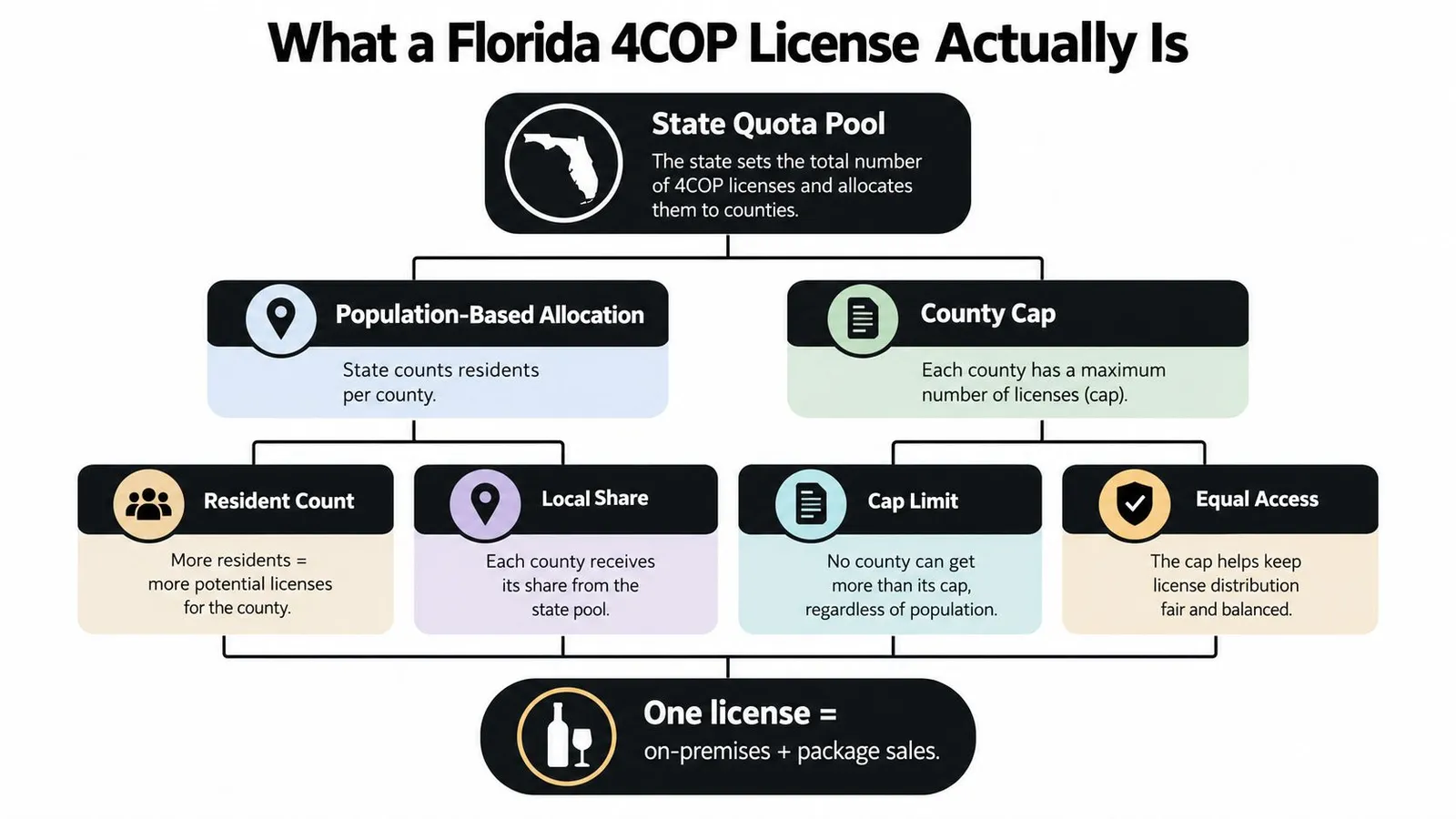
A 4COP quota license is a straight full-liquor license that generally supports beer, wine, and liquor sales by the drink, along with package sales. That combination separates it from narrower on-premises licenses and makes it relevant to bars, nightclubs, full-service restaurants, and other hospitality businesses that need a complete beverage program.
Think of the license as a county-specific mining right. Florida counts population at the county level, creates limited opportunities when the population threshold is reached, and allows existing rights to trade through regulated transfers. The right has value because the state limits how many comparable rights can exist in that county.
The mechanics in plain language
Florida sets the quota structure. The population cap limits the number of quota licenses assigned within each county.
County population drives potential supply. When the population threshold is met, the state can create a new quota opportunity. That doesn't mean every county has an active drawing at the moment you need one.
The county controls your practical market. A license issued for one county isn't a statewide operating pass. If your intended location is in a different county, the original license may not solve the problem.
Existing licenses become transferable assets. When new issuance is unavailable, buyers usually pursue an existing license through a compliant transfer instead of waiting for a new award.
The operating model follows the license privileges. Confirm that your planned cocktail service, by-the-drink sales, and packaged offerings match the license. Your beverage program should be designed around the approved authority, not assumptions from another venue.
For menu planning, operators should separate beverage legality from merchandising decisions. A strong bar drinks menu doesn't replace licensing analysis, and a 4COP license doesn't remove the need to verify local requirements, premises documentation, and operating conditions.
County Quotas and Market Scarcity
A restaurant can have its lease, buildout plan, and opening date ready, then discover that the county has no new 4COP quota license available. Florida is not one liquor-license market. The practical market is the specific county, and quota inventory can be limited to selected counties at a given time.
Read the county before reading the application
For a buyer targeting Miami-Dade, Broward, Orange, or Hillsborough, the first question is whether the state is issuing a new quota license there. If the answer is no, waiting for a drawing is a scheduling decision, not a licensing strategy. It works only if the business can open profitably without full liquor service during the wait.
A county may be populous and commercially attractive while offering no immediate new-license supply. A smaller county may have a different inventory position, but relocating the concept rarely solves the problem when the customer base, lease economics, or operating plan depends on a major metro area.
The quota system creates a constrained supply of licenses in established counties. Existing licenses therefore become transaction assets. Their value changes with geography, local demand, license condition, and the seller's timing. A legal guide cited in the state-notice context places a Miami-Dade 4COP quota license near $180,000, while broader listings may be materially higher or lower.
The useful conclusion is simple: county inventory determines negotiating power. A buyer with no alternatives has less control over price, closing conditions, and the transfer timetable.
The scheduling consequence
Treat county research as a calendar exercise. Confirm the county's issuance status, check whether active or inactive licenses are available for transfer, and determine how long the transaction can remain open without affecting construction, hiring, financing, or the planned opening.
A license search that starts after lease execution is already late.
If no new draw is available, contact qualified brokers or counsel before committing capital, request current inventory, and compare each transfer timeline with the business schedule. A seller may need time to cure compliance issues, while the buyer still has to complete premises documentation and state review. Those steps can affect the deal even when both parties agree on the price.
The practical choices are to buy an existing license, open temporarily with narrower privileges, or revise the opening plan. Make that decision before the lease and buildout turn a county shortage into an expensive delay.
State Fees Versus Secondary Market Prices
The government fee is usually the least important number in a 4COP acquisition budget. A selected applicant pays a one-time $10,750 issuance fee after winning a new quota license, while the annual renewal fee for a 4COP license in larger counties is listed at $1,820 by the Division of Alcoholic Beverages and Tobacco in its license types and fee schedule.
Those figures don't describe what most buyers in major counties pay for access. Recent Florida market data reports a median disclosed asking price of $375,000, with disclosed asks ranging from $80,000 to $1,300,000, according to the Florida Liquor License Market Index. Acquisition and renewal belong in separate budget lines.
A practical cost comparison
| Cost Category | Typical Amount | Notes |
|---|---|---|
| State drawing issuance fee | $10,750 | Paid once if selected for a new quota license |
| Annual renewal in larger counties | $1,820 | Government renewal cost, not market acquisition value |
| Disclosed secondary-market median ask | $375,000 | Market data reports a median disclosed asking price |
| Disclosed secondary-market range | $80,000 to $1,300,000 | Varies by county, inventory, and transaction conditions |
| Early transfer fee | $27,300 | Applies when a quota license transfers within 36 months of acquisition, according to Florida liquor-license legal guidance |
Budget the transaction, not just the license
Ask the seller when the license was acquired before you negotiate price. The early-transfer fee can alter the economics of a quick resale, reorganization, or multi-unit rollout. Also budget for professional review, filing costs, diligence, and any temporary authority needed to maintain service during review.
A winning drawing is financially attractive, but it only helps if your county has an active issuance path and your opening schedule can tolerate the process. A transfer may cost far more, yet it can be the only realistic route in a closed major market. For broader context on how liquor-license costs differ across jurisdictions, compare the New Jersey liquor license cost discussion, but don't use another state's pricing model to forecast Florida.
How to Apply Through the State Drawing
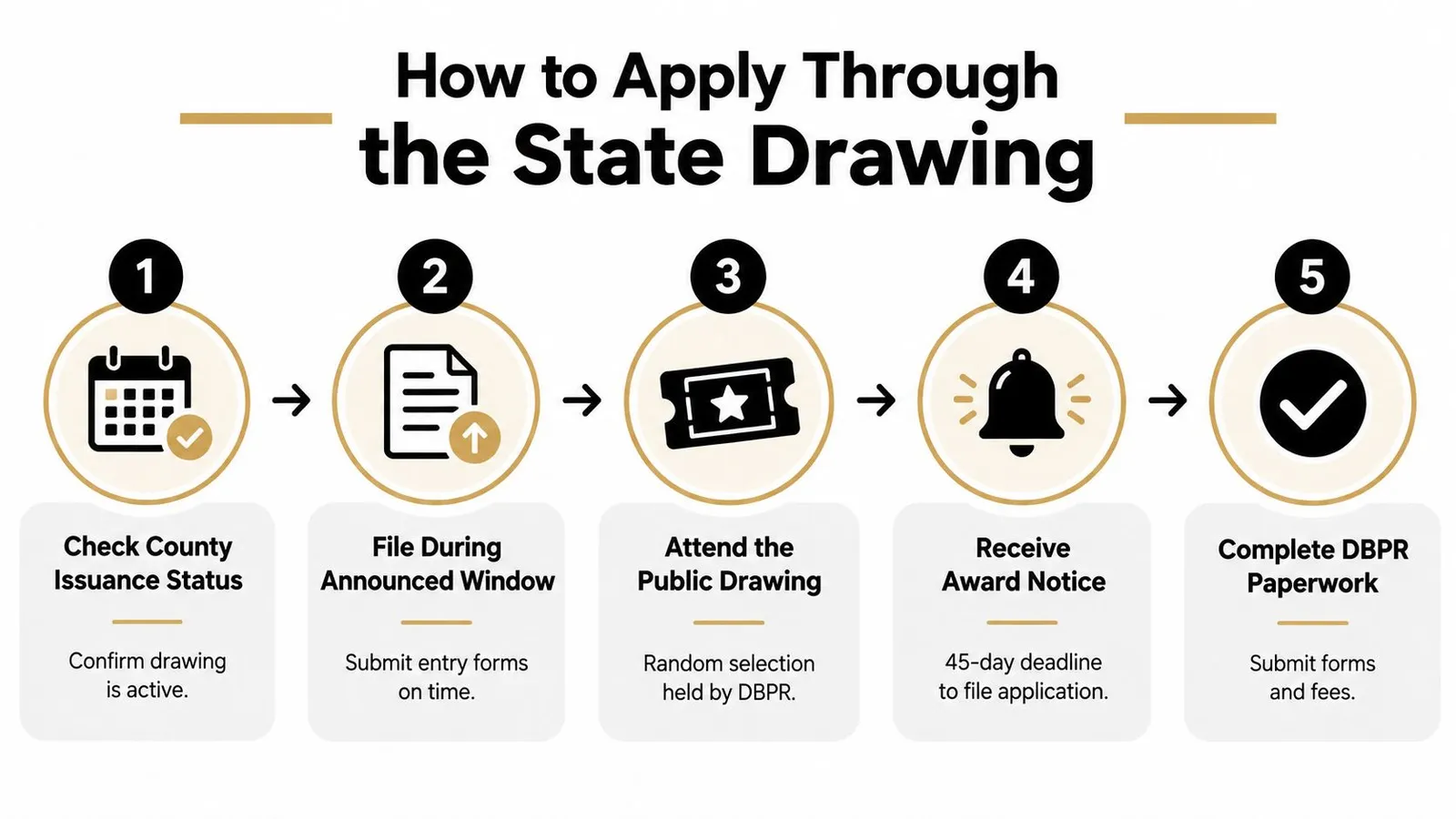
The state drawing path makes sense only when your county has an active issuance opportunity. Qualification doesn't create supply. Confirm the county status first through Florida's Division of Alcoholic Beverages and Tobacco notices, then read the current announcement carefully for the filing window, eligible license category, and submission requirements.
Follow the sequence, not the hope
Confirm county issuance status. Check whether the state has announced a drawing for the county and license category you need.
File during the announced window. Prepare the entry materials early. Late submissions don't become valid because the business has a lease or an urgent opening date.
Attend the public drawing process. Selection is not the same as final licensure. Treat the award as permission to continue the application, not as operating authority.
Track the award notice. If selected, the applicant must file the full application within 45 days, as described in Florida guidance on selling and obtaining alcohol licenses.
Complete DBPR paperwork and pay required fees. Ownership disclosures, premises documents, and other supporting materials must align. A mismatch can turn a short filing window into a missed deadline.
Build a fallback before entering
The drawing route has a low government acquisition cost compared with a secondary purchase, but it has a serious planning weakness: selection timing isn't fully controlled by the operator. Keep the lease, build-out, staffing, and marketing plan flexible enough to survive without immediate full-liquor authority.
If the drawing is closed, or if the county has no new quota available, shift immediately to transfer diligence. Don't spend weeks preparing for an event that cannot provide inventory for your location.
How to Buy a 4COP License on the Secondary Market
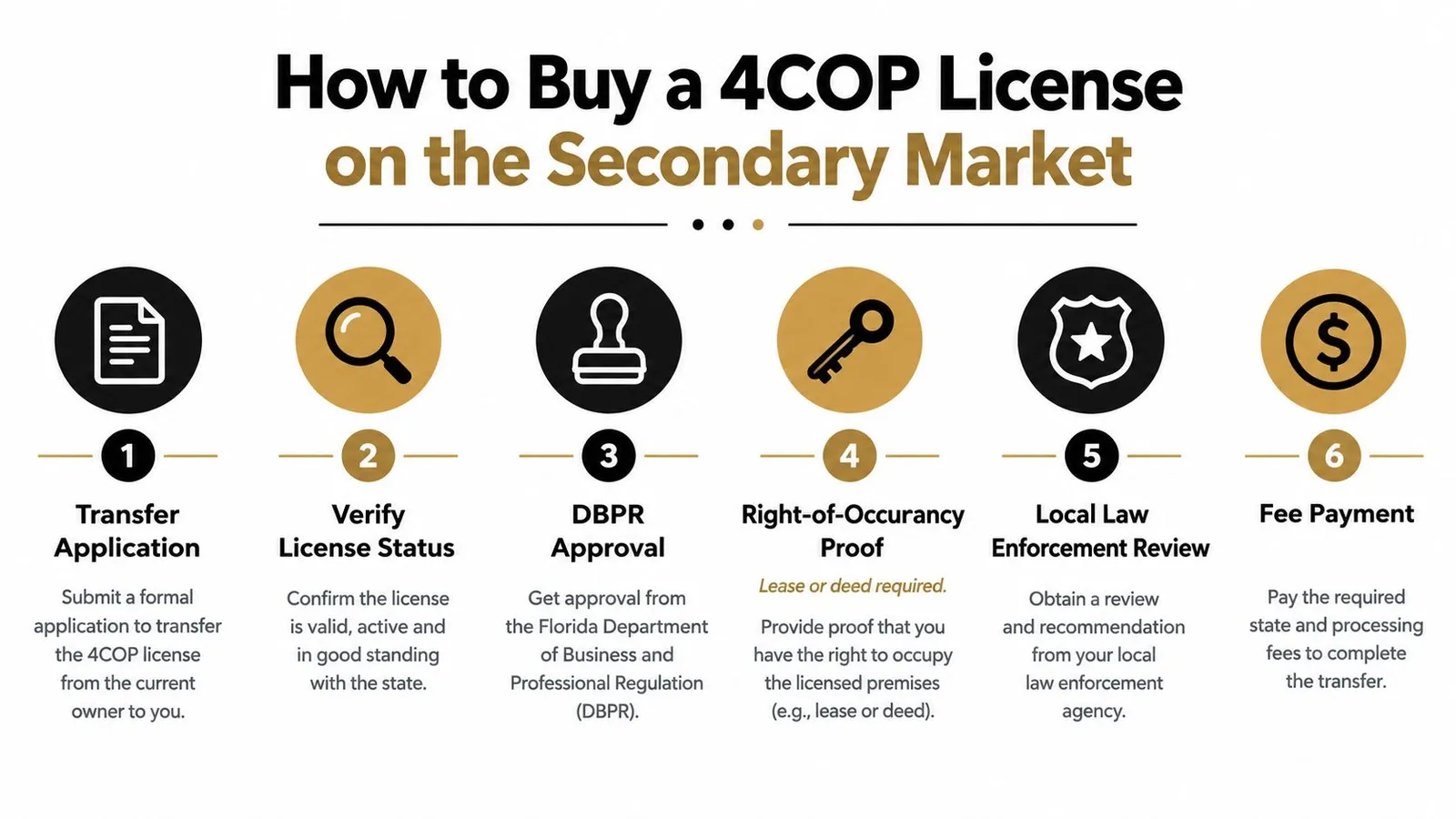
A 4COP purchase is a business transaction tied to a state approval process. A seller can sign an agreement and accept a deposit while the license remains unusable for the buyer. DBPR approval is required before the license can be used under the new ownership, so the closing plan must account for review time and operating risk.
Start diligence before signing. Verify the license type, county, active or inactive status, renewal standing, current ownership, and any restriction that could affect transferability. Confirm that the intended premises has a valid lease, deed, or other right-of-occupancy document matching the applicant and operating plan. The state checklist for transferring an alcoholic beverage license belongs in the deal file before negotiations are finalized.
Structure the deal around approval
Write the purchase agreement around the transfer, not just the asset. Make approval a closing condition, set document deadlines, and state who carries operating risk while DBPR reviews the application. Use escrow instructions and a written continuity plan if the business depends on uninterrupted alcohol sales.
The application may require:
- Ownership disclosures: Identify every required principal consistently across all forms.
- Fingerprints where applicable: Complete background-review requirements before filing becomes urgent.
- Right-of-occupancy proof: Submit a lease, deed, or qualifying premises document.
- Transfer fee: Confirm the current amount and payment method before submission.
- Local review: Prepare for law-enforcement or other agency involvement where required.
- Temporary authority: Ask about the temporary-license fee and bridge process if continued pouring matters. Do not assume service continues automatically.
The early-transfer fee can change the economics of the deal. If the quota license moves within 36 months of acquisition, the reported fee is $27,300. Include that obligation in the purchase model before agreeing to price, escrow, or closing terms.
A broker can locate county inventory, but experienced alcohol-beverage counsel should review the transaction when the license represents a large share of the business value. The practical objective is simple: match the transfer schedule to the opening schedule, because a delayed approval can leave payroll, rent, and build-out costs running without full-liquor revenue.
Common Pitfalls That Delay or Derail Applications

A Florida 4COP license transfer can become the critical path for an opening. The buyer may control the site, sign the purchase agreement, and schedule staff, yet still lack authority to sell alcoholic beverages under the new ownership until the state approves the transfer. Treat the license as part of the business deal and the operating schedule, not as a final form to submit after closing.
| Decision criterion | State drawing | Secondary-market transfer |
|---|---|---|
| County availability | Requires an active issuance opportunity | Depends on an existing license in the county |
| Acquisition cost | One-time $10,750 issuance fee if selected | Market price can reach the disclosed range of $80,000 to $1,300,000 |
| Timing control | Limited by announcement and selection | More controllable, but approval still governs use |
| Main risk | No selection or no available county drawing | Failed diligence, delayed approval, or a defective deal |
| Best fit | Flexible operators in counties with open issuance | Operators with a defined location and opening schedule |
The operational failure points
The two paths create different scheduling risks. A state drawing may cost less when the county has new inventory, but selection is uncertain and timing follows the state's process. A secondary transfer gives the buyer access to an existing county asset, but price, diligence, approval, and closing conditions can still delay operations.
Common failure points include:
- Lease mismatch: The occupancy document does not match the applicant, entity, address, or operating arrangement.
- Incomplete disclosures: A missing principal, inconsistent ownership record, or unresolved background issue can slow review.
- Unplanned downtime: The buyer assumes alcohol sales can continue while approval is pending without arranging temporary authority.
- Weak escrow language: The contract does not state what happens if approval is delayed, denied, or returned for correction.
- County mismatch: The buyer finds a license without confirming that it supports the intended county and location strategy.
- Premature opening promises: Marketing, hiring, and vendor commitments begin before the license is approved.
See the Florida transfer checklist referenced earlier for disclosures, fingerprints where applicable, right-of-occupancy documentation, and temporary-license requirements. These items directly affect operating continuity.
Build the bridge before signing. A temporary license, staged closing, or delayed opening may protect the business better than an improvised workaround. If approval fails or arrives late, revenue can stop while rent, payroll, and build-out costs continue. Set the approval deadline, correction process, and responsibility for operating risk in writing, then align the closing date with the actual licensing schedule.
Where to Start and Where to Get Help
Start with the county, not the form. Check Florida's Division of Alcoholic Beverages and Tobacco notices for drawing announcements and quota availability. Then confirm the application and transfer requirements in the state licensing portal.
Your next move depends on the county's inventory:
- Open drawing: Confirm the filing window, prepare the application package, and build a backup plan if you are not selected.
- No drawing: Ask qualified brokers about active and inactive quota licenses in the same county.
- Potential purchase: Have counsel verify license status, ownership, renewal standing, transfer history, county restrictions, and closing conditions before you sign.
- Complex premises: Confirm zoning and right-of-occupancy documents before setting a transfer date.
- Food-led concept: Check whether another licensing route fits the operation. A food certification license guide can organize related compliance questions, but it does not replace DBPR or legal advice.
Treat acquisition as a scheduling problem. A live county drawing may suit a flexible opening date. If the county is closed and cocktails are central to the concept, the secondary market becomes a business transaction with escrow, diligence, approval, and downtime controls.
Set the approval deadline and closing conditions before committing cash. A license is valuable because it can determine whether the business opens when the lease begins, not merely because the license is scarce.
AnchOps helps restaurant operators manage scheduling, shift coverage, timekeeping, labor projections, and Toast-based tip calculations. If licensing changes your launch plan, visit AnchOps to manage the staffing impact without relying on group texts and manual spreadsheets.
Your back-of-house partner is ready
AnchOps handles scheduling, tip calculations, labor costs, and timecards — so you can focus on your restaurant, not your paperwork.