Food Certification License: A Restaurant Operator's Guide
Published on
By Tony Newcome — Founder of AnchOps · Owner, Pizza Harbour
This article was drafted with AI assistance and reviewed by Tony Newcome, a working restaurant operator.
A food certification license breaks into two categories: licenses and permits that belong to the business (health permits, food service licenses) and certifications that belong to individual employees (food handler cards, manager credentials). Requirements vary by city and county, so the fix is a repeatable tracking system for both — not inspection-day scrambling. Separate them first; renewals get simpler immediately.
That's where food certification license issues stop being “paperwork” and start becoming operations. On paper, it sounds simple. Get the business licensed. Get staff trained. Keep records. In practice, one city wants a posted certificate, another wants a manager credential, a third accepts the state card except in a few counties, and suddenly your opening checklist includes chasing PDFs and calling health departments.
The fastest way to get control is to separate what belongs to the business from what belongs to the employee, then build a repeatable system for tracking both. If you don't, the hidden costs stack up fast: duplicate training, managers doing last-minute course completions, wasted payroll hours, and the kind of inspection-day scrambling that tells you the system is running you, not the other way around.
Table of Contents
- That Moment the Health Inspector Walks In
- Certifications vs Licenses A Practical Analogy
- What belongs to the business
- What belongs to the employee
- The Essential Restaurant Credential Checklist
- Start with the establishment documents
- Track staff-level credentials separately
- Don't forget operation-specific approvals
- Why Your Statewide Card Might Be Useless Here
- The county exception problem
- What to verify before you schedule anyone
- Your Step-By-Step Pathway to Getting Required Credentials
- Step one is location mapping, not training
- Use the right training provider the first time
- Plan for manager-level credentials differently
- Treat alcohol licensing like a separate project
- Managing Renewals and Records Without The Headache
- Build one source of truth
- Use manager coverage strategically
- Your Restaurant Compliance Final Check
That Moment the Health Inspector Walks In
Every operator knows the sound of confidence dropping out of a room. The inspector opens the door, introduces themselves, and suddenly the manager on duty is asking where the binder went, whether the posted permit is current, and if the prep cook from the other location is cleared to work here.
That moment usually exposes the same problem. We treat compliance as a stack of documents instead of a live operating system. The business has licenses and permits that allow it to operate. The staff have certifications and cards that prove training. When those get mixed together, people assume “we're covered” right up until someone asks for proof.
I've seen the scramble happen over small things that should never become emergencies. A certificate is saved on one laptop but not printed. A replacement manager covers a shift but their credential belongs to another jurisdiction. A card is valid, just not for this county. Even sanitation issues become documentation issues because weak routines usually travel together. If your team is already tightening inspection readiness, a practical guide on preventing grill mold issues is worth keeping in the same operational playbook as your licensing records.
Practical rule: If you can't produce it in under a minute, you don't really control it.
The good news is that this is fixable. Most licensing pain isn't caused by complexity alone. It comes from unclear ownership, inconsistent records, and assumptions that one approval covers more than it really does. Once you separate the business paperwork from the employee paperwork, the whole subject gets easier to manage.
What Is the Difference Between a Certification and a License?
Think about driving.
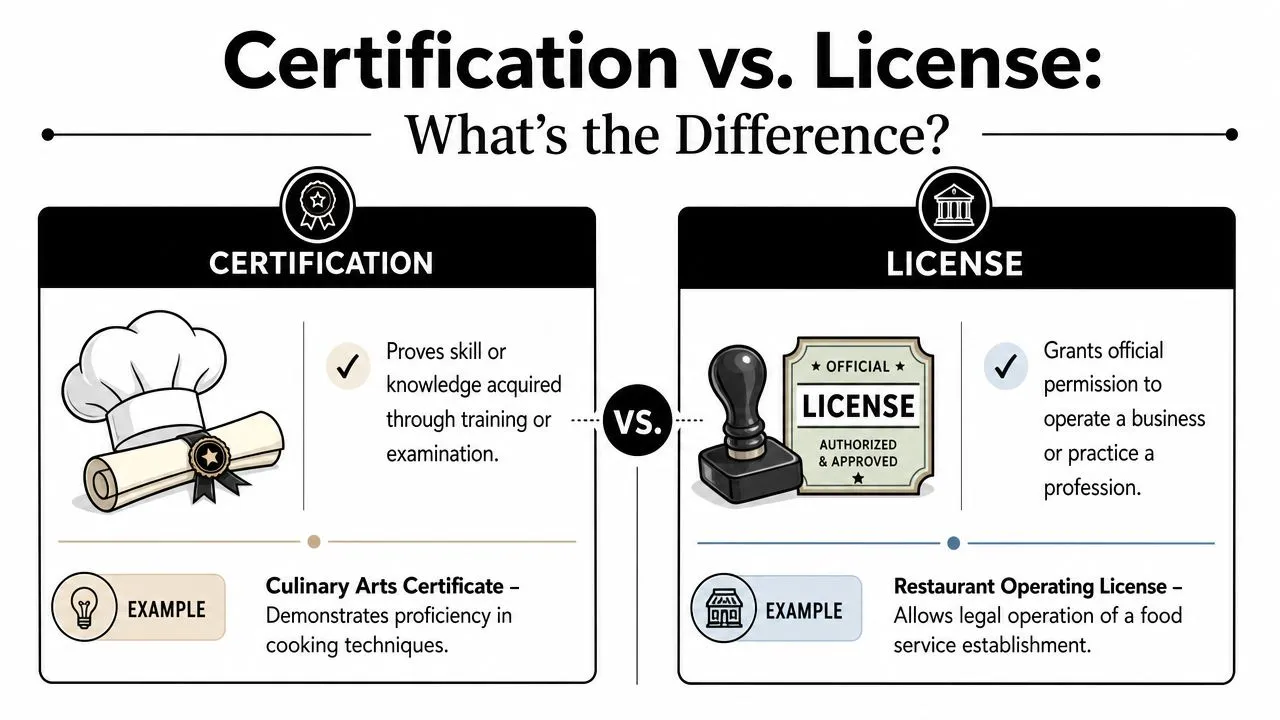
A license is what the government issues to say you're allowed on the road. A certification is extra proof that you've learned a specific skill or passed a specific standard. In restaurant terms, your establishment license or permit lets the business operate. Your food safety certifications show that a person has been trained to do a job safely.
What belongs to the business
The business side includes the approvals that let the restaurant exist legally in that location. Depending on the concept and jurisdiction, that can include a food establishment permit, business license, health permit, and sometimes additional approvals for alcohol or specialized production.
If the business paperwork lapses, the location has a problem.
What belongs to the employee
The employee side covers proof of training. In major U.S. jurisdictions, food handler training must come from an ANAB-accredited program, and new hires often have a short deadline to complete it, such as 14 days in Washington or 60 days in Florida, or the business can face fines or permit suspension, according to this state requirements guide for food handlers.
If the employee paperwork lapses, the shift has a problem.
Here's the cleanest way to remember it:
| Item | Who holds it | What it does |
|---|---|---|
| Operating permit or business license | The restaurant | Gives the establishment permission to run |
| Food handler card or similar training certificate | The employee | Proves basic food safety training |
| Manager-level food safety credential | The supervisor or designated leader | Shows advanced oversight competency |
The phrase food certification license gets used loosely in the industry, but it usually blends two different responsibilities into one phrase. That's why operators lose time. They're solving the wrong problem. If a line cook is missing a card, renewing the business permit doesn't help. If the establishment permit isn't current, no amount of staff training fixes that gap.
Keep two folders, even if they're digital. One for location credentials. One for employee credentials. Mixing them creates blind spots.
Once you use that split consistently, staffing, renewals, and inspection prep all get cleaner.
The Essential Restaurant Credential Checklist
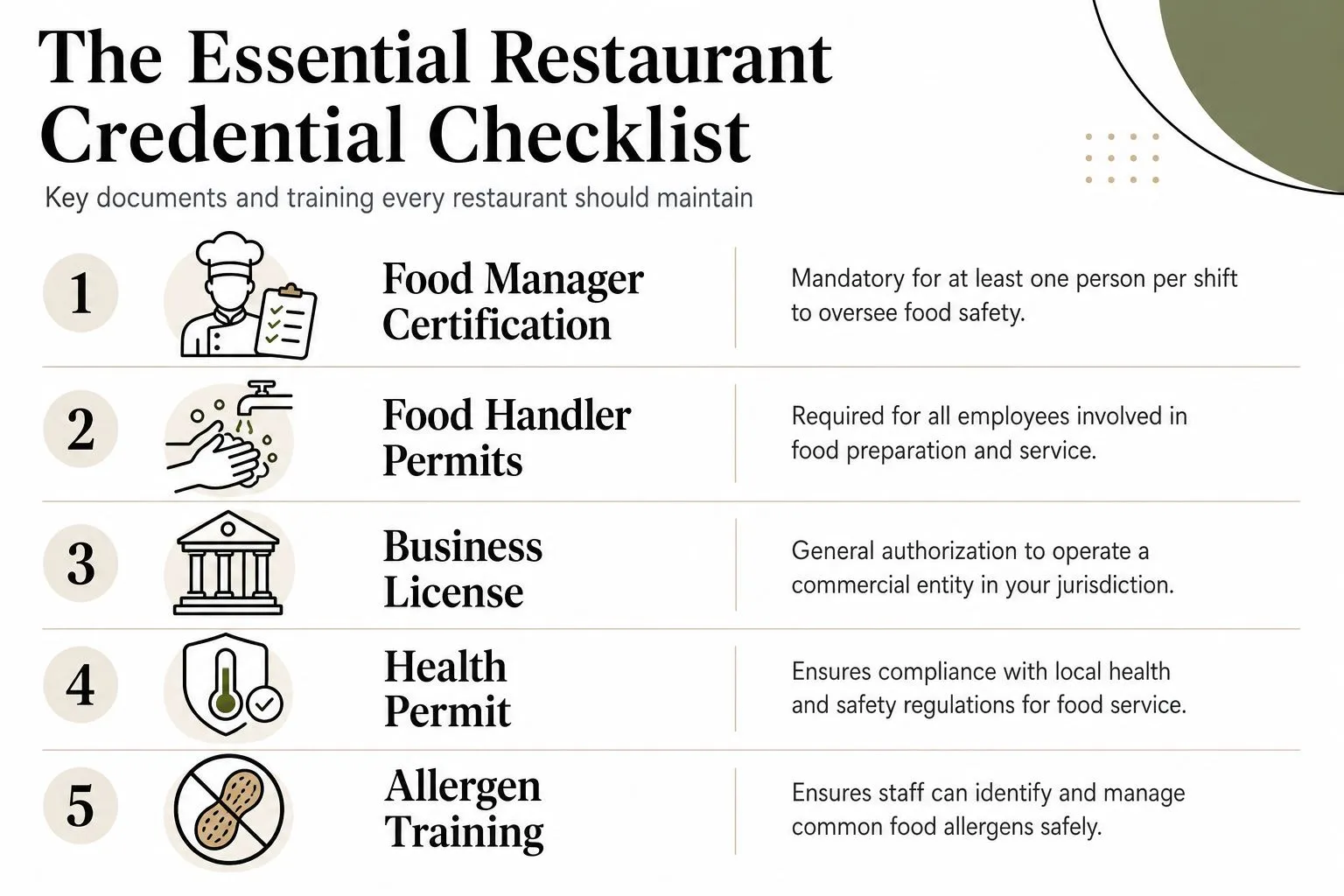
The easiest way to stay sane is to stop thinking in broad compliance terms and start using a working checklist. Not every concept needs every item, but most restaurants are managing some version of the list below.
Start with the establishment documents
These are the records the restaurant itself needs to keep current and accessible.
- Food establishment permit: This is the core approval that lets you prepare and serve food from that site. It should be current, easy to locate, and posted if your jurisdiction requires posting.
- General business license: This handles your legal right to operate as a business entity in that city or county. It isn't a food safety credential, but if it's missing, you still have a compliance problem.
- Health permit or local operating approval: Some operators treat this as interchangeable with the food establishment permit, but local agencies often treat paperwork differently. Check what must be displayed and what only needs to be on file.
Track staff-level credentials separately
Here, most daily friction shows up.
- Food handler card or equivalent training proof: The employees who touch unpackaged food or food-contact surfaces often need this. Build onboarding around it, not around memory.
- Certified Food Protection Manager credential: This isn't just a “nice to have manager cert.” It often determines whether your shift has proper supervisory coverage.
- Training records and copies of completion certificates: If a worker completed the course but nobody saved the document, you still have an inspection problem.
A lot of operators underestimate how much smoother hiring gets when training is bundled into onboarding. If you're comparing providers or trying to make training more accessible for new staff, this resource on affordable training for hospitality jobs is useful as a model for how to think about cost, accessibility, and role-specific credentials.
Don't forget operation-specific approvals
Not every location needs these, but when they do, they matter.
- Alcohol licensing: Separate workflow, separate timing, separate consequences if it's wrong.
- HACCP-related documentation or process approvals: More likely if you handle specialized processes or higher-risk production methods.
- Allergen or concept-specific training expectations: Even when not framed as a formal card, these often show up in operational standards and inspection conversations.
Here's the practical mistake to avoid. Don't store this list in an operations manual nobody opens. Put it into your live people process. If you're tightening your onboarding flow, your restaurant employee policies should spell out who must complete which training, who verifies it, and where the records are stored.
The checklist only works if one person owns each line item. Shared responsibility is usually unowned responsibility.
A complete checklist does more than keep you legal. It prevents the hidden admin costs that come from duplicating training, guessing at coverage, and chasing records across email threads.
Why Might Your Statewide Card Be Useless Here?
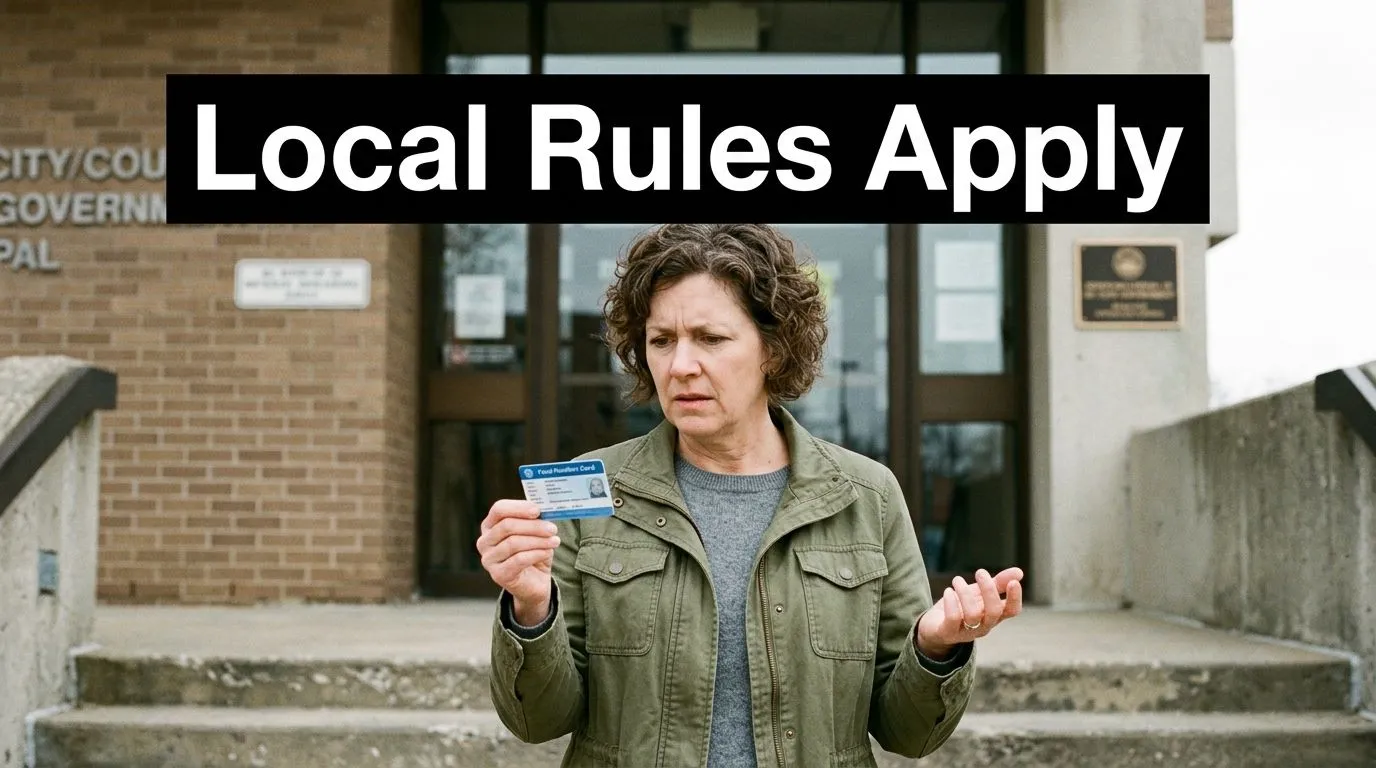
Operators get burned when they assume “statewide” means everywhere they need it to mean.
The county exception problem
A California food handler card is valid statewide except in Riverside, San Bernardino, and San Diego counties, which require separate county-specific cards. New York City also has its own permit process that isn't covered by New York State's general training. That fragmented validity can lead to immediate health inspection violations if you schedule people based on assumptions instead of local acceptance rules, as explained in this California food handler FAQ covering county-level exceptions and NYC differences.
That single issue creates a lot of hidden cost for multi-unit groups. A manager transfers a strong employee from one location to another. HR sees “valid card” on file. Payroll sees an active employee. Ops sees an open shift. Then the worker arrives at the new store and the credential is wrong for that jurisdiction.
What to verify before you schedule anyone
Use a local-validity check before first shift assignment, especially for transfers and floating managers.
- Check the issuing jurisdiction: Don't stop at the state name.
- Check the store address against county and city rules: Border-region operators get caught here all the time.
- Check whether the location requires a separate in-person exam or local permit process: Big cities often do.
- Check posting and on-site manager rules: Some jurisdictions care less about where the PDF lives and more about what's visible and who's present.
A valid card and an accepted card are not always the same thing.
This is why broad internet answers don't help much. “State requirement” articles are useful for orientation, but not for shift-level decisions. The key question isn't whether the employee is trained. It's whether that exact credential is accepted at that exact restaurant.
Your Step-By-Step Pathway to Getting Required Credentials
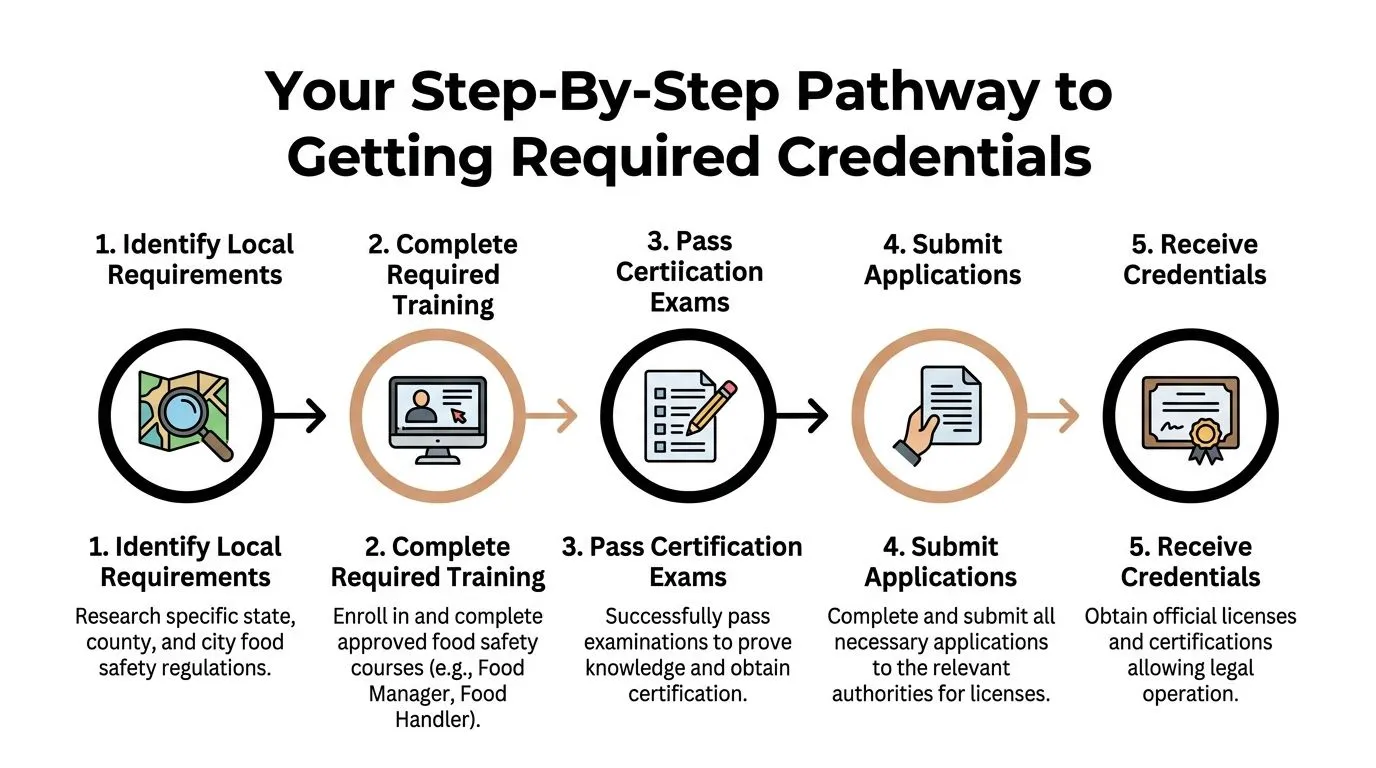
If you want fewer surprises, build the process in the same order a good operator thinks: location first, role second, timing third.
Step one is location mapping, not training
Before you enroll anyone, map every location by state, county, and city. That sounds basic, but it prevents the most expensive error, paying for the wrong course.
For each store, answer these questions:
- What does the establishment need to open and stay open?
- Which roles need basic handler training?
- Which roles need manager-level certification or supervisory coverage?
- Are there local exceptions to the statewide rule?
If you're opening a coffee-led concept or working through startup compliance in another market, a broader launch guide like how to start your UK coffee shop can help frame the bigger licensing workload around the food safety pieces.
Use the right training provider the first time
For staff-level food safety training in major U.S. jurisdictions, the first filter is accreditation. The training must come from an ANAB-accredited program, and employees may have a tight post-hire deadline to complete it, including 14 days in Washington and 60 days in Florida, according to this food handler requirements overview.
That should change how you onboard.
- Don't wait until the schedule is already published: assign training during onboarding.
- Don't accept screenshots without provider details: save the actual completion record.
- Don't assume one deadline fits every store: tie the training task to the location.
Plan for manager-level credentials differently
Manager credentials need more planning than basic employee cards. They usually involve a more formal exam path, and they affect coverage, not just compliance status.
Here's a practical split:
| Credential type | Best time to assign | Why |
|---|---|---|
| Basic food handler training | During onboarding | It's role-entry compliance |
| Manager-level food protection certification | Before promotion or before opening a new store | It affects supervisory coverage and scheduling |
| Replacement or transfer training | Before cross-location deployment | It prevents local mismatch |
One operational upgrade that helps is linking training status to scheduling readiness. If you're still handling that in scattered messages, your staff scheduling workflow should include a gate that prevents assigning someone before their required documents are verified.
Treat alcohol licensing like a separate project
Alcohol approvals shouldn't live in the same mental bucket as food handler training. They involve different agencies, different timelines, and much less forgiveness when details are wrong.
Handle them like a launch project with an owner, a checklist, and dated milestones. Don't tuck them into “manager admin” and hope they move.
The cheapest food certification license process is the one you only do once per person, per location, with the right provider and the right jurisdiction attached.
That's the pathway. Not just course, test, file. It's verify, assign, complete, save, and only then schedule.
Managing Renewals and Records Without The Headache
Getting compliant once is manageable. Staying compliant across turnover, transfers, and renewals is where operators usually lose hours.
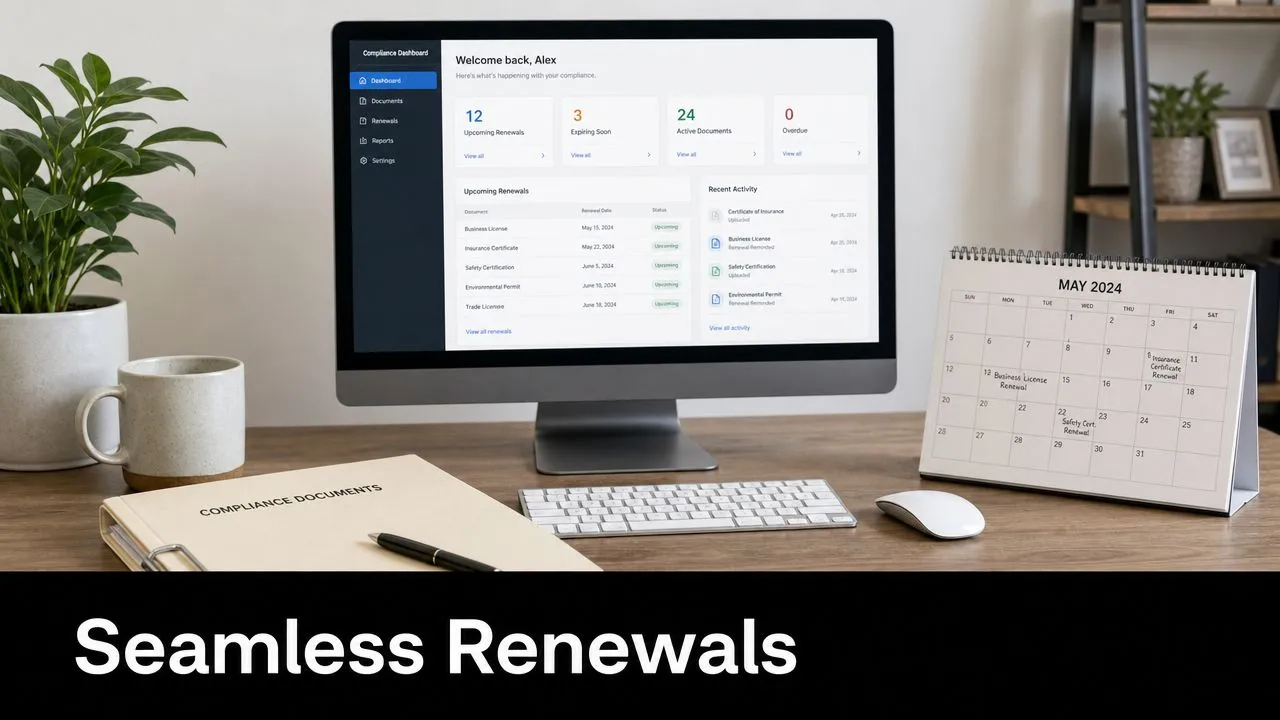
Build one source of truth
Use one live tracker for every location and every employee credential. Spreadsheet, HRIS, shared operations file, it doesn't matter as much as consistency.
Your tracker should include:
- Employee name and home location
- Credential type
- Issuing jurisdiction
- Issue date
- Expiration or renewal date
- File location for the certificate copy
- Notes on local exceptions or transfer limits
Then set reminders before anything expires. Don't rely on memory and don't rely on the employee to bring it up first.
A lot of this breaks down because communication breaks down. If your managers are still chasing certificate photos in group texts, moving credential reminders into a cleaner team communication system for restaurants reduces missed follow-ups and duplicate requests.
Use manager coverage strategically
There's also a cost lever many operators miss. In some jurisdictions, hiring a Certified Food Protection Manager can exempt all other food handlers in that facility from the training requirement, which can eliminate the per-employee certification cost for the restaurant, as noted by the Illinois Restaurant Association's explanation of food handler requirements and CFPM exemptions.
That doesn't mean every restaurant should stop training everyone else. It means you should evaluate the trade-off carefully.
- For high-turnover teams: a strong CFPM coverage strategy may reduce repeated training admin.
- For multi-shift operations: manager scheduling becomes more important because coverage drives compliance.
- For groups with frequent transfers: local validity still matters, so don't confuse exemption logic with jurisdiction acceptance.
Good recordkeeping isn't clerical work. It's labor protection, inspection prep, and cost control rolled into one.
The operators who handle this well don't keep more paper. They make fewer assumptions.
Your Restaurant Compliance Final Check
Use this as a quick self-audit before your next inspection, transfer, or opening-week rush.
- Is the main establishment permit current and posted if required?
- Can the manager on duty produce business and food safety records quickly?
- Does every required employee have the right credential for this exact jurisdiction, not just the state?
- Do you know which shifts require manager-level food safety coverage?
- Are training records saved in one place, not scattered across email and phones?
- Do renewal reminders exist before expiration dates hit?
- Have transferred employees been re-verified for county and city acceptance?
- Do your onboarding and scheduling processes stop noncompliant assignments before they happen?
This matters more every year because compliance pressure isn't going away. The global food certification market is projected to grow from USD 6.41 billion in 2025 to USD 8.72 billion by 2031, which reflects rising consumer awareness and government mandates making rigorous compliance harder to treat as optional, according to Mordor Intelligence's food certification market report.
A strong food certification license system doesn't just help you avoid fines. It gives you calmer openings, cleaner inspections, and fewer payroll-hours wasted on preventable admin. That's usually the difference between a restaurant that reacts to compliance and one that runs it like any other core operation.
If you want fewer scheduling mistakes, less credential chasing, and better control over labor admin, AnchOps is built for the way restaurants run. It helps operators organize staffing, communication, time review, and shift execution in one place so compliance-related work doesn't get lost inside group texts, spreadsheets, and last-minute manager follow-up.
Your back-of-house partner is ready
AnchOps handles scheduling, tip calculations, labor costs, and timecards — so you can focus on your restaurant, not your paperwork.