How to Open a Bakery: Costs, Permits and Launch Plan
Published on
By Tony Newcome — Founder of AnchOps · Owner, Pizza Harbour
This article was drafted with AI assistance and reviewed by Tony Newcome, a working restaurant operator.
A busy bakery can still lose money every day it opens. That's not a contradiction, it's the math of labor. Bakery manufacturing allocates 18.9% of expenses to labor, compared with 10.6% across food processing, according to Farm Credit Canada's 2026 food and beverage report on bakery and tortilla products. If your menu needs too many hands for too long, or your doors stay open through quiet hours with a full team waiting, strong sales won't save you.
When you open a bakery, the profit question isn't "how many people do I need?" It's how many labor hours can each product support at the price customers will pay. Every decision below, from format to opening hours, should answer that question before you spend money.
Table of Contents
- Test Demand and Pick a Location
- Map What Already Exists
- Get Orders Before Rent
- Choose a Format and Menu
- Build a Menu That Shares Work
- Permits, Food Safety and Equipment Layout
- Map the Flow Before You Buy
- Write the Controls Down
- Startup Costs at a Glance
- What Moves Each Line
- Unit Economics and Demand Testing
- Test Before You Commit
- Labor Budget and Staffing Roles
- May 2025 US Median Pay Benchmarks
- Schedule Labor and Track Costs Daily
- Track Labor Cost Percentage Daily
- Opening Day Checklist and Your Next Step
- Run the First 90 Days Tight
Test Demand and Pick a Location
Don't start with a lease. Start with counted demand, because a good product in the wrong place still loses money.
Map What Already Exists
List every bakery, café and grocery bakery within a 15-minute drive. Note their hours, price points and which items sell out, and when. Sellouts show unmet demand. Deep discounting late in the day shows overproduction you shouldn't copy.
Count foot traffic at candidate sites during the exact hours you'd open, not at midday if you'll trade on morning commuters. Check parking for pickup orders, nearby bus stops and rear access for supplier trucks. A site that can't take a flour delivery without blocking the counter will cost you labor every week.
Get Orders Before Rent
- Ask local buyers directly: Visit at least 20 cafés, offices, caterers and grocers and ask whether they'd buy wholesale, which items and at what weekly volume. Those answers set your first wholesale target.
- Check zoning first: Confirm each address allows food production before making an offer. The wrong zone can block the whole plan after you've paid for drawings.
- Run a live test: Build a preorder list or trade at a pop-up, and record confirmed orders each week. If you're testing that route overseas, learning how to plan a temporary shop in Singapore shows the same discipline, short commitment, real orders, measured conversion.
Reject any site where measured weekly demand can't cover rent in your break-even check. I would rather lose a good looking shopfront than sign for demand I only hoped existed.
Choose a Format and Menu
Format comes before menu because format sets sales per labor hour. The same croissant earns differently depending on whether it's baked to a confirmed order, delivered by the tray to a café, or sitting in a display case while two staff wait for walk-ins.
Bakery formats compared
| Format | Labor per item | Waste risk | Best fit |
|---|---|---|---|
| Preorder-only | Low, batches to confirmed orders | Low | Loyal local base with limited walk-in sales |
| Wholesale production | Low per unit at volume | Low with fixed contracts | Steady volume and a reliable delivery route |
| Cafe retail | Spread across all opening hours | Highest when quiet periods meet a full display | Walk-in traffic and a full counter |
| Market stalls | Concentrated in weekend peaks | Medium, unsold stock after market day | Testing products before a lease |
| Hybrid | Shared base batch plus preorders | Controlled by preorders | Most first-year operators |
Preorder-only keeps waste low because you bake what's sold, but you'll turn away impulse buyers. Wholesale spreads mixing, shaping and baking labor across large batches, yet one lost account can leave a production day half empty, and you need a delivery route that doesn't eat the margin. Café retail gives you the highest price per item and the highest risk, since staff cost runs whether customers come or not.
Market stalls concentrate labor into brutal weekend peaks. They're excellent for testing which products sell, poor as a permanent answer if setup, transport and unsold stock consume the takings.
Bake the base batch for confirmed demand first, then add a small speculative top-up for walk-ins. Never the other way around.
Build a Menu That Shares Work
Choose 5 to 8 core products that share doughs and fillings. One enriched dough can become buns, knots and a filled loaf. Rank every item by sales per labor hour, not by how much you love making it. Cut or reprice anything that needs a separate mix, long hand-finishing and its own packaging for a handful of daily sales.
Then match suppliers to that menu. Confirm minimum order sizes and delivery days for flour, butter and packaging against your production calendar, and keep one backup supplier for each critical ingredient. A cheaper butter price means nothing if delivery lands after your lamination day.
Permits, Food Safety and Equipment Layout
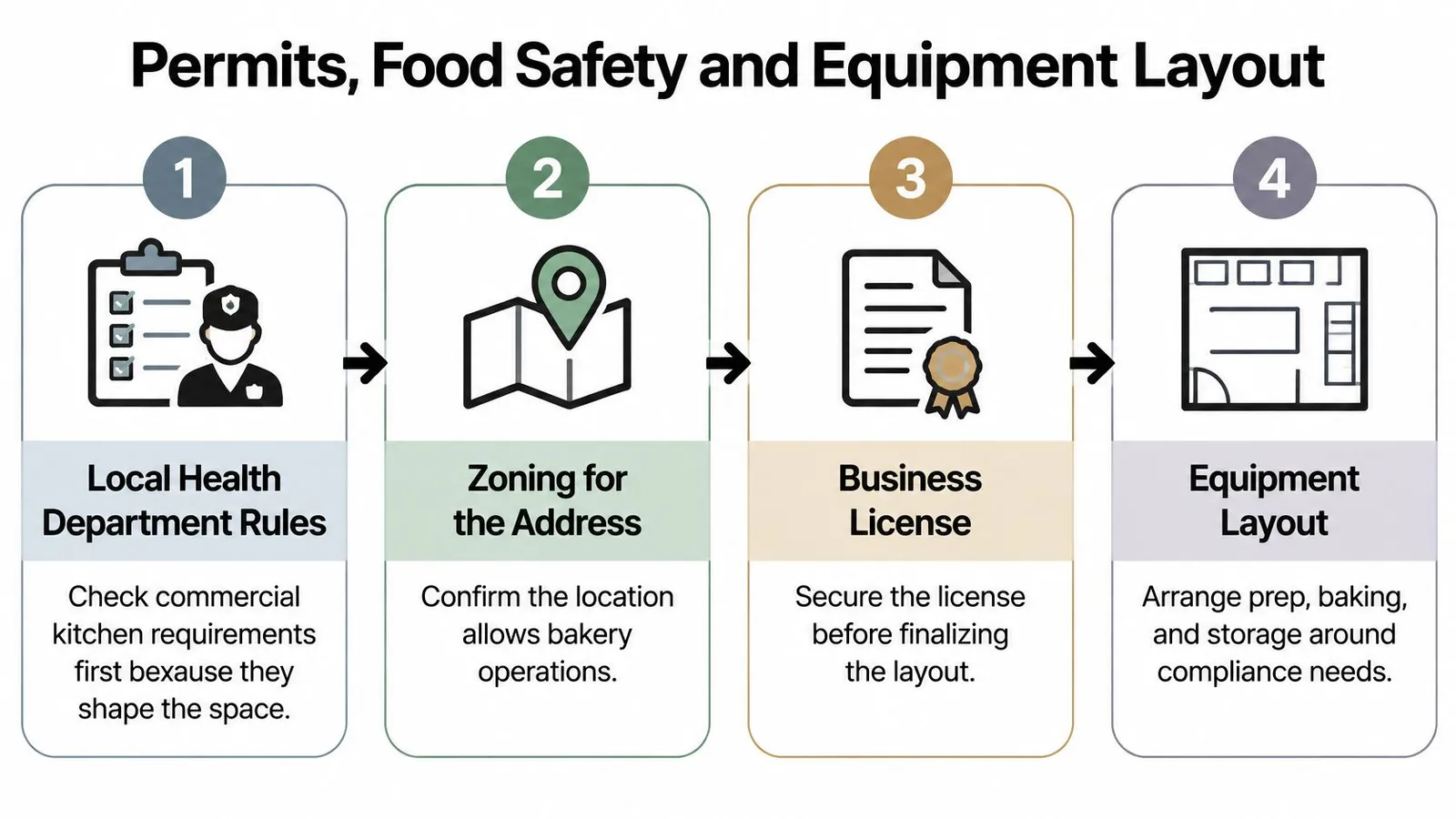
Permits and food safety decide your layout, so they come before equipment orders. Check local health department rules for a commercial kitchen, zoning for the address and your business license before signing anything. If you're working through certification requirements, start with the food certification license requirements for your jurisdiction.
Map the Flow Before You Buy
Draw one line through the space: receiving, storage, preparation, baking, cooling, finishing, display and delivery. Food should move forward along that line without raw ingredients crossing finished products. Mark critical control points for cream-filled, custard, dairy or egg-based items, since those products need time and temperature control that a plain loaf doesn't.
Under the FDA Food Code model, cooked TCS food must cool from 135°F (57°C) to 70°F (21°C) within 2 hours and then to 41°F (5°C) or below within a total of 6 hours.
Cooling limits for cooked time and temperature control foods
| Cooling stage | Target temperature | Time limit |
|---|---|---|
| Stage 1 | 135°F (57°C) down to 70°F (21°C) | 2 hours |
| Stage 2 | 70°F (21°C) down to 41°F (5°C) or below | 4 more hours (6 hours total) |
That rule drives purchases. You'll need shallow pans, smaller separated batches, airflow or rapid-cooling capacity and dedicated cooling space. Pushing hot trays into a crowded walk-in slows cooling and warms everything already inside. For practical bench, oven and refrigeration placement once those constraints are set, the Simply Hospitality bakery setup guide is a useful layout reference.
Write the Controls Down
- Allergen controls: Ingredient identification, segregated storage, labeled recipes, scheduled allergen-heavy production, validated cleaning and changeover verification.
- Batch records: Batch ID, time, product temperature, corrective action and disposition for every controlled product.
- Cleaning schedule: Named owner and frequency for each surface and machine, posted where the work happens.
Good logs aren't paperwork for inspectors alone. They let you trace a customer complaint to one batch in minutes instead of guessing across a whole week.
Startup Costs at a Glance
Budget four lines first, then protect working capital. According to DoorDash's 2026 bakery business plan guide, typical US costs include approximately $10,000 to $100,000 or more for kitchen space and buildout, $10,000 to $50,000 or more for equipment, $1,000 to $5,000 for licenses and permits, and $1,500 to $7,500 for initial inventory.
Typical US startup costs for a bakery
| Cost item | Typical range (US) | What it covers |
|---|---|---|
| Kitchen space and buildout | $10,000-$100,000+ | Lease improvements, plumbing, ventilation and grease handling |
| Equipment | $10,000-$50,000+ | Ovens, mixers, proofers, sheeters, refrigeration and sinks |
| Licenses and permits | $1,000-$5,000 | Business registration, food service permits and inspection fees, which vary by jurisdiction |
| Initial inventory | $1,500-$7,500 | Flour, fats, dairy, packaging and supplies for the first weeks |
| Working capital (first 3 months) | 3 months of fixed costs | Rent, payroll and utilities before sales cover costs |
What Moves Each Line
A converted storefront with existing hood venting sits near the low end of buildout. Installing ventilation, grease handling and plumbing from scratch pushes you toward the top. Refurbished deck ovens and mixers cut equipment cost, while a sheeter, retarder-proofer or walk-in cooler raises it fast. Buy capacity for your tested volume, not your hoped-for volume.
Format changes the total, too. A wholesale-only or preorder bakery needs far less front-of-house buildout than a café with seating, display cases and customer toilets.
Total the lines, compare the sum against savings and any loan amount, and decide cuts in advance. Cut seating, finishes and menu breadth first. Don't cut cooling capacity, sanitation or the three months of working capital that pay rent and payroll while sales build. That last line is where underfunded bakeries die.
Unit Economics and Demand Testing
Your prices must fit inside a tight cost structure. The Scientific Baking production and food safety guide cites a commonly used benchmark of ingredients at roughly 25 to 35% of selling price, labor at approximately 25 to 40%, and net profit at only about 3 to 10%.
Where bakery revenue goes
| Cost line | Typical share of selling price | What moves it |
|---|---|---|
| Ingredients | 25-35% | Yield, waste and supplier pricing |
| Labor | 25-40% | Production hours per item, scheduling and wage rates |
| Net profit | 3-10% | Everything above, plus rent and overhead |
With profit that thin, small errors aren't rounding. A 5% reject rate increases the effective cost of each accepted unit by about 5.3%, because you paid ingredients and labor for items you can't sell. Yield and waste control matter as much as price.
Test Before You Commit
- Standardize first: Document formulas, batch yields, proofing or resting times, bake curves, cooling needs, allergens and shelf life for a narrow product mix.
- Run peak test batches: Record units produced per labor hour, ingredient cost per sellable unit, waste and maximum daily capacity under realistic pressure, not a quiet test kitchen pace.
- Price from actuals: Cost ingredients and packaging per sellable unit, then stress-test against lower volume and higher wages or ingredient prices. Structured sales forecasting methods help you model those lower-volume cases instead of planning only for your best week.
Finish with break-even: fixed monthly costs divided by contribution per item, using your own rent, wages, taxes, utilities and equipment financing. Say your contribution after ingredients and packaging is small and break-even needs more units than your oven can produce in a day. That plan fails on paper, and finding out on paper is free. Change the menu, change the format or extend preorder testing. Don't sign and hope.
Labor Budget and Staffing Roles
Your bakery's labor budget determines whether its menu can make money. Count your own management hours, too. If scheduling, purchasing, supervision and compliance are unpaid, the business looks profitable only because you are subsidizing it.
Set pay by role rather than using one blended wage. The Bureau of Labor Statistics occupational outlook for bakers reports that bakers had median pay of $37,160 per year, or $17.86 per hour, in May 2025, including $37,180 in bakeries and tortilla manufacturing.
May 2025 US Median Pay Benchmarks
- Bakers: $17.86 per hour, as above.
- Food and beverage serving workers: Median pay of $15.24 per hour, or $31,710 annually, according to the Bureau of Labor Statistics outlook for food and beverage serving and related workers.
- Food-service managers: Median pay of $69,390 per year, or $33.36 per hour, according to the Bureau of Labor Statistics outlook for food service managers. Use this as a benchmark for the replacement cost of your management hours.
Pastry chefs, decorated-cake specialists and production supervisors will cost more than the median baker. Budget for the skill and production time each role requires. If a product takes too many labor hours to produce for its selling price, a busy counter will not make it profitable.
Costing rule: If a product only works when the owner's hours are free, the product doesn't work.
These wage medians exclude employer payroll taxes, benefits, overtime, training, shift premiums, and paid setup and cleaning time. Add those costs separately in your labor planning model. Estimate the hours each role needs across opening production, peak service, closing and cleaning, and weekend coverage. Compare the labor hours required for each product with the units it can sell; a labor-heavy menu or long opening hours can erase the margin even when sales seem strong.
If this budget makes break-even impossible at realistic volume, cutting wages below what you can hire at is not a workable fix. Shrink the menu, shorten opening hours or change the format before committing money.
Schedule Labor and Track Costs Daily
Build your weekly schedule from a template of normal staffing, not a blank grid you reinvent every Sunday night. Map shifts to the production timeline so people arrive when work exists.
Early-morning bakers mix, shape and get first bakes through the oven. A midday shift covers finishing, packing and the counter peak. A closing shift cleans, counts waste and preps for tomorrow. Stagger starts to match those waves instead of bringing everyone in at opening and paying them to wait between rushes.
Track Labor Cost Percentage Daily
Every morning, divide yesterday's labor cost by yesterday's sales. Read it that day, while you can still cut a shift, delay a start or move someone to production. Waiting for month-end reconciliation turns a fixable scheduling problem into a month of losses.
Break the same view down by product where you can. If one item consumes the most bake-hours and sells modestly, you'll see it in units per labor hour long before you see it in the bank account. Practical workflow changes, from batch sequencing to packaging layout, can help your bakery work smarter without adding headcount.
- Compare scheduled with worked hours weekly: Late clock-outs and unplanned cleaning time inflate the template.
- Cut by daypart, not by person: If Tuesday afternoons run under forecast, shorten that shift rather than spreading thin cuts everywhere.
- Cross-train deliberately: Counter staff who can pack, label and portion give you cover without extra hires.
Scheduling tools can support this routine. AnchOps can draft schedules from sales history and staff availability, project labor cost before publishing, and manage open-shift outreach and approved shift swaps. If you run Toast POS, confirm which sales and labor data it can export before relying on it for your daily percentage, rather than assuming the connection is automatic.
End each week by adjusting the template itself. The schedule should get more accurate as your sales history grows, not stay frozen at your opening guess.
Opening Day Checklist and Your Next Step
Work this list in order. Skipping ahead to marketing before production is proven just brings more people to watch you struggle.
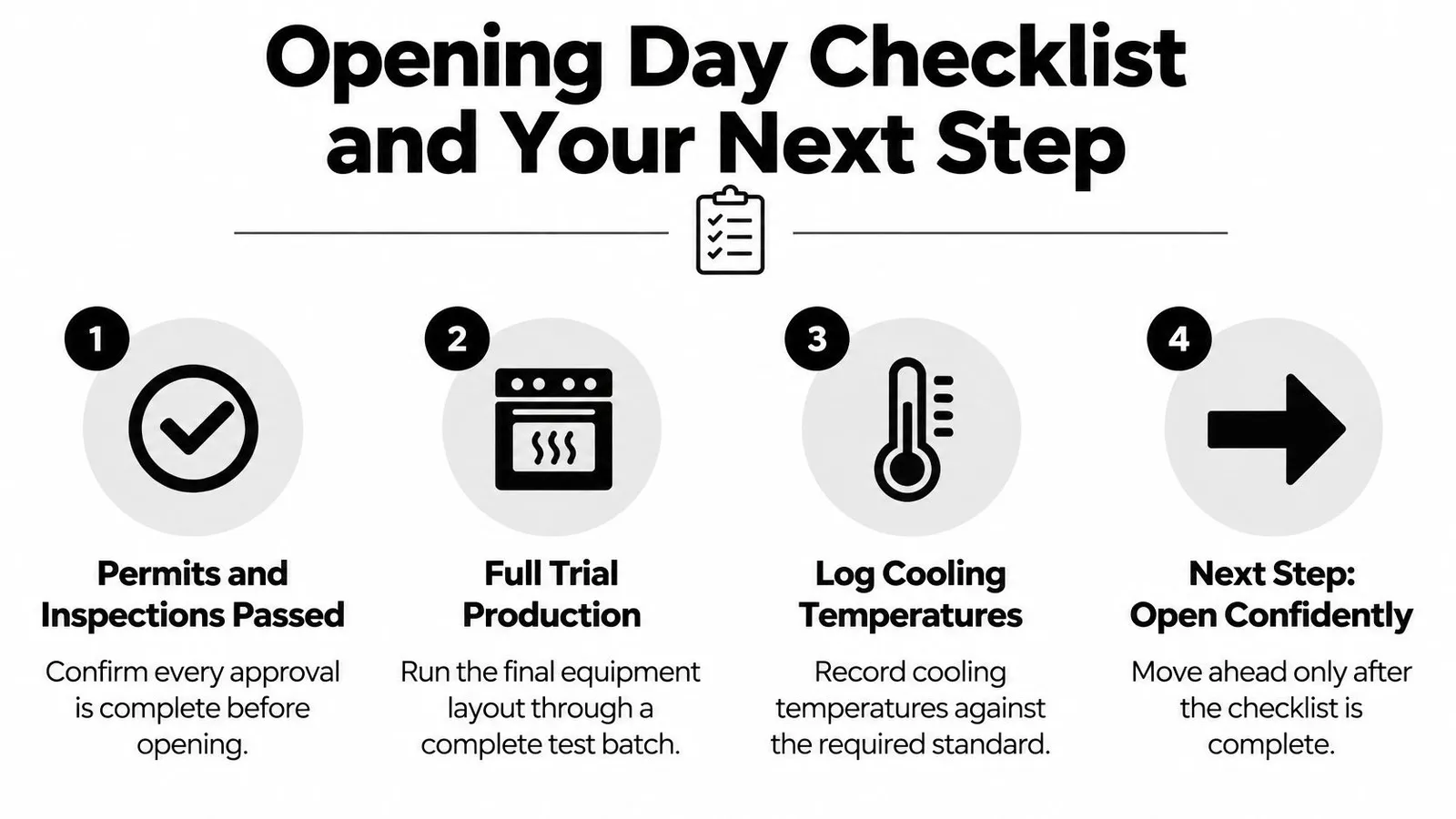
- Confirm permits and inspections are passed. No soft opening fixes a missing approval.
- Run full trial production on the final layout. Log cooling temperatures for every controlled product and fix any stage that misses its limit.
- Verify allergen labels and the cleaning schedule. Check labels against the actual recipes in use, not earlier drafts.
- Hire and cross-train at least one backup per station. One sick call shouldn't stop mixing, baking or the counter.
- Set par levels and a markdown or donation rule before the first sale. Decide in advance when unsold goods get discounted, donated or recorded as waste, so staff don't improvise nightly.
Run the First 90 Days Tight
Open with a preorder list or one local wholesale account already in hand. Promote only the core products through a Google Business profile, local social posts and farmers market samples, and post opening hours clearly everywhere. Collect customer feedback, but adjust the menu monthly, not daily, or you'll never get clean production data.
Review waste by product, sales per labor hour and reject rate every week. Those three numbers tell you whether to bake less, staff differently or drop an item. More variety and fuller shelves feel generous, and they routinely destroy margin.
Open when the numbers pass, not when the space looks finished.
The single gate before spending is this: confirm break-even at realistic volume using your own rent, wages and costs. If it passes, sign the lease and order equipment. If it fails, reduce the menu, change the format or extend the demand test. I would always choose a smaller bakery that pays its people properly over a beautiful one that can't.
When you're ready to turn your labor plan into a working weekly schedule, AnchOps drafts schedules from sales history and availability, projects labor cost before you publish, and fills open shifts so one absence doesn't stall production. Visit the site to see how it fits a bakery team that starts before dawn and can't afford underused hours.
Your back-of-house partner is ready
AnchOps handles scheduling, tip calculations, labor costs, and timecards — so you can focus on your restaurant, not your paperwork.