Do Hostesses Make Tips? How Pools and Tip-Outs Work
Published on
By Tony Newcome — Founder of AnchOps · Owner, Pizza Harbour
This article was drafted with AI assistance and reviewed by Tony Newcome, a working restaurant operator.
In the United States, hostesses do not automatically get guest tips, but they can share in tips through a pool or tip-out. Eligibility depends on job duties, local practice, and the restaurant's written policy, even though 70% of U.S. adults who used sit-down restaurant services in 2025 said they always tipped servers.
That Bankrate survey of 2,277 adults is about servers, not the host stand. Guests deciding to tip a server doesn't put cash in a hostess's hand, and it doesn't create a personal gratuity for the person holding the reservation book.
The popular line is "if the floor is busy, guests will take care of the host." That's the wrong lever. A hostess's tip is a house policy decision. Money reaches the stand only when the written policy names eligible roles, states the formula, and ties each payout to sales and hours. A greet-and-seat shift in one dining room can be hourly only. The same title next door can take a defined share because the house wrote hosts into the pool.
Operators get this wrong when they copy a percentage from a group chat and apply it to every concept. Full service, counter service, and an undesignated jar are not the same paycheck. Before you promise tip income in a job posting, write the rule, name the roles, and keep a record a payroll person can audit.
Table of Contents
- Where Hostesses Do and Don't Receive Tips
- When a Hostess Qualifies for a Tip Pool
- Duty checklist
- Tip Pool and Tip-Out Methods Compared
- How to Calculate a Fair Hostess Share
- A single-shift walkthrough
- Tax Reporting Rules for Hostess Tips
- What the house must keep
- State items to confirm
- Managers' Controls and the Policy Decision
- Four controls, one failure each
- What the audit has to show
- Take the decision in order
Where Hostesses Do and Don't Receive Tips
Hosts and hostesses usually live on hourly wages. Tips are an optional supplement, not the occupation's standard pay. The Bureau of Labor Statistics says most food-and-beverage workers earn hourly wages alone, while some restaurants distribute all or part of tips through a pool. There's no reliable national percentage for how many hostesses receive tips or how much those tips are. Restaurant policy, local custom, state wage law, and whether the work counts as tip-producing service decide it.
A full-service room may send a slice of server tips to the host team. A counter-service or fast-casual shop may share nothing, or it may run one general pool. When an employer claims a federal tip credit, the pool generally may include only workers who customarily and regularly receive tips, such as servers and bartenders. Hosts need evidence that hosts in comparable local restaurants are tipped. Managers and supervisors can't take other employees' pooled tips.
| Restaurant setting | Hostesses usually share tips? | How the tip reaches them |
|---|---|---|
| Full-service dining with a server tip-out | Often, if house policy includes hosts | Tip-out from server sales |
| Full-service dining with a general tip pool | Sometimes | Share of a general pool |
| Full-service dining, hosts with no table service pay | Sometimes | Hourly wage only, or a small pool share |
| Fast-casual or counter service with no tip share | Usually not | None; hourly wage only |
| Restaurant with an undesignated tip pool | Possibly, if hosts customarily receive tips locally | Pool split by a set formula |
Three things sit behind every row. First, the duties on the stand: greeting only is a weaker case than running the wait list and coordinating tables. Second, local custom: what comparable houses in the same city do. Third, the policy you can hand someone. A service charge is not a tip, and mixing the two on a guest check creates fights later. Keep the two ideas separate the way a service charge versus tip breakdown does, then write the host rule in plain language.
Ask the manager three questions: Is there a written tip policy, are hosts named in it, and how is the split calculated from sales or hours?
When a Hostess Qualifies for a Tip Pool
A hostess qualifies for a tip pool when two facts line up: her duties are the kind guests tip for, and comparable restaurants in the same locality customarily pass tips to that role. The job title alone proves neither. Hosts and hostesses were not on the legislative list of workers who customarily and regularly receive tips. A U.S. Department of Labor opinion letter still says they may qualify when hosts in comparable establishments in the same locality receive tips directly or through a pool. The same letter described an enforcement posture that generally did not question mandatory pool contributions at or below 15% of an employee's tips. Treat that 15% as a compliance reference point, not a required host share and not an entitlement.
Consider two hosts in the same restaurant group. One only says hello and walks parties to a table. That house can leave the role out of a mandatory pool. The other runs the wait list, handles highchairs and seating needs, and coordinates tables with the floor. Those duties look like tip-producing service, and that house can include the role when local custom supports it. Federal guidance treats hosts who interact with guests, seat them, manage wait lists, and support the service experience as possible pool participants, as the Department of Labor's tip pooling guidance describes. The house still has to show the role customarily and regularly receives tips.
Under a federal tip credit, a mandatory pool stays with employees who customarily and regularly receive tips. The host question is therefore narrower than whether the role deserves a share. It is whether the role in fact receives tips by local practice and whether the written policy names it. A manager who cannot point to both is guessing.
Duty checklist
Mark each duty, then note what comparable local restaurants do and the date you checked.
- Guest greeting: Yes for customer contact, no as the only basis for a pool share.
- Seating: Yes when it is regular guest service, unclear if the host never chooses tables.
- Wait list management: Yes. This is service work guests feel.
- Table coordination: Yes when the host staggers sections and supports servers.
- Guest assistance: Yes for real help during the meal path, unclear for rare one-off favors.
State rules can narrow this further. California tip laws are a useful contrast because a state can reject the federal tip credit entirely. Eligibility follows duties and local practice, not the title on the schedule.
Tip Pool and Tip-Out Methods Compared
Four methods move money, or refuse to. Pick one, write the math, and name the failure mode before the first Saturday.
| Method | How the split works | Best fit | Main risk |
|---|---|---|---|
| Percentage tip-out | Hosts receive a set share of server sales or tips | Full-service with defined host duties | Share drifts from actual host work |
| Hours-based or points pool | Pool divided by hours or points per shift | Hosts who work mixed shifts | Hours recorded incorrectly |
| Flat pool per shift | Pool divided equally among eligible staff on shift | Small teams with similar shifts | Ignores shift length |
| No tip share | Hourly wage only, no distribution | Counter service or fast-casual | No tip income for hosts |
A percentage tip-out takes a set slice of server sales or server tips and sends it to hosts. It fits a full-service book with stable host duties. The risk is drift: a fixed percent keeps paying the same share on a night when hosts only seated for an hour.
An hours-based or points pool divides the pot by hours or points on that shift. It fits hosts who work mixed lengths, a four-hour opener beside a closer. The math collapses if someone writes 7.5 when the punch says 6.
A flat pool per shift splits the pot equally among eligible people on the shift. Small teams with similar shift lengths can live with it. A closer who worked three hours and an opener who worked eight should not take the same dollars.
No tip share means the hourly wage is the paycheck. That's the honest model for many counter and fast-casual stands.
In 2023, the U.S. Bureau of Labor Statistics reported 425,020 hosts and hostesses in restaurants, lounges, and coffee shops, with a mean hourly wage of $14.78 and a mean annual wage of $30,750. Those figures are occupational wages. They don't separate tip income, so a pool is an extra layer only where the house runs one.
Say a coffee counter pays hosts $15 an hour and collects no tip-out. The jar at the register, if it exists, isn't host pay unless a written formula says so. Post that clearly so applicants don't budget for tips that payroll will never run.
How to Calculate a Fair Hostess Share
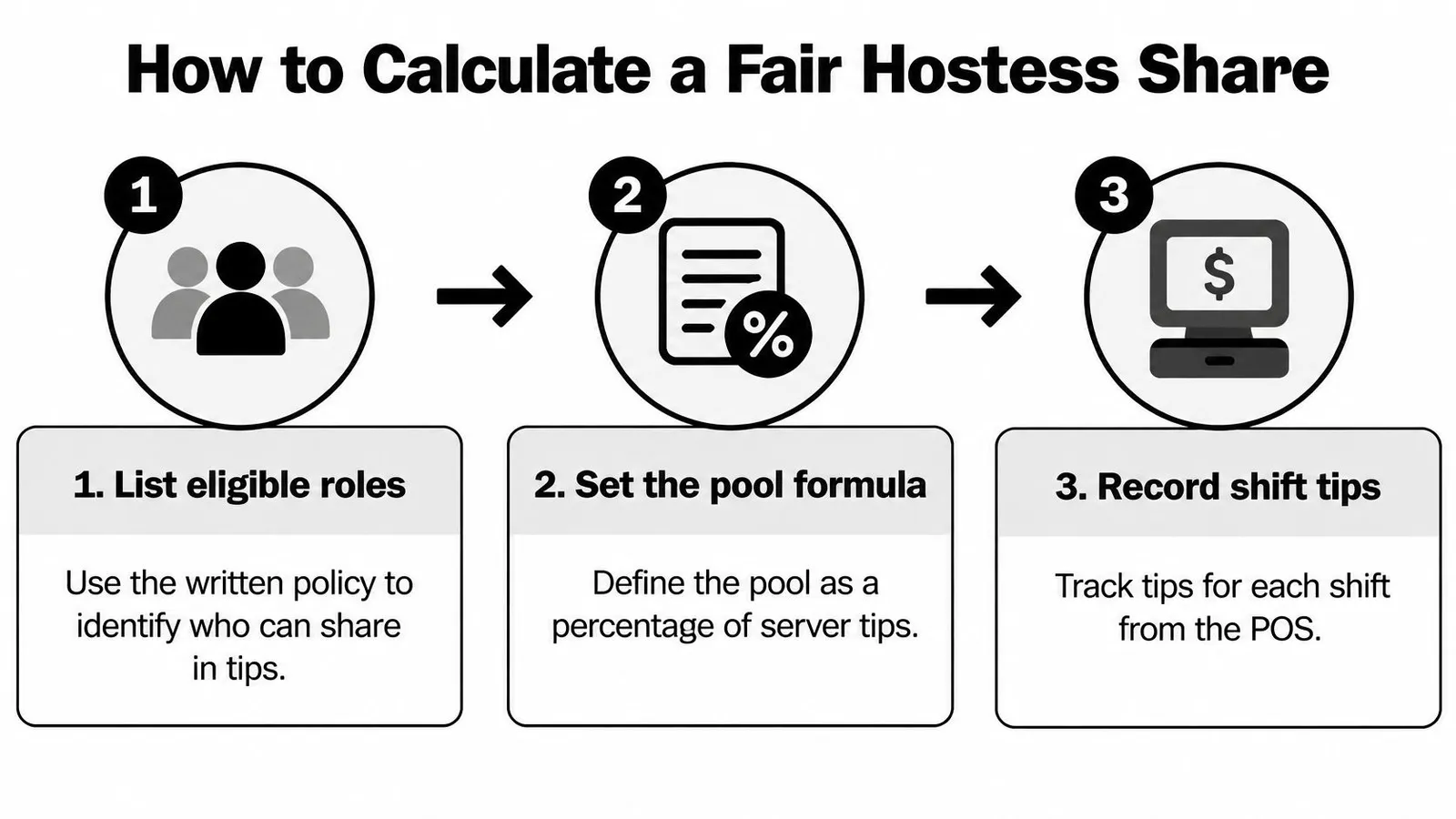
Run the same seven steps every shift. Skipping one is how a "fair" percent becomes a dispute.
- List eligible roles from the written policy. If hosts aren't named, they aren't in the math.
- Set the pool formula before service, such as a percentage of server tips, not a number you invent at close.
- Record tips for the shift from the POS or from declared cash tips. Don't reconstruct from memory.
- Calculate the host pool total from that recorded figure.
- Remove managers and supervisors from the split. Their names never enter the divisor.
- Divide the host pool by hours worked on that shift, using time-clock punches.
- Pay out and file the record by shift and employee. The file should let someone rebuild the number a month later.
A single-shift walkthrough
Servers tip out $800 on one shift. Policy gives hosts 10%, so the host pool is $80. Host A worked 6 hours and Host B worked 4 hours, 10 hours together. Host A receives $48. Host B receives $32. The two checks add back to $80. If they don't, stop and fix the hours before anyone is paid.
Where the employer uses a federal tip credit, the cash wage plus tips the employee receives must still reach at least the applicable minimum wage for each workweek. The Department of Labor's tipped-employee fact sheet is clear that credit applies only to tips the employee ultimately receives, and employees must be told about required contributions. State law can be stricter, so confirm the state rule before you lock a formula. A flat percent applied with no hours and no role check will fail that test on a short week.
Payouts must add up to the pool and match the time records. If either side is off, the share isn't fair yet.
Hosts comparing an offer should separate base pay from any pool. HiredBySkill's salary calculation tool is a practical way to turn an hourly rate and a realistic weekly tip estimate into one annual figure before someone accepts the schedule.
Tax Reporting Rules for Hostess Tips
In the United States, a hostess who receives $20 or more in cash tips from one employer in a calendar month must report that amount to the employer in writing by the 10th day of the following month. The IRS tip-income rules count three streams as cash tips: money received directly from customers, electronically charged tips the employer distributes, and tips received from other employees through tip sharing. Amounts under $20 are still taxable income and belong on the tax return.
| Tip type | Hostess reporting duty | Employer records |
|---|---|---|
| Cash tips received directly from guests | Report to employer in writing if $20 or more in a calendar month, by the 10th of the next month | Written reports received by date |
| Electronically charged tips distributed by the restaurant | Counts as tip income | Amount and date of each distribution |
| Tips shared from other employees through a pool | Counts as tip income | Pool formula and payout per shift |
| Cash tips under $20 in a month | Still taxable; report on the tax return | Payout records kept for the period |
What the house must keep
Record hostess pool distributions separately from server tips. Keep the payout by shift, employee, and amount. Informal envelope cash with no log breaks the report the hostess owes and the trail you need if payroll is questioned. Restaurant accounting insights from Book Tech are worth a look when tip clearing, sales, and payroll need to land in the same books.
State items to confirm
Tipped minimum wage, whether an employer may claim a tip credit, who may join a pool, and extra reporting duties are state rules. A state can be stricter than federal law. Don't fill a policy with a guessed wage rate.
- Tipped minimum wage: Confirm the current state figure with the state labor agency. Don't copy a neighboring state's rate.
- Tip credit: Confirm whether your state allows one at all.
- Pool eligibility: Confirm whether hosts, and any non-server roles, may share.
- Reporting duties: Confirm any state notice or allocation rule on top of the federal $20 report.
If you haven't verified a state this year, leave that cell blank in your worksheet and get the statute. A guessed number in a handbook is worse than a blank.
Managers' Controls and the Policy Decision
Start with one written tip policy. It names eligible roles, the pool formula, the payout schedule, and the calculation method. If those four lines aren't on paper, you don't have a policy. You have a habit.
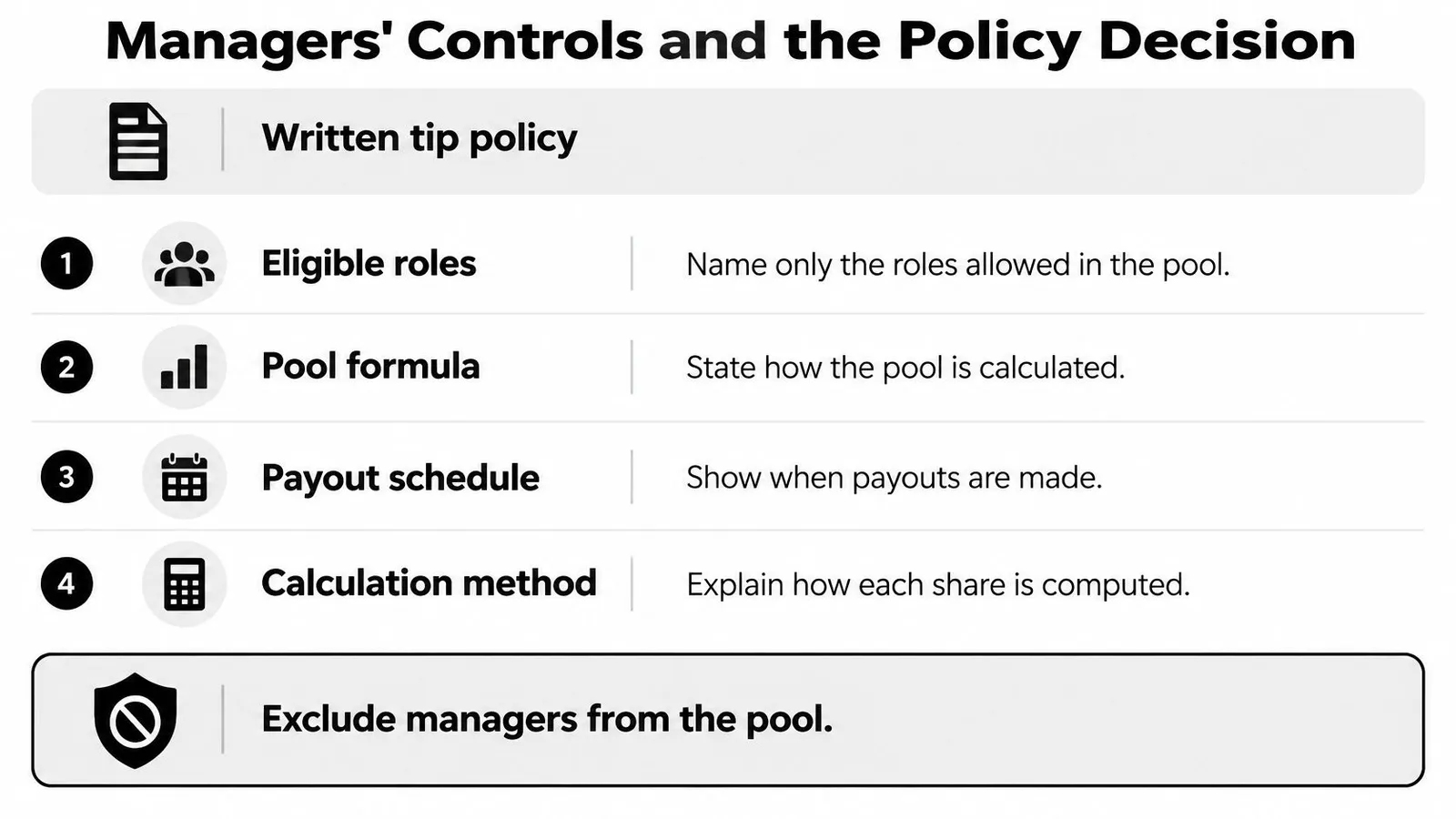
Four controls, one failure each
Keep managers out of the split. A manager in the pool takes tips that belong to staff. Supervisors don't get a line on the payout sheet, even on a short-staffed Saturday.
Check roles before any flat percentage. A tip-out aimed at "front of house" can land on a host who never touches table service. Read the duty list for that shift, then apply the percent only to names the policy allows.
Split by hours when shift lengths differ. Equal splits overpay a three-hour closer and underpay an eight-hour opener. Headcount is the wrong divisor unless every eligible person worked the same length.
Log every cash declaration in a dated record. A lost declaration breaks the tax trail and makes the pool impossible to rebuild. The log needs the employee, the date, and the amount.
Match the workflow to volume. A spreadsheet can serve a few staff on two shifts a week if someone reconciles it. Frequent shifts favor calculations taken from POS sales, with employees, time entries, and sales in one place. AnchOps is one option for that workload: $59.99 per location per month, flat, with unlimited employees, covering scheduling, inventory, food cost, and tips. The Pro plan includes a Toast POS integration with automatic tip calculations. Spreadsheets, POS reports, and payroll tools can do the same job if a person owns the close. With Toast connected, pools, tip-outs, delivery, and cash declarations can compute daily from real sales, and every distribution should keep an audit trail.
What the audit has to show
Keep the trail by shift, employee, role, and amount. Reconcile payouts to the pooled total each month before payday. A mismatch is a stop, not a note for later. Build the same discipline into the rest of the handbook. Employee policies for restaurants should sit next to the tip sheet so new hosts see wage rules and conduct rules together. Pay clarity is part of how people stay. Practical workplace reward examples help when you want recognition that isn't a quiet, undocumented bump in someone's envelope.
Take the decision in order
- Confirm whether hostesses at your concept share tips at all.
- Write the policy: roles, formula, schedule, method.
- Confirm state wage and tax rules before the first payout.
- Run one test pay period.
- Reconcile that test to the pool, then go live.
A written policy, documented eligible roles, and payouts that trace to sales and hours settle whether hostesses make tips in your restaurant.
AnchOps calculates tip pools and tip-outs from Toast POS sales, with role-based splits and an audit trail your host team can see in the app. If you're tired of rebuilding a host share from a spreadsheet after close, connect your sales and time entries and let the formula run the same way every shift. Visit AnchOps to see how scheduling, timekeeping, and tip payouts fit one location.
Your back-of-house partner is ready
AnchOps handles scheduling, tip calculations, labor costs, and timecards — so you can focus on your restaurant, not your paperwork.