Service Charge vs Tip: The Operator's Guide (2026)
Published on
By Tony Newcome — Founder of AnchOps · Owner, Pizza Harbour
This article was drafted with AI assistance and reviewed by Tony Newcome, a working restaurant operator.
The legal difference: a tip is the guest's voluntary payment and belongs to employees; a service charge is a mandatory fee that belongs to the business, counts as regular wages when distributed, and is taxed accordingly. Choose by operational burden as much as law — the model changes who controls the money, payroll processing, POS setup, staff morale, and guest communication.
That decision isn't just about compliance. It changes who controls the money, how payroll gets processed, what your POS needs to do, how your team feels about the system, and whether your guests leave confused at the end of the meal. The legal distinction matters, but the operational burden matters just as much.
Table of Contents
- The Payroll Problem You Can't Ignore Anymore
- Why this becomes an operations issue fast
- Service Charges and Tips Legally Defined
- Where restaurants usually get this wrong
- How Service Charges and Tips Impact Your Bottom Line
- Service Charge vs. Tip Operational & Financial Comparison
- Where margin gets tighter than expected
- What changes in payroll and tax handling
- The trade-off operators actually have to make
- The Impact on Your Team's Pay and Morale
- Why BOH equity pushes operators toward service charges
- Why FOH pushback is real
- Communicating Changes to Your Guests
- What guests need to see before they pay
- Copy you can actually use
- Configuring Your Toast POS for Service Charges
- The settings that affect guest behavior
- The setup mistakes that create payroll headaches
- Choosing the Right Model for Your Restaurant
- A practical decision filter
The Payroll Problem You Can't Ignore Anymore
Most restaurants don't start debating service charge vs tip because they love compensation design. They start because something in the operation has stopped feeling workable.
A common trigger is pay imbalance. The front of house can have a strong night tied directly to guest spend, while the back of house handles the same rush for a wage structure that doesn't rise with demand. That gap gets harder to justify when hiring cooks gets tougher, payroll is less predictable, and managers spend too much time smoothing over internal resentment instead of running service.
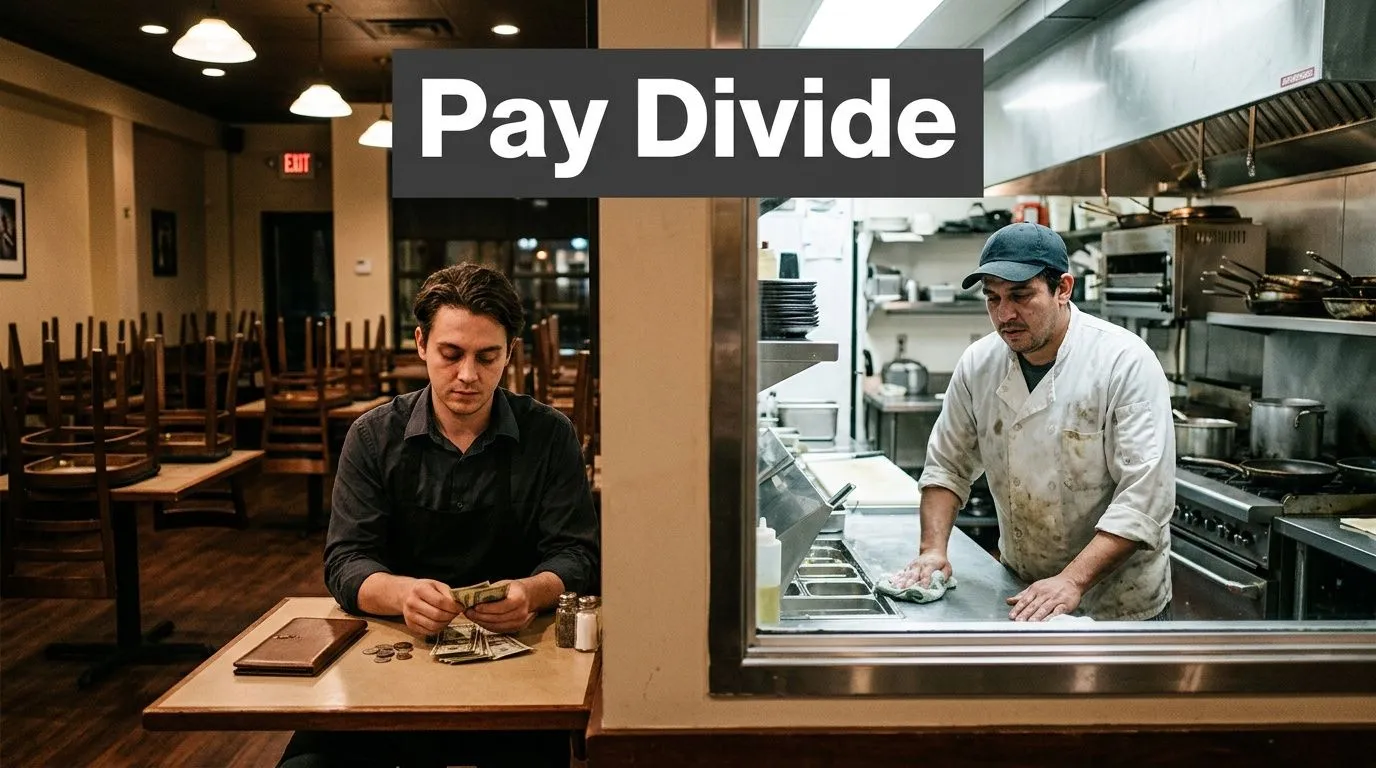
The federal structure behind that pressure hasn't helped. The federal minimum cash wage for tipped workers has remained $2.13 per hour since 1991, and if a server's wages plus tips don't reach the federal minimum wage of $7.25 per hour, the employer has to make up the difference under the FLSA, as outlined in Grubhub's explanation of service charges and tips. That puts operators in the middle of a model that depends on guest discretion but still leaves the business holding the compliance risk.
Why this becomes an operations issue fast
Once you look past the policy debate, this becomes a workflow problem.
- Scheduling gets harder: A tip-heavy model can reward high-volume shifts well, but it doesn't automatically solve wage pressure in prep, line, dish, and expo.
- Payroll gets messier: The more compensation rules you layer on, the more opportunities there are for classification mistakes.
- Managers carry the friction: They field complaints from both ends. FOH wants earning upside protected. BOH wants compensation to reflect workload.
Practical reality: operators rarely switch models because one system is perfect. They switch because the current one is creating daily tension they can't keep absorbing.
If your admin side already feels stretched, it helps to tighten the process layer before changing the pay model. A useful reference is Steingard Financial's guide to payroll efficiency, especially if your current payroll workflow still relies on manual cleanup after service.
What Is the Legal Difference Between a Service Charge and a Tip?
Misclassify this once, and the cleanup spreads fast. Payroll codes get set up wrong, managers explain the charge inconsistently, and staff expectations drift away from what the business can legally do with the money.
The legal line is straightforward. A tip is optional. A service charge is required.
For a payment to count as a true tip, the guest has to choose whether to leave it, choose how much to leave, and decide who gets it. If the amount is preset by house policy, added automatically, or required as part of the bill, it falls into service charge territory even if the receipt uses the word gratuity.
That receipt language matters less than operators think. The actual structure controls the classification.
Where restaurants usually get this wrong
The trouble starts with charges that look like tips to the guest but do not function like tips behind the scenes.
- Automatic gratuity on large parties: If it is added by policy instead of chosen by the guest, treat it as a service charge.
- Banquet or event fees: If the contract or invoice sets the amount, the business controls the charge first.
- Flat service fees on every check: Calling it support for the team does not turn it into a tip.
That legal distinction also decides who owns the funds first. Tips are customer-directed payments to employees. Service charges are restaurant revenue first, then distributed based on employer policy.
Operators feel that difference in day-to-day decisions. A tip can go through tip reporting and tip pool rules. A service charge has to be handled like business revenue before any payout to staff. That changes how you write the menu language, train managers, and set expectations with the team before rollout.
It also affects smaller policies that cause outsized friction later. For example, if you already have questions about whether credit card processing fee tip deductions are allowed, you need the classification right first. You cannot clean up a deduction policy if the underlying payment type was coded wrong from the start.
The operational lesson is simple. Do not decide based on what sounds better to guests. Decide based on who controls the charge, when that control starts, and how much payroll handling the model will create for your office each week.
How Do Service Charges and Tips Impact Your Bottom Line?
Friday night closes strong. Sales look healthy. Then Monday hits, payroll gets reviewed, and the numbers stop looking so clean. The difference usually is not food cost or cover count. It is how the restaurant handled money that looked similar on the check but moved through the business in completely different ways.
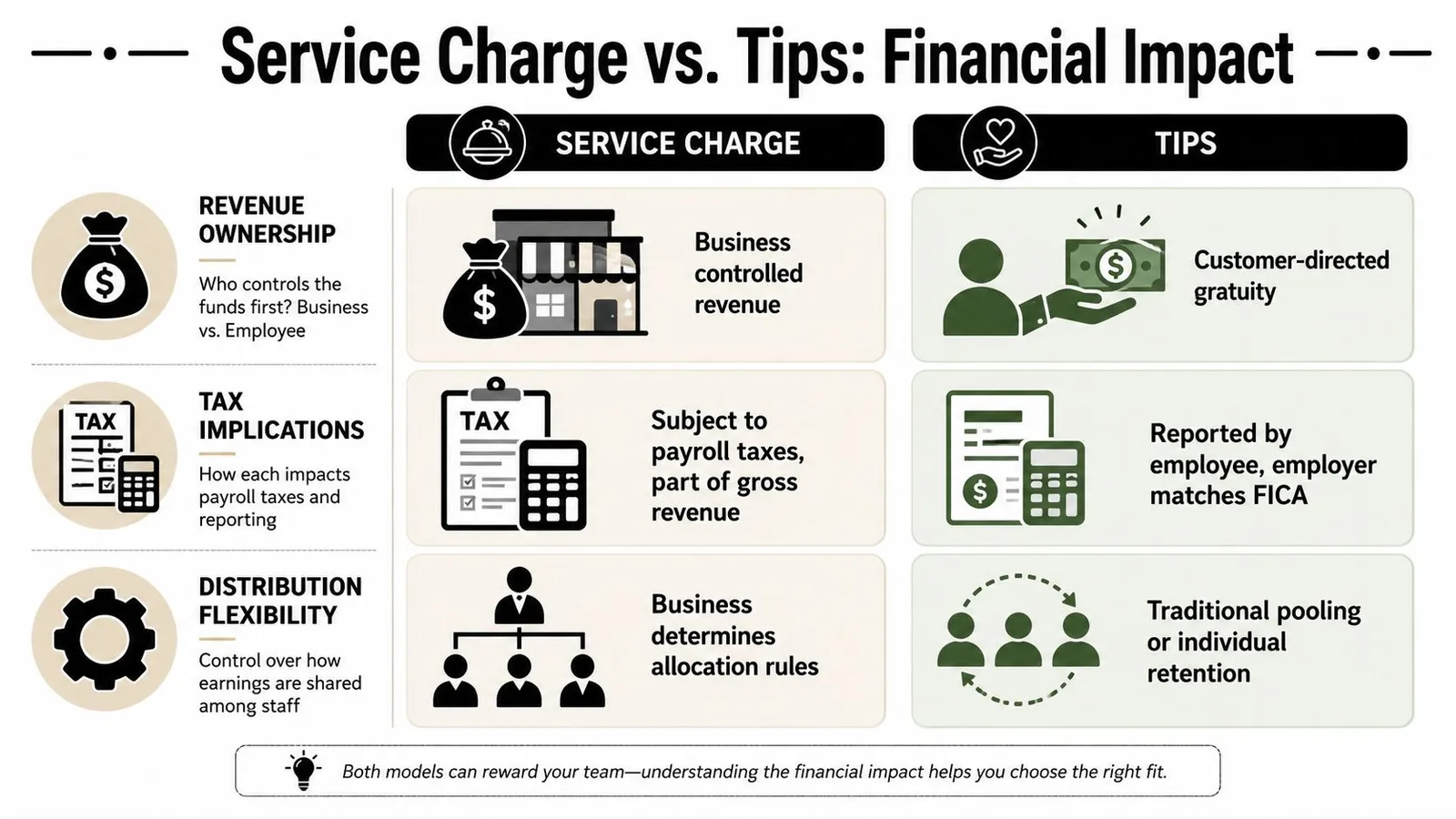
Operators who switch to a service charge often focus on the upside first. More control. More predictable labor planning. More room to support BOH pay. All true. But that control comes with extra payroll handling, tighter bookkeeping requirements, and more ways to code something wrong.
Service Charge vs. Tip Operational & Financial Comparison
| Attribute | Traditional Tips | Service Charges |
|---|---|---|
| Who controls the payment first | Employee-directed gratuity | Restaurant-controlled revenue |
| Whether guest chooses the amount | Yes, if it meets tip criteria | No, amount is mandatory or employer-set |
| Payroll classification when paid to staff | Tip income | Non-tip wages |
| Payroll tax withholding | Taxable, handled under tip rules | Full payroll tax withholding required |
| FICA Tip Credit potential | May apply under certain conditions | Doesn't apply the same way because distribution is treated as wages |
| Distribution flexibility | Individual tips or tip pool | Employer determines allocation |
| Use for BOH support | Limited by tip structure and policy | Can be allocated more broadly by employer policy |
| Guest expectation | Familiar to most diners | Requires explicit explanation |
Where margin gets tighter than expected
A service charge gives the business more control over how funds are allocated. That can help smooth wage disparities, support benefits, or build a compensation model that is less dependent on nightly sales swings.
It also changes what hits the books first. Service charge revenue belongs to the restaurant before any payout goes to staff. Once that happens, the money has to be tracked, assigned, taxed, and paid out through the right wage setup. If the policy is loose, the admin work spreads fast across managers, payroll, and accounting.
I have seen operators underestimate this part. They assume a service charge will simplify payroll because the house controls the money. In practice, it only gets simpler if the POS mapping, payroll codes, payout rules, and manager training are all set before rollout.
What changes in payroll and tax handling
The actual cost difference appears at this point.
Tips and service charges can look nearly identical on a guest receipt, but they do not move through payroll the same way. As noted earlier, service charges paid to employees are generally handled as non-tip wages. That means full withholding applies through normal payroll processing. Tips follow a different reporting path, and that difference affects tax treatment, payroll exports, and how labor is reported internally.
For operators, the day-to-day impact usually looks like this:
- Service charge payouts need wage code discipline
- Tips need accurate reporting and tip pool controls
- POS mappings have to match payroll settings
- Labor reviews can get distorted if service charge payouts sit in the wrong bucket
- Month-end cleanup gets harder when managers apply exceptions by habit
The hidden burden is not one big expense. It is the stack of small errors. A charge gets set up wrong in the POS. A manager promises staff one payout method, payroll uses another, accounting has to reclassify it later, and now the team no longer trusts the policy.
If you are reviewing related payment rules at the same time, this guide on whether credit card processing fee tip deductions are allowed is a useful companion because deduction questions and classification mistakes usually show up in the same payroll audit.
The trade-off operators actually have to make
Traditional tips usually create less employer control and more income variability. Service charges usually create more employer control and more employer admin. That is the fundamental trade-off.
For some restaurants, that trade is worth it. A service charge can support steadier compensation planning and broader distribution across the team. For others, the added payroll friction eats up the benefit, especially if the office is already stretched thin or the management team is inconsistent with policy. The right choice is the model your systems can run cleanly every single pay period.
The Impact on Your Team's Pay and Morale
Money structure becomes culture faster than most operators expect. A compensation model doesn't just change paychecks. It changes how staff judge fairness, effort, teamwork, and opportunity.

Why BOH equity pushes operators toward service charges
For many restaurants, the strongest argument for service charges is simple. They create room to spread compensation beyond the guest-facing roles.
That matters because the kitchen, prep, dish, and support team influence the guest experience every bit as much as the server does, even if they don't traditionally participate in tip income. Service charges give operators a mechanism to allocate funds across the full team, including back-of-house staff, as discussed in Forte's analysis of tips, tip pools, and service charges.
In practical terms, that can help with:
- Back-of-house hiring: Candidates often care more about stable, understandable pay than theoretical upside.
- Cross-team resentment: FOH and BOH conflict usually cools down when compensation feels less lopsided.
- Manager credibility: Leaders have an easier time defending the pay model when it matches the work distribution more closely.
Why FOH pushback is real
The trade-off is just as real. Some employees may feel disconnected from direct performance incentives when compensation is no longer tied to guest tipping behavior, which creates the paradox many operators underestimate.
Top servers and bartenders often like systems where skill, upselling, pace, and guest rapport show up directly in their take-home pay. A service charge model can flatten that connection. Even if total pay is stable, the psychology changes.
The server who thrives on variable upside may read “stability” as “cap.”
That doesn't mean service charges fail. It means the rollout has to address what FOH staff believe they're losing, not just what the restaurant is trying to fix.
A few practical guardrails help:
- Show the allocation rules clearly: If staff can't explain where the money goes, they won't trust the model.
- Train managers before the announcement: Staff questions get sharper after preshift than they do in the planning meeting.
- Review your pooling logic carefully: If you're comparing alternatives, this guide on how to calculate tip pooling is helpful for pressure-testing fairness before you change systems.
The wrong way to do this is to pitch service charges as universally better. They aren't. They solve some problems cleanly and create new ones just as fast if your FOH team built its identity around direct earning power.
Communicating Changes to Your Guests
A guest reaches the payment screen, sees a service charge, and asks the server, "So am I still supposed to tip?" That moment decides whether your policy feels clear or slippery.

Operators often treat guest communication like a branding task. It is really an operations task. If the wording is vague, the dining room pays for it in longer payment interactions, more manager touchpoints, more voids or tip adjustments, and more staff frustration at the end of the shift. I have seen solid compensation policies create avoidable tension simply because the receipt, menu, and server explanation did not match.
Guests do not need a lecture on labor law or payroll tax treatment. They need one plain answer to one plain question: Is this charge replacing the tip, or is it in addition to the tip?
What guests need to see before they pay
The policy has to appear before the check hits the table, and it has to say the same thing everywhere.
Use these checkpoints:
- Menu language: Put the policy near pricing or at the bottom of the menu where guests will see it before ordering.
- Online booking and event confirmations: Large-party disputes usually start here, not at the host stand.
- Receipt detail: Label the line clearly and state whether additional tipping is expected.
- Server script: Give every FOH employee the same short explanation so guests do not hear three different versions in one week.
Consistency matters more than creativity. If your menu says one thing, the receipt suggests another, and the payment screen still prompts for a full tip, guests assume the restaurant is stacking charges.
That is also where staff confidence starts to crack. Servers should never have to guess whether they are defending the policy, apologizing for it, or translating it. If you are changing both compensation and pooling rules, train the team on the guest-facing explanation and the back-end mechanics together. A messy rollout on either side creates distrust fast. Restaurants making that shift often benefit from tightening the back office at the same time with tools that automate tip pooling in Toast POS.
If your printed and digital receipts are cluttered or inconsistent, it helps to look at examples of how to create itemized restaurant receipts so the charge appears in a format guests can read quickly.
Copy you can actually use
The best language is short, direct, and hard to misread.
Menu note
“A service charge is added to each check to support team compensation. Additional tipping is not expected.”
Large party note
“An automatic service charge applies to large parties. Ask a manager if you want details on how it is handled.”
Receipt line explanation
“Service charge included. This charge is part of our staff compensation model.”
Server script
“The service charge is already included on the check. I can explain how it works if helpful.”
The weak version is usually too clever or too careful. Guests do not trust fuzzy phrases like “wellness fee,” “operations charge,” or “hospitality included” unless you explain exactly what they mean. Clear wording protects the guest experience, reduces payment friction, and saves your managers from spending service recovering a policy that should have been understood before dessert arrived.
Configuring Your Toast POS for Service Charges
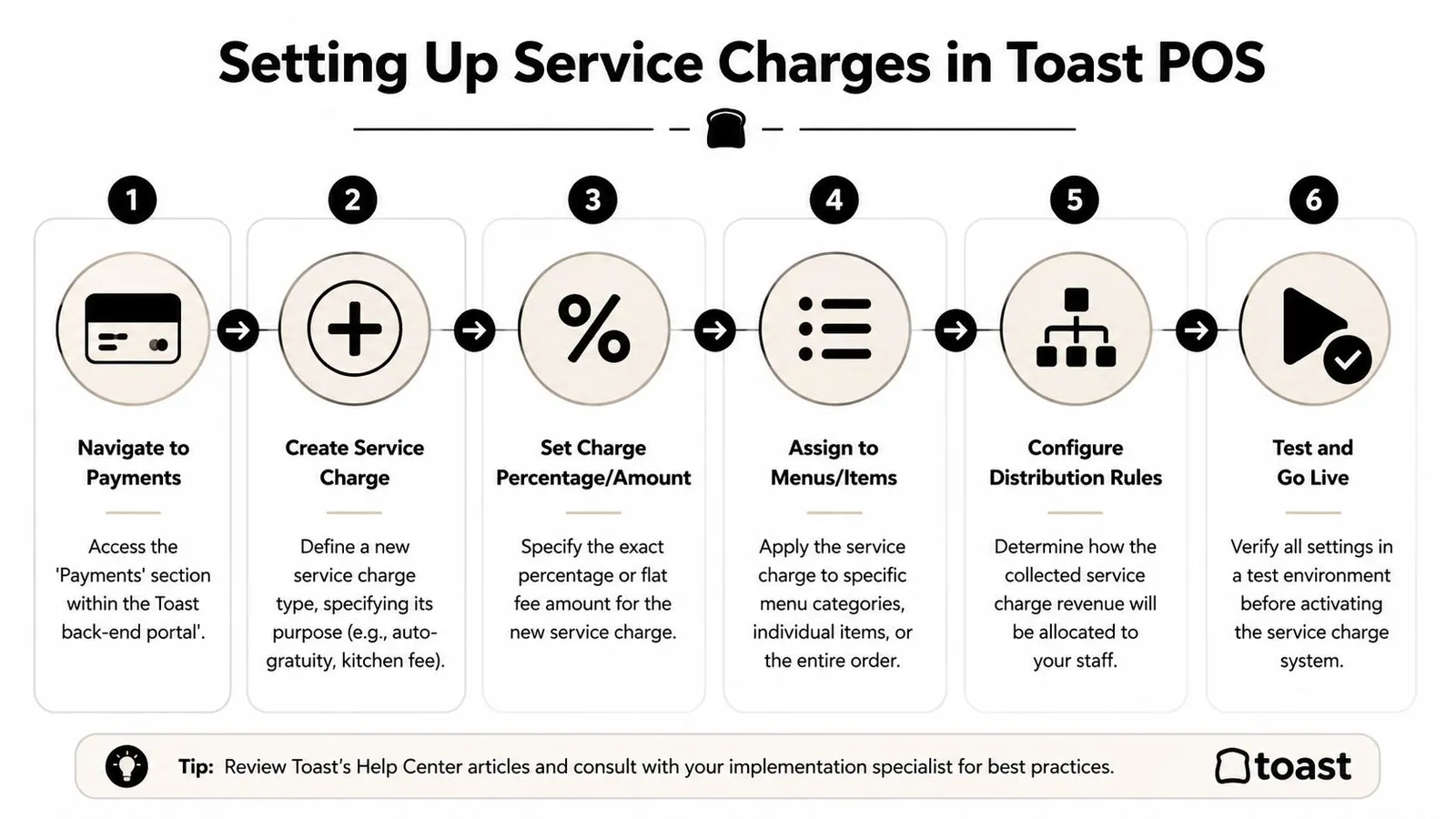
A service charge policy can be perfectly sound on paper and still create bad data if Toast is configured poorly. That's where a lot of operators get burned. They approve the policy, flip the switch, and only later realize the receipt prompts changed, taxes weren't handled the way they expected, or payroll exports don't match what management thought was happening.
The settings that affect guest behavior
Toast lets you configure service charges as Fixed Percent, Fixed Amount, or Open Amount, and those choices affect reporting and the guest-facing payment flow, according to Toast's guide to mandatory gratuity and service charges.
One setting matters more than many teams realize. If a service charge is not assigned to the check owner and is included in net sales, Toast adjusts digital receipt tip prompts to 3%, 5%, and 7% of the reduced subtotal. If it is assigned to the check owner, Toast uses the standard tipping thresholds configured in UI options.
That matters because the payment screen teaches guests what to do next. If the prompt shrinks unexpectedly, staff may assume guest generosity dropped when the POS changed the suggestion logic.
The setup mistakes that create payroll headaches
The tax setting is the next place operators stumble. Toast's “Taxed?” parameter gives you three options:
- No Tax
- Tax Inclusive
- Tax Exclusive
Each one changes how the charge interacts with the check and how much cash sits behind the sale after tax treatment. If your reporting team, payroll admin, and whoever configured Toast aren't aligned, your labor review can drift from reality.
A practical setup process looks like this:
Define the purpose first
Auto-gratuity for large parties is different from a house-wide service fee. Don't reuse one charge type for multiple policies.Map the charge to the right checks
Broad application sounds efficient until managers start voiding charges manually.Review the tip prompt outcome on a test check
Don't assume the digital receipt will behave the way the dining room expects.Confirm how the charge appears in reports
Net sales treatment affects downstream review.Run a payroll test before going live
Make sure the exported data lands in the right wage category.
If you're automating the operational side around Toast, this walkthrough on automate tip pooling with Toast POS helps clarify how payout logic and POS configuration need to stay aligned.
A clean service charge policy with bad POS setup will still produce bad payroll.
Which Model Is Right for Your Restaurant?
A switch from tips to service charges looks clean on paper until the first payroll after rollout. Servers compare take-home pay line by line, managers spend hours explaining checks to guests, and the office is left sorting out whether the new model fixed the original problem or just moved it into payroll and retention.
There is no universal right answer. The right model depends on where your operation is breaking today, what your team will tolerate, and whether your back office can carry the added discipline without constant cleanup.
A practical decision filter
Choose traditional tipping if your concept wins on individual hospitality, upselling, and strong server ownership of the guest experience. In those restaurants, top FOH performers usually value earning upside more than pay stability. If you remove that upside, expect turnover risk, slower sales behavior, and a harder time hiring experienced servers.
Choose a service charge model if your bigger problem is compensation control. That usually means uneven earnings between shifts, pressure to support BOH pay, or too much week-to-week volatility in labor costs. The trade-off is administrative. You gain more control over how money is collected and distributed, but you also take on more payroll responsibility, more policy enforcement, and more room for setup mistakes.
A hybrid approach works well when the restaurant is not ready for a full conversion. Events, large parties, catering, and banquet service are common starting points because the billing structure is already more formal and the guest expectation is easier to set. It also gives operators a safer test case for staff reaction before changing the whole floor.
Ask these questions before you commit:
- What problem are you solving first: FOH earning swings, BOH pay pressure, or guest confusion?
- Will your strongest servers view this change as fair, or as a cap on earnings?
- Can payroll handle the reporting and wage treatment cleanly every pay period?
- Can managers explain the policy the same way on a busy Saturday night?
- Can your POS, payroll exports, and payout process match the policy exactly?
The best model is the one your restaurant can run repeatedly without side calculations, exceptions, and damage control meetings on Monday.
AnchOps helps restaurant operators turn all of this into something manageable. If you're using Toast and want tighter labor forecasting, cleaner tip pooling and tip-out calculations, batch timecard review, and export-ready payroll files without the nightly spreadsheet scramble, AnchOps is built for that reality.
Your back-of-house partner is ready
AnchOps handles scheduling, tip calculations, labor costs, and timecards — so you can focus on your restaurant, not your paperwork.