How to Run Gen Z Restaurants That Actually Win
Published on
By Tony Newcome — Founder of AnchOps · Owner, Pizza Harbour
This article was drafted with AI assistance and reviewed by Tony Newcome, a working restaurant operator.
To win with Gen Z, stop treating them as a marketing audience and run the restaurant around how they actually order: digital-first channels, pickup and app volume, discovery through Google and social, and value-driven bundles — with staffing shaped to order mix instead of front-door traffic. Menu, tech stack, pricing, and scheduling all follow that shift; this playbook works through each.
That's the problem with gen z restaurants. Most operators still think about this group as a marketing audience, but Gen Z is changing the way the whole business runs, from order mix to staffing shape to what “good service” even means. If you're still scheduling like every guest walks through the front door and waits to be greeted, you're probably paying for the wrong kind of capacity.
Table of Contents
- Why Gen Z Changes the Way a Restaurant Runs
- The old “walk-in first” plan breaks quickly
- What Gen Z Spends and Where
- Spend follows convenience, but not everywhere
- Designing the Menu, Order Flow, and Tech Stack
- Build for handheld speed, not menu sprawl
- Choose the stack that clears work, not the stack that looks modern
- Building a Discovery Engine Across Google, Apps, and Social
- Make Google and delivery apps do the heavy lifting
- Pricing, Value, and Bundle Strategy That Don't Erode Margin
- Build value the guest can see
- Margin control starts with simplicity
- Scheduling and Labor Forecasting for Gen Z Demand Patterns
- Forecast by channel, then assign people to the bottleneck
- Use live signals, not last week's instincts
- Your 30-Day Gen Z Restaurant Reset
Why Does Gen Z Change the Way a Restaurant Runs?
Friday night is where the mismatch shows up first. A manager opens the schedule expecting a heavy dine-in rush, stacks the floor with hosts and servers, and leaves the prep side lean because the room looked like the main event. Then the night turns into a digital-order fire drill, with mobile tickets rolling in while tables turn slower than expected, and the labor plan starts drifting in real time.
That is not a small operational annoyance. It means guest demand has moved faster than the schedule template. TouchBistro's 2024 Gen Z report says 64% of U.S. Gen Z diners eat out at least once a week, 35% do so several times a week, and 46% prefer delivery over pick-up, drive-thru, or walk-in for to-go orders, up 19% year over year. That combination means the customer base is frequent, flexible, and increasingly comfortable with off-premise habits, which changes how labor gets used on the line and in the front of house. It also matters that Gen Z's average dine-in spend is $51 per visit, ahead of Millennials, Gen X, and Boomers, while takeout and delivery average $36 per order, the highest across generations, according to the same TouchBistro report. TouchBistro's 2024 Gen Z report
The old “walk-in first” plan breaks quickly
Gen Z guests do not behave like a single-channel crowd. They order ahead, they shift between pickup and delivery, and they expect the restaurant to absorb that complexity without friction. Once that pattern becomes normal, the manager who builds labor only around seats in the dining room is already behind.
Practical rule: if your peak-hour staffing plan only makes sense when every guest walks in cold, it is not a plan for Gen Z demand.
A more accurate way to think about Gen Z restaurants is this, the guest journey is split before the guest arrives. A lot of the work now happens before the door opens, in the app, on Google, or in a delivery marketplace. That means the job is not just filling the room, it is staffing for the order path the guest already chose, then correcting fast when that mix shifts mid-shift.
What Does Gen Z Spend, and Where?
The spend pattern is concentrated, and that matters for staffing and prep. In The NPD Group data cited by The Food Institute's summary of Gen Z restaurant traffic, Gen Z made 5 billion restaurant visits in the 12 months ending July 2022, and 4.3 billion of those visits were to QSRs, which works out to about 86% of their restaurant traffic going to quick-service restaurants. For an operator, that points to a guest base that is showing up where speed, line flow, and handoff timing matter most.
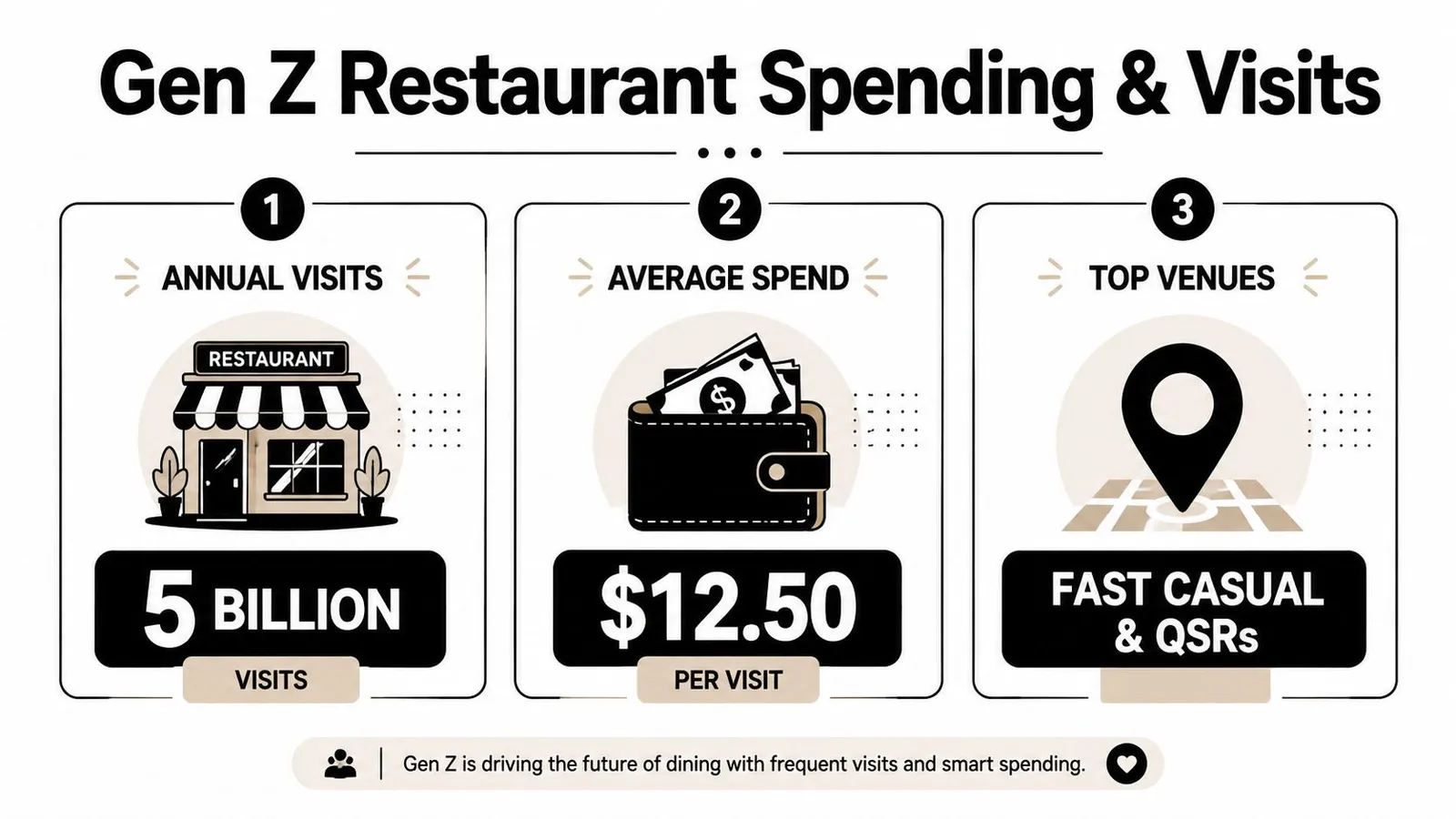
The same reporting points to a detail that matters on the floor. Gen Z fast-casual visits were up 4% year over year even while overall quick-service traffic was flat. That tells you the category mix keeps shifting inside the broader quick-service bucket, and a slightly more polished format can win this guest if the speed penalty stays low.
Spend follows convenience, but not everywhere
The trap is treating volume like margin. Gen Z's average dine-in ticket is strong, but the off-premise check is lower, and lower checks can still create heavy labor when ticket flow is messy or production is built for the wrong channel mix. The practical move is to forecast by channel, then line up labor, prep, and expediting with where the tickets are coming from.
Price pressure sits on top of that. Restaurant Dive on Gen Z visit frequency and price pressure reported that Gen Z made 66 fewer restaurant visits in the 12 months through February 2022 than Gen X did at the same age, and that inflation and higher menu prices discouraged traffic. That does not mean Gen Z will not spend. It means the guest is looking for visible value before committing, especially when the check is tied to pickup, delivery, or a quick-service occasion.
A practical weekly forecast starts with where Gen Z concentrates, quick-service, fast-casual, pickup, delivery, and drive-thru, then weights labor and prep to match. A dining-room-heavy plan can still work, but only if the room is built around how this generation buys food and how quickly the mix can shift mid-shift.
Designing the Menu, Order Flow, and Tech Stack
A Gen Z menu fails fast when the line gets clogged. In the units I've rebuilt for younger guests, the first problem was usually not demand, it was the menu forcing too many decisions, too many modifiers, and too many handoffs at the wrong point in the shift. Gen Z still responds to quick and easy meals, and the pull between flavor and variety and convenience stays close enough that the menu has to do both jobs at once, give the guest a reason to choose it and give the kitchen a clean way to execute it.
Build for handheld speed, not menu sprawl
Cut for line clarity before you cut for style. Keep the items that travel well, hold temperature, and can be built with minimal modification, because those are the items that protect ticket time and keep your prep list from ballooning. Handheld items, shareable sides, and repeatable core sauces usually outperform broad, unfocused variety because they shorten the decision at the counter and reduce the number of ways a ticket can go sideways.
A menu should read like a production plan. If an item needs a long explanation from the cashier, a special reminder at the expo line, and a cleanup step on the back end, it is asking for labor you may not get back in sales. That is the kind of item that looks good in a brainstorm and gets exposed on a Friday rush.
Operational shortcut: if an item needs constant explanation from the cashier, it probably needs a rewrite before it needs a campaign.
Tech belongs in the order flow, not as a shiny layer on top of a weak menu. The National Restaurant Association says Gen Z is comfortable ordering through a smartphone app at a limited-service restaurant, using QR codes for menus, and ordering online in advance at sit-down restaurants so the food is ready soon after they arrive. The takeaway is simple, remove friction where the guest already expects it, then stop. National Restaurant Association on restaurant technology adoption
Choose the stack that clears work, not the stack that looks modern
A QR menu only helps if it loads quickly and the item descriptions make sense without staff translation. I've seen QR setups fail because the guest still had to ask three questions before ordering, which meant the technology shifted labor instead of removing it. An app can help too, but only when ordering, payment, and modifiers are stable enough that your team is not fixing tickets at the expo line.
Before adding another system, ask whether it cuts steps or just moves them to a different screen. The best tech decisions I've seen were boring in the right way, fewer order errors, fewer mid-shift rescues, and less back-and-forth between the floor and the kitchen.
If you're comparing systems, start with a practical review of top restaurant management software and match the tools to the actual pain points on your floor. That means looking at labor, ordering, and payment flow first, then deciding whether the software removes enough manual work to justify the change.
When budget is tight, ship the piece that removes the most repeated manual work. For many operators, that is online ordering tied cleanly to the POS, because it cuts avoidable errors and keeps the line from absorbing chaos it did not create. After that, tighten the menu architecture, then add QR or kiosk ordering only if it clearly shortens the path from decision to payment.
Building a Discovery Engine Across Google, Apps, and Social
Gen Z doesn't discover restaurants in one place, and that's where a lot of local marketing goes wrong. A Gen Z dining report says 42% search Google first when deciding where to eat, while 27% go straight to a delivery app. The rest scatter across social platforms, recommendations, and whatever happens to catch their attention in the moment. That means visibility has to be built across channels, not just posted into one feed. Restaurant association generational trend reporting
Make Google and delivery apps do the heavy lifting
Your Google Business Profile needs current hours, correct category choices, crisp photos, and menu information that mirrors what guests order. The goal is less romance and more confidence. If a guest is comparing three spots on a phone screen, the one that looks easiest to understand often wins.
Delivery apps deserve the same care. Keep the top sellers visible, trim weak items that cause prep confusion, and make sure names, modifiers, and photos match what guests see when they search. That reduces cancellation risk, lowers back-of-house rework, and helps guests choose without second-guessing.
Social still matters, but not as a daily content treadmill. Operators do better when they use social to document proof, not to manufacture a personality. A clean dining room, a recognizable plate, a fast pickup shelf, or a short staff clip can all do the job if the story is consistent.
If you want a stronger framework for venue-level community building, the modern venues fan engagement guide is a useful reference point for turning visits into repeat attention.
The mistake is chasing “viral” content while ignoring the basics that Gen Z uses to screen choices. They're looking for price, deliciousness, convenience, freshness, and cleanliness, in that order, according to Dairy MAX and Knit. If your listing and your photos don't support those signals, the social content won't save the conversion. Dairy MAX and Knit Gen Z dining report
Pricing, Value, and Bundle Strategy That Don't Erode Margin
A Gen Z guest will pay for value they can see in the cart and feel in the first bite. They will also walk away fast if the price looks padded, the bundle feels arbitrary, or the add-ons turn a simple order into a scavenger hunt. The operator's job is to make the ticket feel justified before the guest reaches checkout.
Build value the guest can see
Use anchors that make the main item feel like the obvious starting point, then build bundles around that item so the guest is not doing mental math at the counter or in the app. Keep combos clean. Put the upgrade path in front of the guest instead of burying it in a modifiers screen or depending on a server to explain it table by table.
The choice is not only about low cost. In US Foods' Gen Z research, 50.8% prioritized flavor and variety while 50.5% prioritized convenience. That close split is why a good bundle can beat a blunt discount. A guest will pay for something that tastes distinct, arrives quickly, and feels complete.
| Driver | Will Pay More For | Will Switch Away For |
|---|---|---|
| Flavor | A menu item that feels bold or distinct | A bland version with no clear upside |
| Convenience | A meal that's easy to order and quick to get | A clunky order path or slow handoff |
| Transparency | Clear portions and obvious bundle value | Hidden add-ons and confusing pricing |
| Freshness | Ingredients that look and taste current | A product that feels stale or overworked |
The same US Foods report says natural foods are valued 1.8 times more than organic, which is useful guidance for how you frame sourcing. Guests do not need premium jargon. They need something that feels real, easy to understand, and worth the price.
Margin control starts with simplicity
If Gen Z is selective, broad discounting is usually the wrong answer. Tighter portion control, cleaner item architecture, and bundles that move profitable components together do more for margin and still give the guest a clear reason to say yes.
The same logic applies to service fees and tip communication. Guests accept complexity better when the math is transparent, and staff accept it better when the rules are consistent. For operators comparing how to present that math, this guide on service charge versus tip is worth keeping close because clarity at checkout affects trust and close rates.
A practical rule is simple, fix the value problem before you chase traffic with discounts. If the menu looks expensive, the bundles are confusing, and the add-ons feel opportunistic, the guest will notice before you do. Gen Z is price-led yet discerning about value, and that changes the operating problem.
How Should You Schedule for Gen Z Demand Patterns?
The wrong schedule shape is expensive even when sales are good. If your template assumes a classic dine-in peak, it can leave the prep team thin when the app gets busy and overbuild the front when the room is quiet. Gen Z makes that problem sharper because limited-service meals are often eaten on the go, and Restaurant Dive reported that about 24% of limited-service meals among Gen Z are eaten in the car, compared with 17% for all other generations. Restaurant Dive on in-car limited-service meals
Forecast by channel, then assign people to the bottleneck
A better schedule starts with channel mix. If pickup is spiking, labor needs to shift toward expo, packing, and hot-line coordination. If delivery is heavy, the bottleneck may be bagging, handoff timing, or driver staging. If dine-in is strong but ordering is app-led, the floor still needs coverage, but the pacing changes.
Workforce optimization stops being a buzzword and starts being a control system. The schedule should be tied to sales history, expected channel mix, and the times of day when labor drifts first. what is workforce optimization
Use live signals, not last week's instincts
The best operators I've seen do three things well. They publish schedules from actual sales patterns, they keep shift swap rules tight, and they watch labor drift before it gets away from them. That last piece matters because by the time the end-of-night review happens, the loss is already baked in.
For teams exploring more automated help, an AI task orchestration guide is useful because it frames automation around operational handoffs, not just novelty. The point isn't to replace managers. The point is to let managers react faster when the channel mix changes mid-shift.
Practical rule: if your labor review only happens after close, you're using reporting, not management.
Hiring fits this same pattern. Gen Z employees respond well to clear expectations, fast onboarding, and schedules that don't change every five minutes. If the first shift arrives too late, the training is too long, or the schedule is too opaque, you're building churn into the model before the employee even starts.
Your 30-Day Gen Z Restaurant Reset
Week 1, measure what's happening. Pull channel mix, labor cost by daypart, ticket times, and the share of orders coming from dine-in versus off-premise. If you don't know where the labor drift starts, you can't fix it.
Week 2, simplify the menu and the guest path. Remove confusing items, tighten bundle logic, and fix the ordering screens guests touch most. Then make sure the value story is visible without needing a manager to explain it.
Week 3, repair the hiring funnel. Shorten onboarding, clean up availability collection, and make the first few shifts easier to understand. New hires shouldn't spend a week figuring out where they fit.
Week 4, rebuild the schedule around the channel mix you've just measured. Assign labor to bottlenecks, not assumptions, and set mid-shift checks so managers can correct drift before it compounds. That's how the shift from trend-chasing to actual control starts.
If you want a scheduling and labor system built for the way Gen Z orders, AnchOps can help your team forecast labor, auto-build schedules from sales history, and catch labor drift before it hits the close. It's built for operators who need cleaner shifts, less manual admin, and a better grip on off-premise demand.
Your back-of-house partner is ready
AnchOps handles scheduling, tip calculations, labor costs, and timecards — so you can focus on your restaurant, not your paperwork.