What Are 1st 2nd and 3rd Shifts
Published on
By Tony Newcome — Founder of AnchOps · Owner, Pizza Harbour
This article was drafted with AI assistance and reviewed by Tony Newcome, a working restaurant operator.
1st shift usually means the daytime block, commonly around 7 a.m. to 3 p.m.; 2nd shift often runs 3 p.m. to 11 p.m.; and 3rd shift typically covers overnight hours such as 11 p.m. to 7 a.m. In restaurants those labels are only a starting point — the real work is deciding what they should mean inside your operation.
If you're building next week's schedule while texting for a closer, checking who's available for early prep, and trying to avoid accidental overtime, you're dealing with the true reason this topic matters. Most articles answer what are 1st 2nd and 3rd shifts with simple time ranges. That part is easy.
The harder part is deciding what those labels should mean inside your restaurant.
A breakfast-heavy cafe, a dinner-driven bistro, and a late-night bar can all use the same shift names and mean different things by them. If you treat shift labels like fixed definitions, you get sloppy handoffs, mismatched labor, and a team that feels like the schedule was built around the spreadsheet instead of the operation.
Table of Contents
- The Constant Scheduling Scramble
- When shifts are vague, labor gets expensive
- Structure beats heroics
- What Are 1st 2nd and 3rd Shifts in a Restaurant
- The basic definition
- What the labels mean in an actual restaurant
- Why the definition should be relative to your model
- Operational Impact and Handoff Strategy
- Each shift should own a job, not just a time slot
- The handoff is where good schedules fail
- Pros and Cons of Each Shift for Staff and Managers
- How each shift affects staff
- How each shift affects management
- Smart Scheduling Tips for Every Shift
- Build around the operating model
- Use practical guardrails
- Simplify Your Shifts with the Right Tools
- Manual scheduling breaks at the edges
- What the right system should actually do
The Constant Scheduling Scramble
You close the restaurant at night with one problem employee dragging out side work and one solid closer asking if they can come in later tomorrow because they're also opening at another job. Before you've finished the deposit, someone from the morning team messages that prep will be short unless you move a line cook forward by an hour.
That is normal restaurant scheduling life.
The issue usually isn't that we don't know the names of the shifts. It's that we haven't defined what each shift owns. So the opener thinks the closer should've stocked. The closer thinks the mid should've reset the line. The dinner crew blames the lunch crew for a bad handoff, and the lunch crew says they were buried.
When shifts are vague, labor gets expensive
If you don't define shifts clearly, managers start solving problems one day at a time. That leads to patterns like these:
- Too much overlap: You carry extra labor because nobody trusts the incoming team to be ready.
- Too little overlap: Critical tasks get skipped because one crew leaves before the next one can ask questions.
- Wrong skill mix: You have bodies on the floor, but not the right people in the right part of the day.
- Morale drift: Strong employees feel punished because they're always the ones asked to fill the gap.
Practical rule: A shift isn't just a start time. It's a bundle of responsibilities, handoffs, and labor expectations.
Once you start viewing 1st, 2nd, and 3rd shifts that way, the schedule gets easier to read and easier to defend. Your team knows why they are there, what success looks like, and what must be ready for the next crew.
Structure beats heroics
New managers often think good scheduling means saving the day every time someone calls out. Experienced managers know the opposite is true. The goal is to build a structure that needs fewer rescues.
In restaurants, shift labels give you that structure. They create a common language for open, peak, and close. They also help you train supervisors to manage labor by phase of business instead of by instinct alone.
What Are 1st, 2nd, and 3rd Shifts in a Restaurant?
You post the schedule, and a new supervisor asks a fair question: "Who is 1st shift here?" In one restaurant, that means openers and prep. In another, it means the lunch team. In a 24-hour concept, it may mean a standard daytime block. The label only helps if everyone ties it to the same part of the operation.
The basic definition
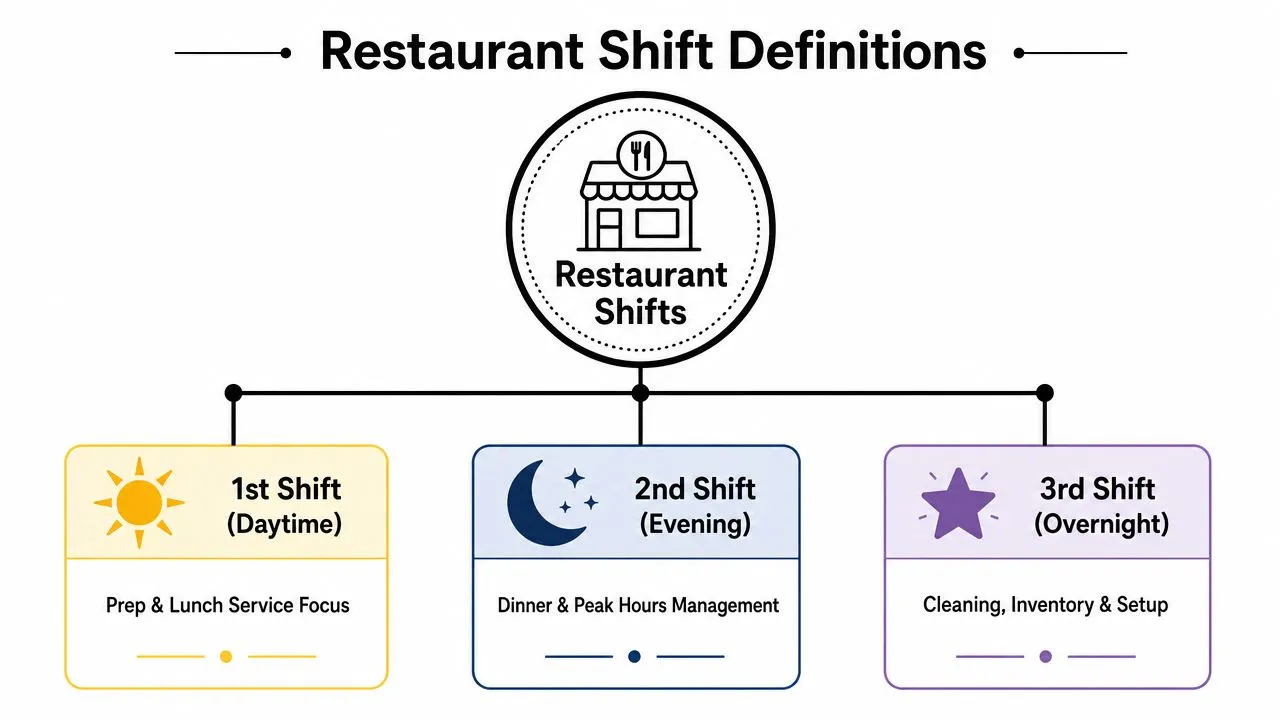
In broad workforce terms, 1st shift usually means the earliest daytime block, 2nd shift covers the later day into evening, and 3rd shift covers overnight work.
Restaurants use those same labels, but the hours are rarely universal. They shift based on your opening routine, your busiest service window, and whether you carry work past close into overnight prep, cleaning, or production.
What the labels mean in an actual restaurant
In practice, these shift names should map to operating phases, not generic clock ranges.
| Shift label | Usually maps to | What it tends to include |
|---|---|---|
| 1st shift | Open and early service | Receiving, prep, setup, lunch, early admin |
| 2nd shift | Peak service and close | Dinner rush, guest recovery, side work, close |
| 3rd shift | Overnight support | Deep cleaning, inventory, bake/prep, next-day setup |
That distinction matters. A cafe that opens at 6 a.m. will define 1st shift differently than a full-service restaurant that opens at 11. A bar-heavy concept may treat 2nd shift as its main revenue shift. A hotel restaurant or 24-hour diner may have a true 3rd shift with separate staffing, checklists, and supervision.
I usually tell new managers to stop asking, "What hours are 1st shift?" and ask, "What work owns the open, the peak, and the recovery?" That gives you a schedule the team can use.
Why the definition should be relative to your model
A shift label should tell your staff what kind of daypart they are stepping into. It should also tell managers what success looks like for that block.
That is why one person can start at 5 a.m. for prep, another at 8 a.m. for service, and both still fall under your version of 1st shift. The exact start time matters for payroll. The shared purpose matters for operations.
If the labels do not match the way the restaurant runs, people stop using them correctly. You see it in small ways first. Wrong prep pars. Confused handoffs. Supervisors scheduling by habit instead of by business pattern.
The fix is simple. Define each shift by operating responsibility, then document it inside your restaurant shift management workflow. A good shift name should answer three questions fast: what this crew owns, what level of volume they are built for, and what condition they must leave for the next team.
Operational Impact and Handoff Strategy
A good shift model reduces surprises. A bad one just relocates them from one part of the day to another.
Each shift should own a job, not just a time slot
In most restaurant settings, the day naturally breaks into three kinds of work.
1st shift usually carries the burden of setup. That includes opening checks, initial prep, early production, and getting the restaurant stable before the first rush. If this team falls behind, everyone after them pays for it.
2nd shift typically absorbs the highest guest pressure. During this time, service speed, communication, and floor leadership matter most. A weak evening shift can hit sales, guest experience, and team energy all at once.
3rd shift, when it exists, is rarely glamorous but often operationally critical. Overnight work may cover deep cleaning, stock recovery, bake or prep for the next day, inventory counts, or security-minded closing routines. It is also harder to staff. One industry source estimates about 3 million Americans work third shift, and it notes that third-shift workers get about 45 minutes less sleep on average than peers on earlier schedules in this discussion of third-shift realities. That's a practical reason to keep overnight assignments predictable and tightly scoped.
The handoff is where good schedules fail
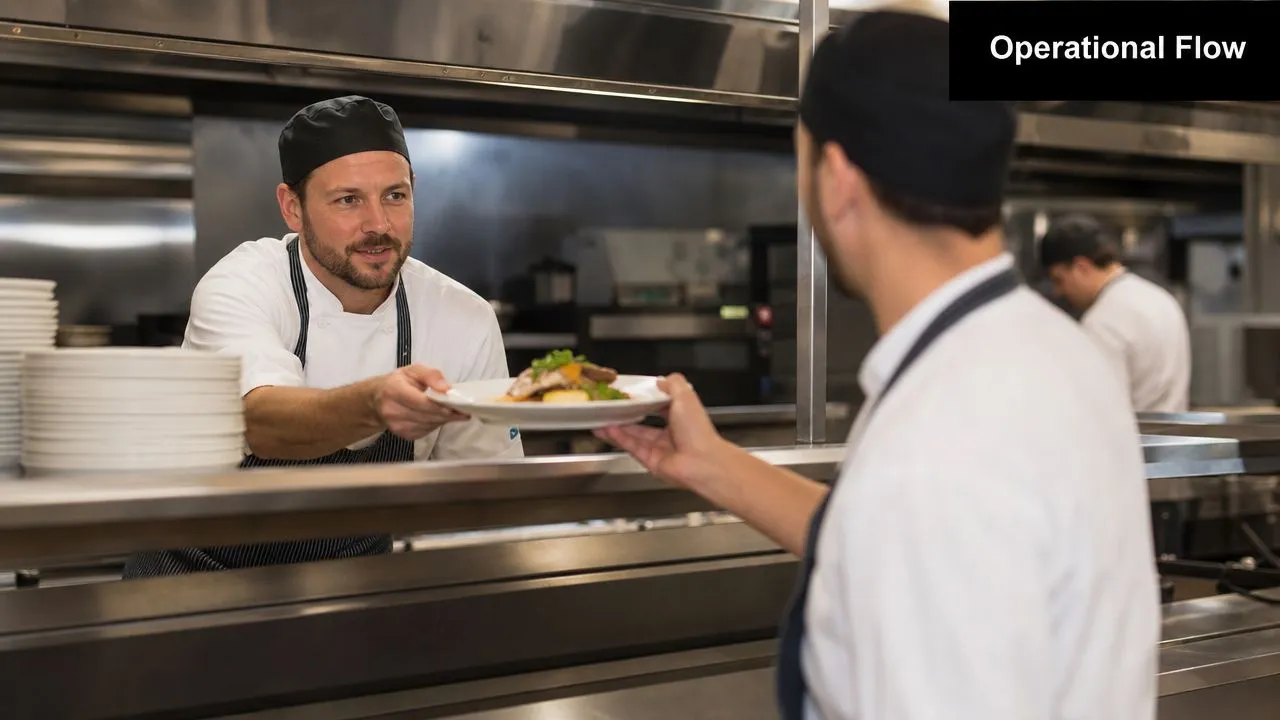
Most scheduling problems are really handoff problems.
When one crew leaves without a clean passdown, the incoming team starts in reaction mode. Tickets slow down. Product disappears. Side work turns into blame. This gets worse when communication lives in random texts instead of a system built for restaurant team communication.
The handoff needs structure. Not a speech. A repeatable process.
Use a short checklist for every transition:
- Product status: What is prepped, what is low, and what is eighty-sixed.
- Equipment status: What is down, inconsistent, or needs service attention.
- Guest issues: Open tabs, complaints, reservations, large parties, delivery problems.
- Labor status: Who clocked out early, who stayed late, and where the next gap is.
- Cash and compliance items: Anything that needs manager acknowledgment before the next crew takes over.
For attendance, lateness, and coverage issues, managers also need clear rules before they need enforcement. That's where resources on building compliant policies for shift work can help, especially if you run multiple units with different supervisors applying the schedule in different ways.
The handoff should answer one question: can the next team start working, or do they first have to clean up our mess?
If the answer is the second one, your shift model still needs work.
What Are the Pros and Cons of Each Shift?
You see the difference fast when you post the schedule. One opening shift fills in minutes. The dinner shift takes follow-up texts. The overnight or late close sits there until someone asks for extra pay or a favor. That pattern usually has less to do with work ethic and more to do with how each shift fits your restaurant's actual operating model.
That matters because 1st, 2nd, and 3rd shifts are not fixed experiences. In one restaurant, 1st shift means heavy prep and receiving. In another, it means a slow open with one cook and a cashier. The label stays the same. The workload, pressure, and quality of life do not.
How each shift affects staff
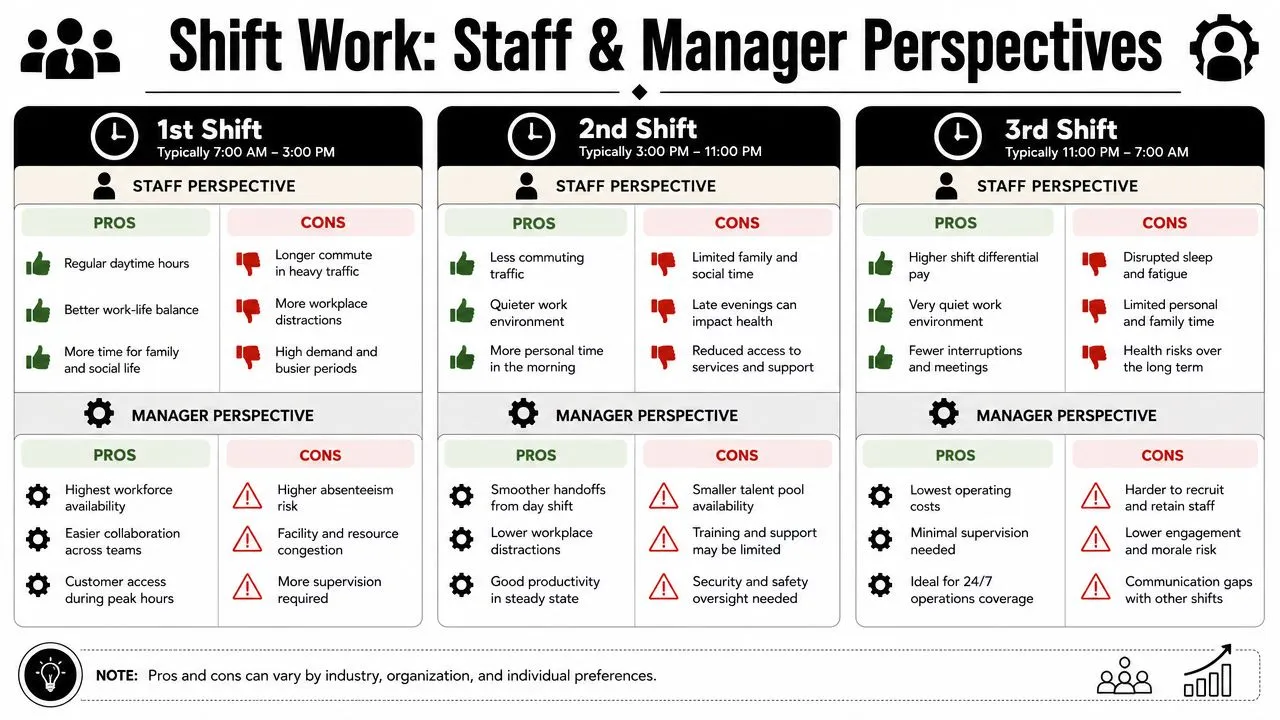
1st shift usually gives staff the most predictable routine. It tends to work better for school schedules, family responsibilities, and normal sleep. From an operator's side, that often makes it easier to recruit and keep people on these hours.
It also carries pressure that gets overlooked. Openers walk into the shift with no cushion. If prep runs behind, a truck is late, or a key piece of equipment is acting up, the whole day starts on its heels. Good employees like the structure. They do not like being set up to lose before service even starts.
2nd shift often fits employees who want their mornings free, but it asks for more socially. Dinner and close shifts cut into evenings, childcare coverage, and time with family. In many restaurants, this shift also carries the highest guest volume and the most direct service pressure, so your strongest floor staff and steadier line cooks often end up here.
That creates a real trade-off. You need experienced people on the shift that makes the most money, but those same people burn out if every hard Friday, double, and close lands on them.
3rd shift is the hardest sell for a reason. Overnight crews usually deal with fewer managers, thinner support, and a smaller labor pool. Some employees like the independence and quieter pace. Many will not stay long if the shift wrecks their sleep, isolates them from the rest of the team, or turns into a catch-all for every task the day crew did not finish.
How each shift affects management
Managers should judge each shift by output, labor efficiency, and repeatability, not by the label on the schedule.
| Shift | Manager upside | Manager downside |
|---|---|---|
| 1st shift | Better access to vendors, more control over prep standards, easier time spotting issues early | If opening tasks are understaffed, delays carry into lunch and dinner labor |
| 2nd shift | Strongest view of peak execution, sales performance, and guest experience under pressure | Callouts hurt more, closes run long, and weak staffing shows up fast in service times and morale |
| 3rd shift | Useful for cleaning, prep recovery, production, or limited overnight service without daytime traffic | Harder hiring, less direct supervision, and more risk if one person underperforms or cuts corners |
The management mistake I see most often is treating every unpopular shift like a staffing attitude problem. Usually it is a design problem. If 2nd shift always leaves an hour late, the close is probably overloaded. If 1st shift keeps missing pars, the prep list may belong across two start times instead of one. If 3rd shift has constant turnover, the role may be carrying work that does not match the pay, support, or pace.
A fair shift gets staffed more easily.
That is the part simple explainers miss. Shift labels only help if they reflect how your restaurant runs. A well-built 2nd shift in a busy full-service restaurant can be more stable than a poorly built 1st shift in a cafe with weak prep systems. The operator's job is to match the shift to the work, then make the trade-offs visible to the team.
Technology can help with that if you use it for the right jobs. Forecasting demand, spotting attendance patterns, and adjusting labor coverage are all practical uses, and Benely's guide to AI in HR gives a solid overview of how those tools are changing workforce management.
A shift becomes easier to keep staffed when the work is realistic, the payoff is clear, and the same crew is not carrying all the friction every week.
Good operators do not ask whether 1st, 2nd, or 3rd shift is best in general. We ask which version of that shift works in this building, with this menu, this sales pattern, and this team.
Smart Scheduling Tips for Every Shift
Managers don't need a theory of shifts. They need a schedule that survives real life.
Build around the operating model
Most explainers stop at clock times. In practice, shift labels are relative to the restaurant's operating model, including prep, peak service, and close, not fixed legal definitions, as explained in this guide to how shift labels map to real schedules. That's the right starting point for scheduling.
A few rules work well:
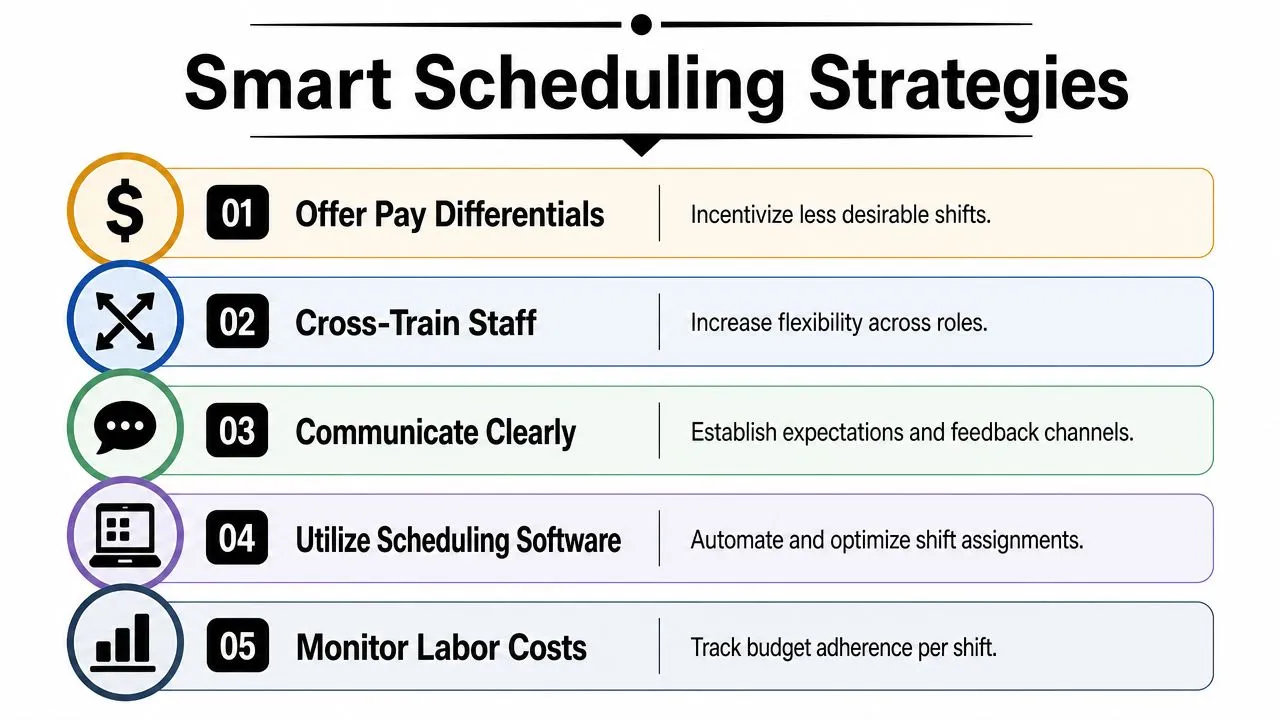
- Schedule to workload, not habit. If prep load is heavy, don't understaff open just because sales are quiet at the doors.
- Use intentional overlap. A short overlap between key roles gives you cleaner passdowns and fewer blind spots.
- Separate peak coverage from closeout labor. Your strongest rush staff aren't always your strongest closers.
- Protect your overnight scope. If you run a 3rd shift, keep its task list tight and measurable.
If you want a cleaner process, build the week from templates first and then adjust from availability inside a restaurant staff scheduling workflow.
Use practical guardrails
Schedules fall apart when every problem gets solved manually. Put rules around the common failure points.
- Cross-train with purpose: Don't cross-train everyone on everything. Cross-train for your most fragile handoff points and your most painful callout slots.
- Post expectations by shift: Openers, mids, closers, and overnight crews should each have a visible completion standard.
- Watch overtime before swaps are approved: A helpful swap can still wreck labor if nobody checks the full week.
- Hold a mid-shift labor check: Managers should pause during service and decide whether the current staffing still fits the sales pace.
- Keep communication in one place: Notes, releases, and coverage requests should live in the same system, not in scattered texts.
This video gives a useful visual primer on scheduling discipline in busy operations.
Stable schedules reduce confusion. Clear ownership reduces resentment. You need both.
Simplify Your Shifts with the Right Tools
Restaurants usually don't struggle because managers lack effort. They struggle because too much of shift management still lives in memory, paper, and chat threads.
Manual scheduling breaks at the edges
You can build a basic schedule in a spreadsheet. The trouble starts after that.
A server asks to swap. A closer stays late. Prep took longer than planned. Dinner volume changes the labor picture halfway through service. Then payroll, tip handling, and timecard review all pull the manager back into cleanup work.
That is where software earns its place. Not because technology is trendy, but because shift management has too many moving parts for manual control once the restaurant gets busy or the team gets larger.
What the right system should actually do
A useful platform should help you do four things well:
- Build schedules from reality: Availability, role coverage, and sales patterns should shape the draft.
- Flag labor issues early: Managers should see when coverage or labor targets drift before the shift is lost.
- Keep communication attached to the schedule: Shift offers, releases, and updates shouldn't depend on group texts.
- Reduce admin after service: Timecards, payroll prep, and tip workflows should be faster and less error-prone.
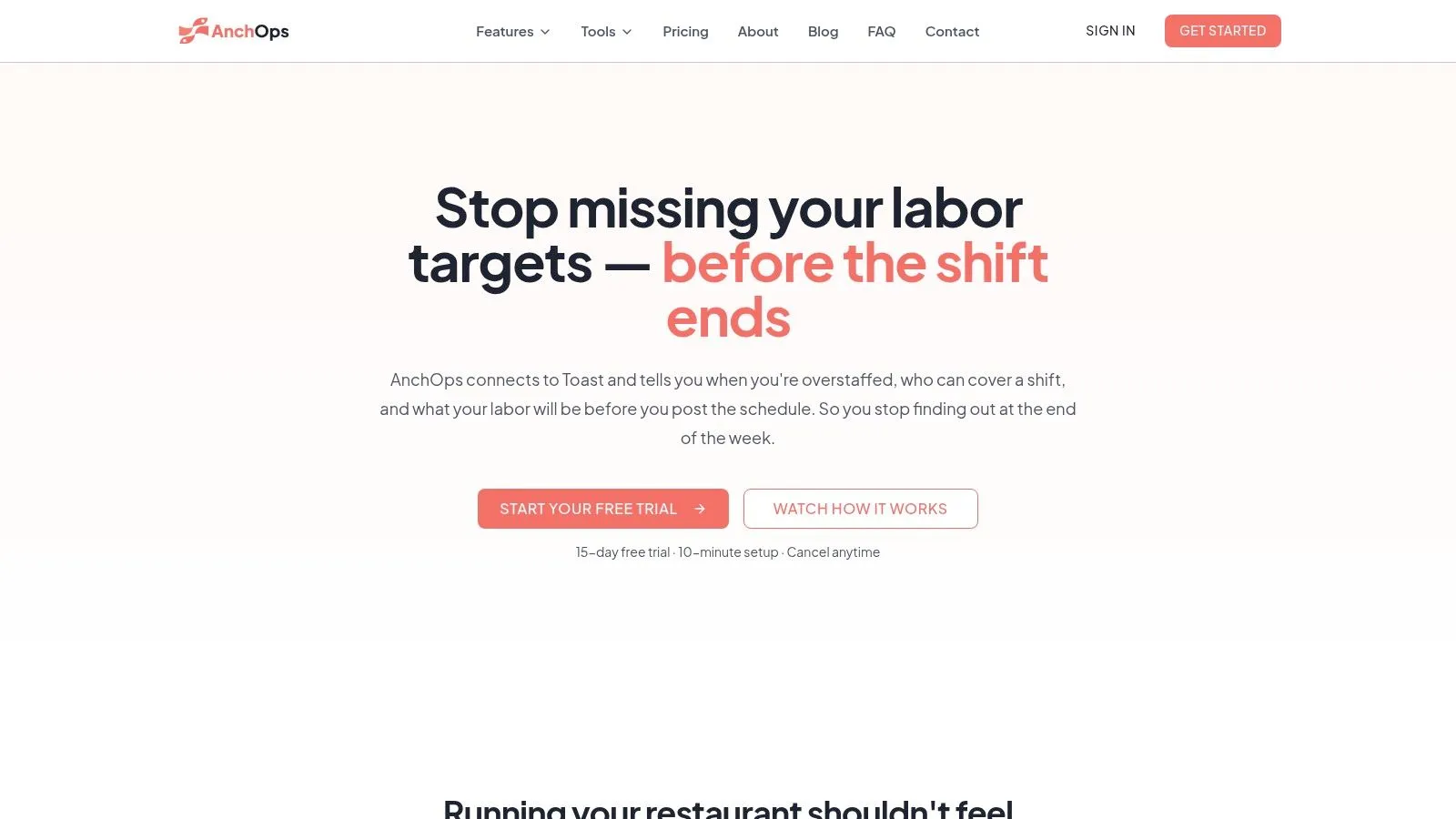
AnchOps is one example built for restaurant labor management. It can auto-build schedules from availability and sales history, surface projected labor before publishing, send mid-shift alerts when labor drifts over target, and keep team communication, coverage requests, timecards, and tip calculations in one place.
If you're evaluating tools more broadly, it's also worth reading Benely's guide to AI in HR for context on how automation is changing scheduling, policy support, and admin workflows across people operations.
The point isn't to force every restaurant into a rigid three-shift model. It's to give each operating phase a clear owner, a clean handoff, and labor visibility you can act on.
If your schedule still depends on texts, spreadsheets, and memory, take a look at AnchOps. It gives restaurant teams a practical way to build cleaner shifts, manage labor before and during service, and cut the admin work that usually lands on managers after the rush.
Your back-of-house partner is ready
AnchOps handles scheduling, tip calculations, labor costs, and timecards — so you can focus on your restaurant, not your paperwork.