2026 Minimum Tipped Wage Colorado: Full Guide
Published on
By Tony Newcome — Founder of AnchOps · Owner, Pizza Harbour
This article was drafted with AI assistance and reviewed by Tony Newcome, a working restaurant operator.
Colorado's tipped minimum wage starts with the state baseline, but local rules — Denver's most prominently — can override it, so what you owe a server depends on the municipality each location sits in. The tip credit is a fixed dollar offset, the cash wage moves with each local minimum, and multi-location operators need per-location payroll assumptions, not one sticky note.
That's why the minimum tipped wage in Colorado can't be managed from a single sticky note on the office monitor anymore. State law still gives you the baseline. Local rules, especially after Colorado's recent changes, can change what you owe by location. If you operate more than one restaurant, or even one restaurant near a city boundary, that difference matters every pay period.
Table of Contents
- The Tipped Wage Puzzle in Colorado
- Why the confusion got worse in 2026
- What actually works in practice
- Colorado Tipped Wage Fundamentals
- Who counts as a tipped employee
- When you can and can't apply the tip credit
- The formula managers should keep in mind
- When Local Rules Override State Law
- Why 2026 changed the operating picture
- 2026 Colorado tipped minimum wage comparison
- What this means for multi-unit operators
- How to Calculate Paychecks and Avoid Shortfall Errors
- Scenario one with enough tips
- Scenario two with a shortfall
- Why tip volatility changes labor forecasting
- The manager habit that prevents the worst errors
- Rules for Tip Pools Tip Outs and Service Charges
- Tip pools need clean rules
- Voluntary tip-outs are different from mandatory pools
- Service charges are not tips
- Your Restaurant's Compliance Checklist
- The checklist operators should actually use
- Why this protects the business
- Put the rules into policy, not memory
- Frequently Asked Questions on Colorado Tipped Wages
- What should I check first if payroll looks wrong for a tipped employee
- What records actually protect me in a wage dispute
- Can a server do non-tipped work during a shift without creating a wage problem
- What causes tipped wage errors when I run more than one Colorado location
- Are service charges the same as tips for payroll purposes
- What is the smartest way to prevent shortfalls before checks go out
The Tipped Wage Puzzle in Colorado
The headache usually starts with a manager trying to do the right thing. They know tipped staff don't follow the same wage setup as back-of-house. They know Colorado has a statewide number. Then they find out Denver uses a different number, and now they're asking whether the payroll system, the POS, and the timekeeping rules are all aligned.

For operators, this isn't academic. If your host starts serving tables during a rush, if your bartender spends a stretch of time on prep, or if your Denver store follows a different direct cash wage than your suburban unit, the mistake won't stay theoretical. It shows up in payroll corrections, employee questions, and exposure you could've avoided with cleaner setup.
Why the confusion got worse in 2026
Colorado's minimum tipped wage rules used to feel more centralized. Now they require local awareness. That means the old habit of memorizing one statewide tipped wage and applying it everywhere is no longer enough for a serious operator.
Practical rule: In Colorado, wage compliance now starts with location first, job duties second, and payroll math third.
Managers don't need more legal jargon. They need a working system. The useful way to approach the minimum tipped wage Colorado issue is to treat it like operations, not theory:
- Know your jurisdiction: Your city may control the rate that matters most.
- Know the job performed: The tip credit only works for hours spent doing tip-producing work.
- Know the shortfall risk: Slow shifts can turn a “cheap” labor plan into a costly payroll catch-up.
What actually works in practice
The operators who stay out of trouble usually do three things well. They verify local wage rules before the year starts, they separate tipped work from non-tipped work in a way managers can track, and they review reported tips before payroll closes instead of after an employee complains.
What doesn't work is assuming payroll software will catch every local exception on its own. It also doesn't work to rely on last year's setup, especially when a city can change its own approach while the state floor remains in place.
What Are the Colorado Tipped Wage Fundamentals?
Payroll gets expensive fast when a manager treats every hour from a tipped employee as tipped time. The statewide math looks simple on paper, but the mistakes happen in job setup, timekeeping, and shift assignments.
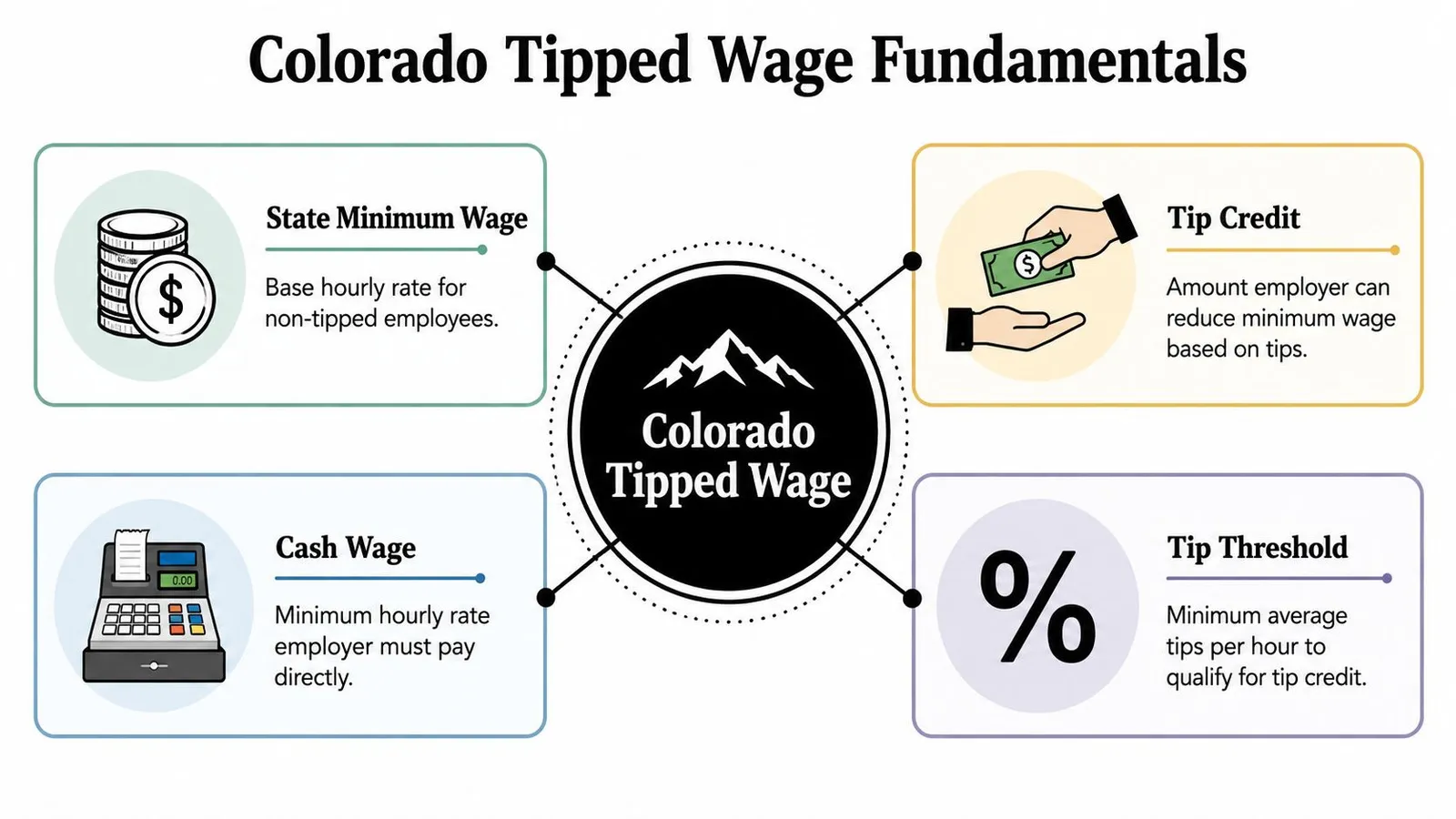
As of January 1, 2026, Colorado's statewide tipped minimum wage is $12.14 per hour, based on a standard minimum wage of $15.16 per hour and a $3.02 tip credit, as outlined by the Colorado Department of Labor and Employment minimum wage order and resources. The practical rule is straightforward. If direct wages plus tips do not reach the full applicable minimum wage, the employer covers the shortfall.
That is the baseline your payroll team starts from. It is not a blanket excuse to pay the lower rate for every clocked hour from anyone who sometimes receives tips.
Who counts as a tipped employee
Colorado uses a monthly tip threshold. An employee must regularly receive more than $30 a month in tips to fall into the tipped employee category under state rules. In practice, that means job title alone is not enough.
A server usually qualifies. A host might or might not. A counter employee who gets occasional pooled tips may not qualify if the tip pattern does not meet the rule consistently.
Operators get into trouble when they code a position once and never revisit it. The safer approach is to review the role, the regular tip flow, and the work performed. For managers who need a quick refresher on wage-and-hour status more broadly, Benely's nonexempt employee explanation gives useful background.
When you can and can't apply the tip credit
The tip credit is tied to tipped work. That is the part many restaurants gloss over until a wage complaint forces a cleanup.
Here is where the day-to-day confusion shows up:
- Serving guests, taking orders, running the section: the tip credit can apply.
- Related side work tied to tipped service: managers need clear limits, consistent tracking, and written expectations.
- Prep, cleaning, or other non-tipped work: paying the tipped rate for that time creates risk.
This is one of those rules that matters more in operations than in policy manuals. If a server spends part of a slow afternoon rolling silverware and resetting the dining room, that may feel harmless. If the same employee is pulled into back-of-house prep or extended cleaning at the tipped rate, the exposure gets harder to defend.
The formula managers should keep in mind
Use the statewide baseline below for locations where no higher local rule applies:
| Item | Statewide 2026 amount |
|---|---|
| Standard minimum wage | $15.16 |
| Maximum standard tip credit | $3.02 |
| Statewide tipped minimum wage | $12.14 |
The formula is simple. Direct wage plus reported tips must equal at least the full applicable minimum wage for the pay period. If they fall short, the restaurant pays the difference.
That is why this issue belongs in operations, not just payroll. The labor hit usually starts with scheduling, role assignment, or weak time coding long before payroll closes.
When Do Local Rules Override State Law?
The biggest trap in 2026 is assuming the state rate is the sole answer everywhere. It isn't. Colorado's statewide number is the floor, but some municipalities set a higher local standard, and the local rule can be the one that governs your labor cost.
Denver is the clearest example. In Denver, the 2026 tipped minimum wage is $16.27 per hour, built from a local minimum wage of $19.29 per hour and the same $3.02 state-allowed tip credit, according to Denver Labor's citywide minimum wage page.
Why 2026 changed the operating picture
A lot of guides still treat Colorado tipped wage as a single statewide number. That misses the key change. HB 25-1208 permits local governments to set tip credits higher than the state's $3.02 limit, creating a fragmented system where a restaurant in Edgewater effectively pays $13.50 while one in Denver pays $16.27, as discussed in Ogletree's review of Colorado's 2026 wage and hour changes.
That doesn't mean every city has already reduced its tipped wage or changed its credit. It means local flexibility is now part of the compliance problem. Managers have to verify the ordinance that applies where the work is performed.
If you operate in more than one Colorado municipality, “What's our tipped wage?” is the wrong question. The right question is, “Which location are we talking about?”
2026 Colorado tipped minimum wage comparison
| Jurisdiction | Standard Minimum Wage | Maximum Tip Credit | Tipped Minimum Wage |
|---|---|---|---|
| Colorado statewide | $15.16 | $3.02 | $12.14 |
| Denver | $19.29 | $3.02 | $16.27 |
| Edgewater | $18.17 | Qualitatively subject to local rule changes | $13.50 |
| Boulder | $16.82 | Qualitatively subject to local rule changes | $13.80 |
| Boulder County | $16.82 | Qualitatively subject to local rule changes | $13.80 |
What this means for multi-unit operators
A multi-unit group can't treat all Colorado stores as one payroll environment. Your scheduler, payroll team, and store managers need a location-based process. That applies to onboarding, wage rates, labor forecasting, and manager approvals.
What works:
- Location-specific pay settings: Don't use a generic statewide tipped rate for all units.
- Annual local ordinance review: Check each municipality before the new year's first payroll runs.
- Manager training by store: A Denver GM should know the Denver rule. A suburb GM should know theirs.
What fails is centralizing wage assumptions without centralizing legal review. That's how one clean payroll setup turns into multiple compliance errors.
How Do You Calculate Paychecks and Avoid Shortfall Errors?
Payroll gets expensive when tips are uneven. Busy Friday dinner can hide a weak setup for weeks. Slow lunch service exposes it immediately. That's why shortfall math needs to be part of your weekly payroll workflow, not an afterthought.
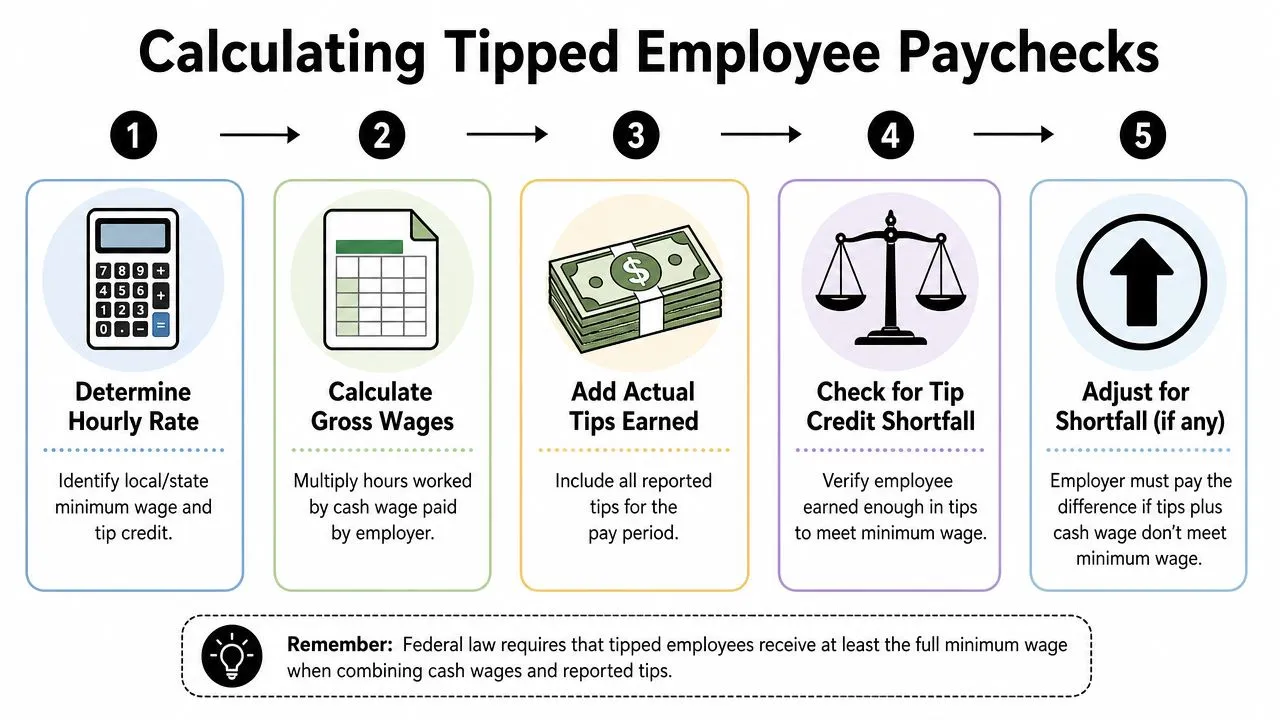
Here's the practical process managers should follow every pay period.
Scenario one with enough tips
Start with the applicable direct cash wage for the location. Then total the employee's hours at that wage. After that, add reported tips for the same pay period or shift, depending on how your internal review is structured.
For a strong service period, the check is simple:
- Apply the correct local or state cash wage.
- Multiply by hours worked.
- Add actual reported tips.
- Compare the total against the full required minimum compensation for those hours.
If the employee's direct wage plus tips clears the required minimum, no shortfall payment is needed. Payroll still needs documentation, but the math ends there.
A lot of operators now use automated tools for this because manual review gets messy fast once tip pools, multiple roles, and different store ordinances enter the picture. If your team is still doing this by hand, a practical reference on restaurant tip calculation workflows can help tighten the process.
Scenario two with a shortfall
The harder case is a weak shift. That's the one generic articles usually skip, even though it's where the liability lives.
Use the same sequence:
- Set the correct cash wage
- Count the hours
- Add actual tips
- Compare the total to the required minimum compensation
- Add employer-funded pay if the employee falls short
If the employee doesn't earn enough in tips to bridge the gap between the tipped cash wage and the full minimum wage, the employer must pay the difference. That's true under the statewide structure and it becomes more painful in higher-wage local markets.
Watch item: Low-tip periods are where your labor model gets tested, not your peak shifts.
Later in the payroll review, many managers also train against this common mistake: using pooled estimates instead of documented tips. If the tips aren't properly tracked, you don't have a clean basis for claiming the credit.
Here's a visual walkthrough of the logic before the next payroll close:
Why tip volatility changes labor forecasting
This is the operating risk a lot of restaurants underestimate. Existing coverage rarely addresses exposure from tip volatility. The law requires employers to pay the difference if tips fall short, and Denver's 2026 tipped minimum wage rose to $16.27, increasing the employer's shortfall liability by about $3.50 per hour of low-tip service compared with 2025, according to this Colorado minimum wage analysis focused on employer exposure.
That matters most on off-peak shifts. A dining room that's half-full can create labor cost you didn't budget because the wage obligation doesn't disappear when guest traffic softens. Operators who forecast labor only from scheduled wage rates miss the added risk from weak tip performance.
The manager habit that prevents the worst errors
Don't wait until payroll day to spot a shortfall. Review reported tips during the week, especially after known weak dayparts. If your concept has heavy lunch variability, brunch inconsistencies, or weather-sensitive patios, that review needs to happen routinely.
The minimum tipped wage Colorado issue isn't just about legal rates. It's about whether your operation catches low-tip exposure early enough to correct it cleanly.
Rules for Tip Pools Tip Outs and Service Charges
Tip pooling causes problems when restaurants blur three different things into one bucket: tips, tip-outs, and service charges. They're not the same. If your written policy treats them as interchangeable, your payroll and employee communication will eventually go sideways.

Tip pools need clean rules
A mandatory tip pool should be written, consistent, and limited to eligible staff. In practice, that means managers and owners shouldn't be participating in a way that turns employee tips into management compensation. If your policy is informal, changes shift to shift, or depends on whichever manager closed last night, it's not a good policy.
For restaurants trying to tighten this process, a practical guide to how to calculate tip pooling is worth reviewing with whoever owns payroll setup and shift-close procedures.
What tends to work best operationally:
- Written pool percentages or formulas: Staff should know how distribution works.
- Consistent role definitions: Server, bartender, busser, and barback rules shouldn't change without documentation.
- Documented tip reporting: If the records are weak, every later wage calculation gets weaker too.
Voluntary tip-outs are different from mandatory pools
A voluntary tip-out is usually a tipped employee choosing to share some of their tips with support staff. A mandatory tip pool is an employer-required distribution system. Don't treat those as the same thing in your handbook or manager scripts.
That distinction matters because the more control the employer exerts, the more important the written policy and compliance structure become. Informal “everybody knows what to do” systems are where disputes start.
Staff usually don't complain about tip sharing when the rules are clear. They complain when the rules change depending on who's closing.
Service charges are not tips
This is one of the most important separations to teach managers. A mandatory service charge is generally employer revenue, even if the business later distributes some or all of it to staff. That means you shouldn't assume a service charge can stand in for tips for tip-credit purposes.
If your restaurant adds automatic charges for large parties, events, or special service formats, treat that policy carefully. Label it clearly on menus and receipts, and make sure your payroll team understands that guest-added gratuities and employer-imposed charges are handled differently.
Your Restaurant's Compliance Checklist
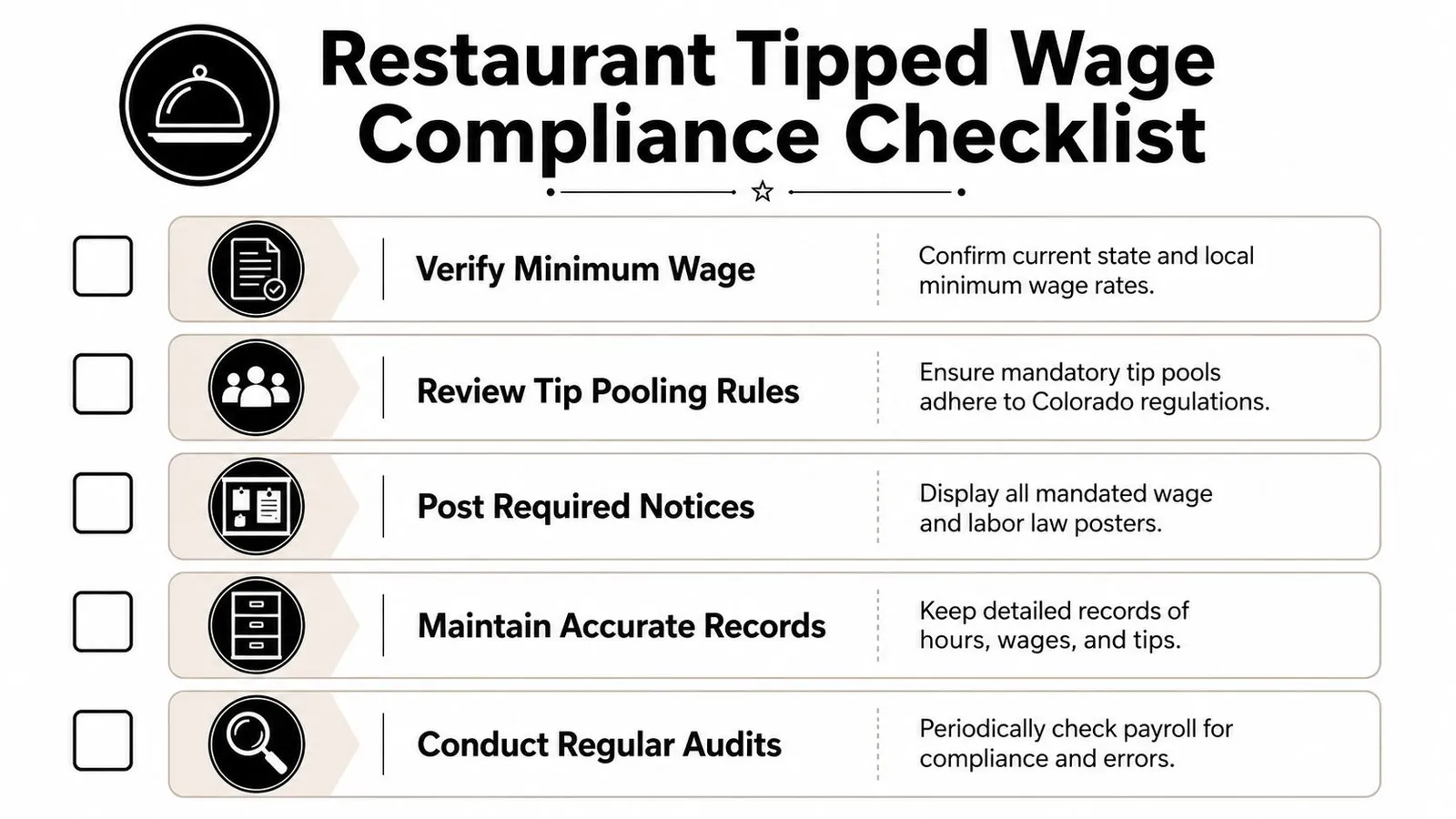
The restaurants that treat compliance like routine pre-shift work tend to avoid the ugliest payroll problems. The restaurants that treat it like office paperwork tend to fix issues after someone is already upset. For tipped wage compliance, the difference is usually systems, not intentions.
The checklist operators should actually use
- Verify the current wage by location: Check the state rule and any local ordinance that applies to the worksite before the first payroll of the year.
- Separate tipped work from non-tipped duties: Don't assume every hour under a tipped job title qualifies for the credit.
- Maintain complete records: Keep hours worked, wages paid, and tip documentation in a form you can explain during an audit or wage complaint.
- Post required notices: Missing posters don't cause every wage claim, but they often show up alongside sloppy wage practices.
- Review policies for dual-role employees: If someone shifts between front-of-house tipped work and non-tipped work, your setup needs to reflect that reality.
- Audit payroll before finalization: Catch shortfalls, rate mismatches, and reporting gaps before checks are issued.
Why this protects the business
Colorado enforcement doesn't care that a mistake was accidental if the employee was still underpaid. A checklist creates a repeatable process that managers can follow when turnover hits, when a new assistant manager takes over scheduling, or when a payroll clerk inherits a messy setup.
Overtime is another place where operators get tripped up because a tipped employee's pay structure already feels complicated. If someone on your team needs a clean refresher on the federal baseline, FLSA overtime rules are a helpful companion resource.
Put the rules into policy, not memory
If a procedure lives only in the GM's head, it disappears the day that GM quits. Restaurants need written policies for wage handling, tip reporting, role changes, and manager approvals. A practical starting point is building these into your restaurant employee policies so the standard survives staff turnover.
Good compliance systems don't slow a restaurant down. They keep one rushed payroll run from becoming months of cleanup.
Frequently Asked Questions on Colorado Tipped Wages
A lot of Colorado tipped wage mistakes do not start with the rate itself. They start on a rushed Sunday night when a manager closes payroll, approves a role change from server to prep, and assumes the system will sort it out. That assumption gets expensive fast.
What should I check first if payroll looks wrong for a tipped employee
Start with the job code, location, and hours bucket. Those three fields usually explain the problem.
If the employee worked in more than one role or more than one city during the pay period, review each segment separately before you look at the final gross pay. I have seen operators chase a “tip credit issue” for an hour when the actual problem was that two dish shifts were still coded as server shifts.
What records actually protect me in a wage dispute
Keep records that let you rebuild the shift from start to finish. Time punches matter, but they are only part of it.
The safer file includes reported tips, tip-pool distributions, role changes, location worked, pay rate applied, and any manager edits to the timecard. If an employee or investigator asks how a number was calculated, your team should be able to show the full chain without guessing.
Can a server do non-tipped work during a shift without creating a wage problem
Yes, but only if the work is tracked correctly and paid correctly. Trouble starts when side work, prep work, or cleaning time gets lumped into tipped hours by default.
This is an operating issue as much as a legal one. If managers do not have a clean way to code non-tipped blocks, payroll ends up fixing the problem after the fact, and that is where underpayments slip through.
What causes tipped wage errors when I run more than one Colorado location
The biggest risk is assuming one setup works statewide. It does not.
A restaurant group can have solid payroll habits and still miss compliance because the POS, scheduling tool, and payroll system are not aligned on location rules, tip handling, or job codes. Multi-unit operators need one standard process for reviewing exceptions, not five store-level workarounds.
Are service charges the same as tips for payroll purposes
No. A mandatory service charge needs to be treated based on what it is, not what the dining room calls it.
If your menus, receipts, and payroll settings use “gratuity,” “service charge,” and “auto-grat” interchangeably, clean that up now. Sloppy labels create confusion for staff and create audit risk for the business.
What is the smartest way to prevent shortfalls before checks go out
Run an exception review before payroll is finalized. Do not wait for employee complaints.
Flag low-tip shifts, unusual manager edits, mixed-role weeks, and any employee whose effective pay looks off compared with the hours they worked. Operators save the most time by catching these cases before payroll is submitted, not by cleaning them up after payday.
Colorado tipped wage compliance gets messy when rates vary by city, tips swing by shift, and managers are stuck doing math after close. AnchOps helps restaurants clean that up with labor forecasting, scheduling, payroll-ready timecard review, and automated tip calculations built for real operations. If you want fewer spreadsheet fixes, fewer payroll surprises, and a tighter grip on labor before and during the shift, it's worth a look.
Your back-of-house partner is ready
AnchOps handles scheduling, tip calculations, labor costs, and timecards — so you can focus on your restaurant, not your paperwork.