Calculating Vacation Time: A Restaurant Operator's Guide
Published on
By Tony Newcome — Founder of AnchOps · Owner, Pizza Harbour
This article was drafted with AI assistance and reviewed by Tony Newcome, a working restaurant operator.
To calculate vacation time for hourly restaurant staff, use accrual math: multiply hours worked each pay period by an accrual rate, and track the balance automatically. Salaried staff usually get an annual lump-sum grant. Choose one of the three standard structures, write it into policy, and stop reconciling spreadsheets — that's where shorted balances and payroll disputes start.
Manual vacation tracking looks small until it collides with real operations. Variable schedules, split roles, no-shows, turnover, and last-minute shift swaps make simple math messy fast. If you’re calculating vacation time for hourly staff by hand, you’re not just doing admin work. You’re making compensation decisions that affect labor cost, payroll accuracy, scheduling coverage, and trust on the floor.
Restaurant operators need a method that works when hours change every week. They also need a policy that staff can understand without chasing three managers for answers. The good news is that the core math is straightforward once you pick the right structure.
Table of Contents
- Why Manual Vacation Tracking Is Costing Your Restaurant
- The cost isn't only administrative
- Restaurants make the problem worse by nature
- The Three Core Methods for Calculating Vacation Time
- Lump-sum grant
- Per-pay-period accrual
- Per-hour-worked accrual
- Vacation calculation methods at a glance
- What works in practice
- Your Step-by-Step Guide to Hourly Accrual Math
- Start with the annual allowance
- Run the pay-period math
- Use a tool when you need a quick check
- Common manual mistakes
- Building a Fair and Compliant Vacation Policy
- Write the rules your managers actually use
- Use tenure tiers carefully
- Simple policy language you can adapt
- How to Automate PTO and Eliminate Payroll Headaches
- What spreadsheets get wrong
- What automation should actually do
- What to look for in a restaurant system
- From Manual Math to Predictable Labor Costs
- The bigger payoff
Why Is Manual Vacation Tracking Costing Your Restaurant?
The usual failure point isn't the formula. It's the process.
A manager approves a few days off during lineup. Another note lives in payroll email. A third version sits in a scheduling spreadsheet with a broken formula in one cell. By the time payday hits, nobody is fully sure which balance is correct. The employee sees one number, payroll uses another, and the GM gets pulled into a problem that should have been settled weeks earlier.
That confusion gets expensive in ways operators recognize immediately. You can overpay unused time, understate labor liability, deny a request that should have been approved, or approve one that leaves the line short on a busy night. This damage shows up in operations. Staff stop trusting the balance. Managers stop trusting the sheet.
The cost isn't only administrative
Manual PTO tracking creates three kinds of risk:
- Payroll risk: One bad formula or missed update can carry through multiple pay periods.
- Scheduling risk: If balances are unclear, managers make coverage decisions with bad information.
- Morale risk: Staff remember payroll mistakes longer than managers expect.
When teams already struggle with coverage, every manual process multiplies pressure. The same habits that create PTO errors often show up in schedule buildouts, labor forecasting, and shift communication. If that sounds familiar, the broader issue usually looks a lot like the problems outlined in these restaurant scheduling mistakes that cost money.
Practical rule: If a manager needs to “reconstruct” a PTO balance from texts, exports, and memory, the system is already broken.
Restaurants make the problem worse by nature
Office teams with fixed schedules can get away with looser tracking for longer. Restaurants usually can't. Your dishwasher may work one set of hours this week and another next week. A server may pick up extra shifts during patio season and drop back later. Someone might train in one role and close in another.
That’s why generic HR guidance often falls apart in hospitality. The environment changes too fast. Vacation time has to move with actual hours worked, approved policy, and current scheduling reality. Anything less creates a recurring cleanup job for managers who already have enough on their plate.
What Are the Three Ways to Calculate Vacation Time?
There are three common ways restaurants handle vacation time. Each can work. Only one tends to fit variable hourly teams cleanly.
Lump-sum grant
A lump-sum grant gives the employee their vacation bank upfront, usually at the start of the year or on their work anniversary. This is the easiest model to explain. It’s also the easiest one to misuse if your staff hours swing a lot.
For salaried managers, this can be fine. Their schedules are more predictable, and the business may be comfortable granting a fixed bank in advance. For hourly restaurant staff, it creates friction quickly. If someone uses a large chunk early and then leaves, the operator has absorbed the mismatch.
Formula
Annual vacation bank granted at once = total annual eligible vacation hours
Example
A full-time kitchen manager is granted 80 vacation hours for the year. Their balance starts at 80, then drops as time is used.
Pros for restaurants
- Simple to explain: Staff know their total right away.
- Easy to administer for fixed roles: Especially useful for salaried leaders.
Cons for restaurants
- Weak fit for variable hourly employees: The grant may not match actual work performed yet.
- Can create payout and recovery issues: Especially if someone takes time early and exits mid-cycle.
Per-pay-period accrual
This method awards a set amount of vacation time every payroll cycle. It’s cleaner than lump-sum, and many operators like it because it aligns with payroll timing.
The weakness is that it assumes a fairly stable relationship between pay periods and work performed. In a restaurant, two employees can both complete a pay period but work very different hours. That can feel arbitrary unless your policy clearly says the accrual is based on status rather than actual hours.
Formula
Annual vacation hours ÷ number of pay periods = vacation earned per pay period
Example
If an employee is eligible for 80 vacation hours annually, and you run bi-weekly payroll, the yearly bank is spread across the year’s pay periods. Each completed pay period adds the same amount to the balance.
This approach works best when employees have reliable schedules and your policy treats similarly classified employees the same way.
Per-hour-worked accrual
For most hourly restaurant teams, this is the cleanest method. It ties earned time directly to hours worked.
The standard accrual formula for hourly employees is:
Accrual Rate = Total Annual Vacation Hours Eligible ÷ Total Annual Workable Hours
A common benchmark uses 80 vacation hours ÷ 2,080 annual work hours = 0.03846. That means a full-time employee earns about 0.0385 vacation hours for every hour worked, and over an 80-hour bi-weekly pay period earns 3.08 vacation hours, as outlined in Shiftbase’s vacation pay explanation for hourly employees.
That structure is popular for a reason. It scales cleanly when schedules don't.
Example
A full-time line cook eligible for 80 hours annually accrues at 0.03846 per hour worked. If that cook works 80 hours in the pay period, they earn 3.08 hours of vacation.
If you have a part-time employee with a different annual workable-hour assumption, the same math still applies. You change the denominator to fit the policy and role, then apply the rate consistently.
Hourly accrual is usually the most defensible approach in restaurants because it rewards actual work performed, not just time on payroll.
Vacation calculation methods at a glance
| Method | Best For | Pros | Cons |
|---|---|---|---|
| Lump-Sum Grant | Salaried managers, fixed leadership roles | Simple, easy to communicate | Poor fit for variable hourly teams |
| Per-Pay-Period Accrual | Stable schedules, simpler payroll administration | Predictable balances, easy payroll rhythm | Can feel disconnected from actual hours worked |
| Per-Hour-Worked Accrual | Hourly restaurant staff, variable schedules | Fair, precise, strong operational fit | Tedious to manage by hand |
What works in practice
Most operators don't need a complicated theory. They need one method for hourly staff, one clear policy for exceptions, and one source of truth for balances.
A practical setup often looks like this:
- Use lump-sum carefully: Reserve it for salaried leaders if you want simplicity.
- Use per-pay-period only when schedules are stable: Otherwise managers will spend time explaining why two employees earned the same amount after working very different hours.
- Use per-hour accrual for hourly teams: It's the method that holds up best under variable shifts, cross-training, and seasonality.
The mistake isn't choosing the wrong formula once. It's choosing a model that your day-to-day operation won't support.
Your Step-by-Step Guide to Hourly Accrual Math
If you manage hourly staff, this is the calculation that matters most.
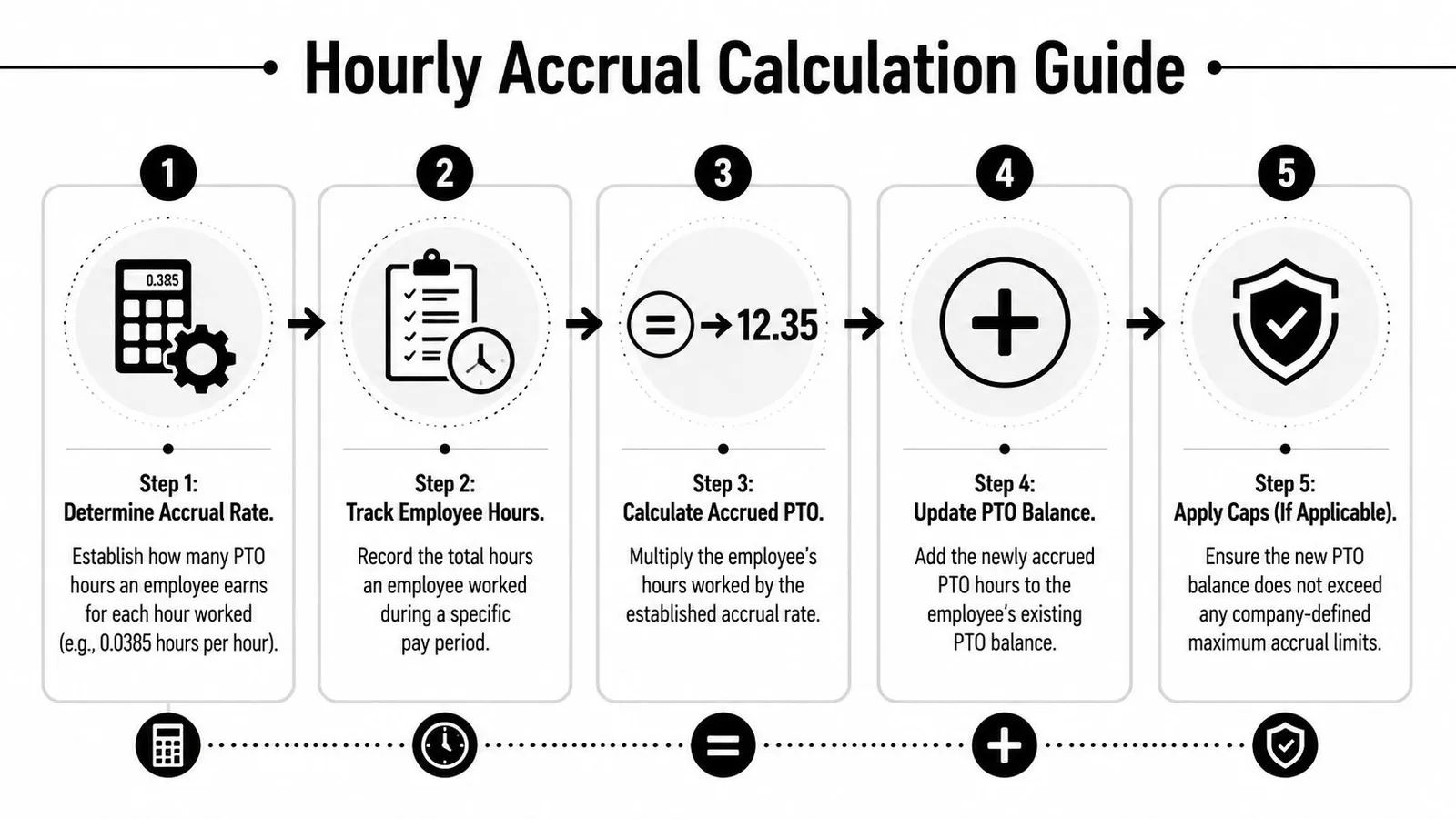
Start with the annual allowance
Pick the annual vacation amount your policy gives the employee. Then divide that by the annual workable hours tied to that policy.
For a standard full-time benchmark, the formula looks like this:
Accrual Rate = Annual Vacation Hours ÷ Annual Workable Hours
Using the common benchmark already established above, 80 ÷ 2,080 = 0.03846. That means the employee earns about 0.0385 vacation hours for each hour worked.
Now apply that same logic to a part-time employee with fluctuating hours. Suppose your policy gives that employee 80 vacation hours over 1,500 annual workable hours. The accrual rate becomes 80 ÷ 1,500 = 0.0533.
Run the pay-period math
Let’s use a realistic restaurant schedule. A server works 25 hours in one week and 32 hours in the next. Total for the pay period is 57 hours.
Multiply hours worked by the accrual rate:
Vacation earned in pay period = Hours worked × Accrual rate
Using the part-time rate above:
57 × 0.0533 = vacation hours earned for that pay period
That gives you the new earned amount. Add it to the employee’s existing balance, then subtract any approved vacation already used.
This is the part managers often skip when they’re rushing. They calculate what was earned but forget to update the live balance after usage. Then payroll and scheduling drift apart.
Use a tool when you need a quick check
If you want a second set of eyes on the math, a calculator like LeaveWizard's accrual calculation page can help you verify your setup before you put it into payroll. It’s useful when you’re translating a written policy into an hourly accrual rate and want to confirm the logic.
A simple manual workflow looks like this:
- Set the annual entitlement. Use the amount your policy grants for that role or tenure band.
- Define the annual workable hours. This is the assumption behind the accrual rate.
- Calculate the accrual rate. Keep it documented in one place.
- Multiply by actual hours worked. Do this each pay period.
- Update the running balance. Include earned time, used time, and any cap your policy applies.
If your managers can't reproduce the same balance from the same hours, the issue isn't employee behavior. It's the process.
Common manual mistakes
- Using scheduled hours instead of worked hours: PTO accrual should follow the rule in your policy. For hourly accrual, that usually means actual worked time.
- Changing formulas by employee: Exceptions spread fast and create disputes.
- Forgetting role transitions: If someone changes status or eligibility, document exactly when the new rule starts.
- Keeping balances in multiple places: One spreadsheet for managers and another in payroll is how errors survive.
Calculating vacation time by hand isn't difficult. Doing it consistently during a packed week is the hard part.
Building a Fair and Compliant Vacation Policy
A clean formula without a written policy still leaves managers exposed.
You need rules for who earns vacation, when it can be used, what happens at year end, and how balances are handled when someone leaves. If any of that lives only in a manager’s memory, the policy isn’t real. It’s a habit, and habits change under pressure.

Write the rules your managers actually use
A restaurant PTO policy has to be short enough to follow and clear enough to enforce. Start with the operational decisions that create disputes most often:
- Accrual and eligibility: State who accrues vacation, at what rate, and from what start date.
- Request and approval rules: Explain notice expectations, blackout periods, and who approves time off.
- Carryover or expiration: Say what happens to unused hours at year end, subject to the laws in your jurisdiction.
- Termination treatment: State whether unused vacation is paid out where required and how final balances are calculated.
If you combine vacation with sick time in one bank, define that clearly. If you separate them, spell out the distinction. For a straightforward breakdown of paid time off policy distinctions, that reference can help operators decide whether a combined bank or separated categories make more sense for their team.
A fair policy doesn't mean every employee gets the same outcome. It means the same rule is applied the same way every time.
Use tenure tiers carefully
Vacation can support retention when employees see a clear path to better benefits over time. The benchmark many operators use starts with national averages. Private industry employees with 1 year of service average 11 paid vacation days, rising to 15 days after 5 years and 17 days after 10 years, according to Deputy’s summary of Bureau of Labor Statistics vacation benchmarks.
Those figures are useful as a reference point, not a mandate. In practice, restaurants should only add tenure tiers if they can administer them cleanly. If your payroll team can't tell when an employee moves from one tier to the next, the policy creates more arguments than value.
A workable tenure structure should answer three questions plainly:
- When does the next tier start.
- Whether the new rate applies immediately or at the next payroll cycle.
- Who updates the balance and where that change is recorded.
Simple policy language you can adapt
Use plain language. Staff should be able to read the rule once and know what it means.
Sample accrual language
Vacation is earned based on eligible hours worked and is added to the employee’s balance each pay period according to the company’s published accrual schedule.
Sample request language
Employees must submit vacation requests in advance through the approved company process. Approval depends on staffing coverage and business needs.
Sample carryover language
Unused vacation time is handled according to company policy and applicable state or local law. Employees should review current balances before year end and request time off early.
Before finalizing anything, have payroll, HR, or counsel review how your policy fits the states where you operate. The math is universal. The legal handling often isn't.
How Do You Automate PTO Accrual?
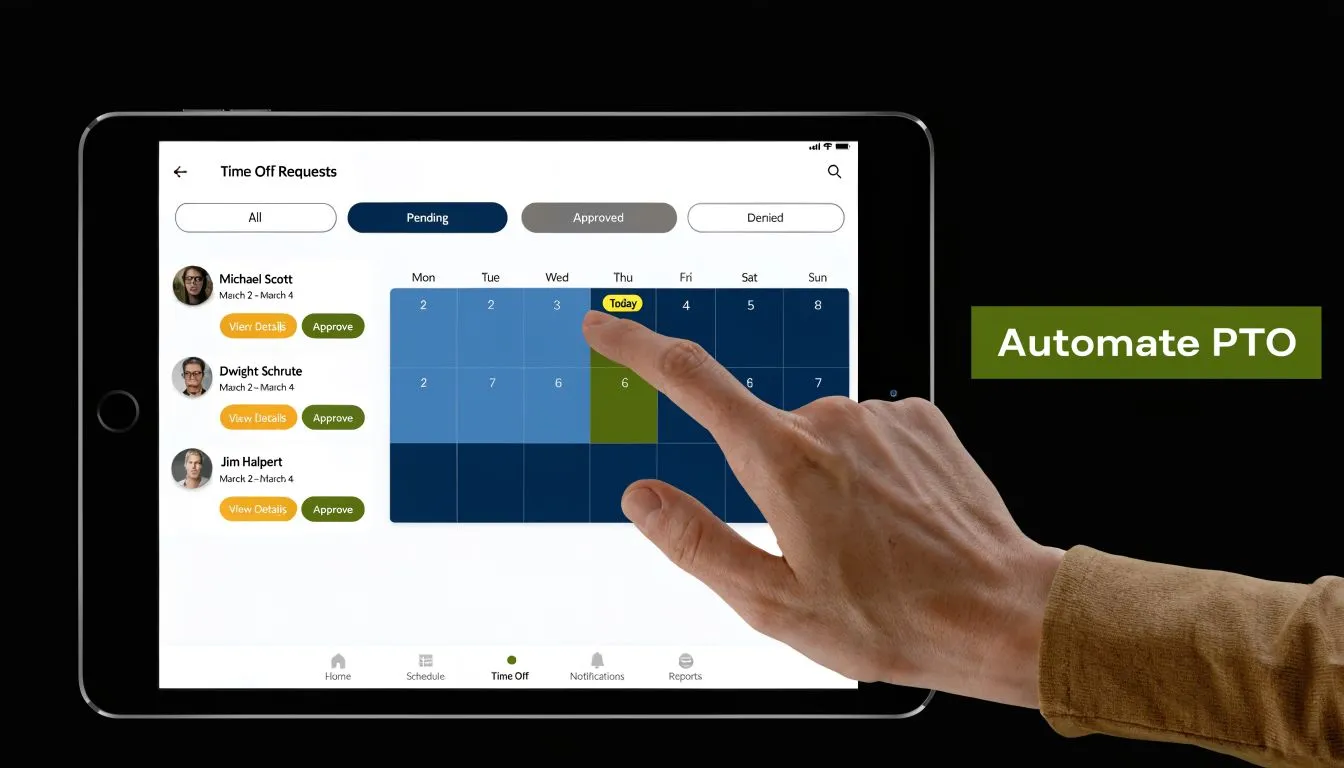
The per-hour method is accurate. It’s also the one most likely to break when managers handle it manually across a busy schedule.
What spreadsheets get wrong
Spreadsheets don't fail because the formulas are impossible. They fail because restaurants change too quickly for manual upkeep. Someone copies a tab wrong. A manager forgets to enter approved time. Payroll updates one file while scheduling references another.
The result is familiar. You spend part of every payroll cycle reconciling balances that should have updated automatically. That time comes straight out of operations. It also creates hesitation around approving vacation because managers aren't confident the balance is current.
What automation should actually do
The best PTO setup doesn't just store a balance. It connects worked hours, approved time off, payroll timing, and labor visibility in one workflow.
Most PTO guides stop at the formula. They don't connect accruals to real-time sales and labor movement inside the restaurant. Modern systems can do that better. As noted in Leaveplan’s hospitality PTO discussion, many guides miss the need to integrate calculations with POS data like Toast, while newer platforms can adjust around projected labor versus sales so operators can manage costs more dynamically.
That matters in restaurants because vacation liability isn't separate from labor management. If one system tracks earned time and another handles staffing, managers end up making decisions with partial information.
A useful automation stack should handle these jobs together:
- Import actual worked hours: Pull from timekeeping instead of asking managers to key them in.
- Apply the correct accrual rule automatically: By employee type, role, or policy tier.
- Show live balances to managers and employees: Fewer payroll questions, fewer disputes.
- Reflect approved time off in scheduling: So coverage decisions happen before the shift breaks.
- Support payroll export or sync: The approved numbers should move cleanly into payroll.
What to look for in a restaurant system
Restaurant operators should prioritize systems that speak to scheduling and POS data, not just HR records. If you’re evaluating platforms, look closely at restaurant-focused labor workflows rather than generic leave tracking alone. Features that connect scheduling, labor visibility, and payroll prep tend to accomplish more essential tasks, and you can compare that kind of functionality in tools built for restaurant operations through restaurant labor management features.
Before you commit, watch how the workflow behaves in practice:
A system is only useful if your managers will trust it during a rush. If they still need side notes, backup spreadsheets, and text confirmations, the software didn't solve the problem. It just moved it.
From Manual Math to Predictable Labor Costs
Vacation time looks like an HR task until it hits payroll, staffing, and shift coverage all at once. Then it becomes an operations issue.
The practical path is simple. Pick a calculation method that fits the way your restaurant runs. For most hourly teams, that means accrual tied to hours worked. Put the rule in writing. Apply it the same way every time. Then stop asking managers to maintain live compensation data by hand.
The bigger payoff
When vacation balances are accurate, managers approve requests faster and with more confidence. Employees trust what they see. Payroll closes with fewer surprises. Labor reporting gets cleaner because PTO liability isn't hiding in disconnected files.
That’s the point many operators miss. Calculating vacation time correctly doesn't just prevent arguments. It improves planning. You know what has been earned, what has been used, and what still sits on the books.
Clean PTO tracking gives you a more reliable labor picture, not just a cleaner employee file.
If you want a quick sense of how time-off costs fit into your broader staffing picture, a tool like this restaurant labor cost calculator can help frame the conversation in operating terms instead of just payroll terms.
Restaurants run better when managers spend less time fixing math and more time running the floor. Vacation policy won't make service smoother on its own, but a broken PTO process will absolutely make operations harder than they need to be.
AnchOps helps restaurant operators replace spreadsheet-heavy labor admin with a system built for real shifts, real payroll cycles, and real staffing pressure. If you want a simpler way to manage scheduling, labor visibility, timecards, and the operational work that surrounds PTO, take a look at AnchOps.
Your back-of-house partner is ready
AnchOps handles scheduling, tip calculations, labor costs, and timecards — so you can focus on your restaurant, not your paperwork.